The Tompkins County Housing Strategy

18 05 2017

The County’s Housing Strategy draft was originally going to be in the next news roundup, but it’s large enough to do separately, and my colleague Kelsey is tackling this meeting for the Voice. For those who couldn’t attend the Housing Strategy hosted by the county last Wednesday evening, the presentation is here and the outline is here. Comments can be sent to the Planning Department here from now through the end of the month.

First, quantities. This was touched on in the news round-up a couple of weeks ago, but the county would like at least 580 units coming online each year, plus specialty student and senior housing. For comparison’s sake, the county hasn’t exceeded that value since 1994, when Kendal was permitted in Cayuga Heights, and prior to 2016, the last time it exceeded 500 units was in 2000.

In more recent years, the value bounced between 200 and 300 units in a given year; during the recession, it dropped into the mid-100s. The article linked above is older, so it lacks the 2015 values, which were 279 units countywide, consistent with 2012-2014. Then we get to 2016, which was just finalized by HUD. There were 575 units, of which 121 were single-family homes, and 454 were multi-family structures. Let’s present that by community (click on the table to expand):

Cayuga Heights and Freeville didn’t approve a single unit, while the 271 units in Ithaca city is their highest stat since 2000, and the second highest in the 35-year online record. Dryden village’s growth can be attributed to Poet’s Landing Phase II, Ithaca town’s to Cayuga Meadows, and Lansing town’s to the Village Solars.

The point of this is to illustrate that 580 units annually is a lofty figure, but it is an attainable goal.
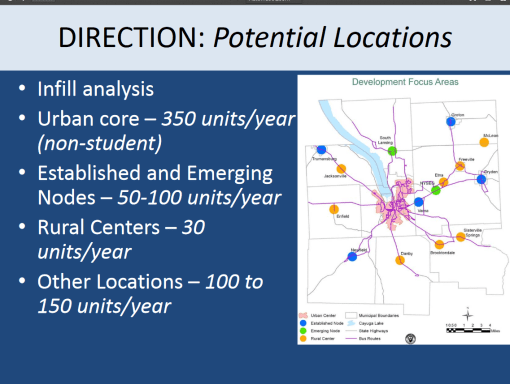
Then we get to locations. The ideal is to focus the growth in the city of Ithaca – since these stats are non-student housing, the targeted areas in the city include Downtown, the State Street Corridor, West End/Waterfront, and anything they can displace from the big box corridor on the southwest side. If a good opportunity for infill presents itself elsewhere in the city, that’s great, but it’s not the focus.

However, not everyone wants to live in Ithaca. Land in the “nodes” is cheaper and oftentimes the approvals process is easier. The county envisions 50-100 in the villages and growing hamlets like Varna and South Lansing, were a town center concept is in the RFP review process. Rural hamlets would see a handful of units annually (30 or less), and other locations basically just refers to Lansing’s suburban sprawl between the village and South Lansing. The town is hellbent on development any which way it happens, conventional approaches are the easiest to get financed, and the county’s not going to fight them.

The county’s housing strategy is three-pronged: Information/Collaboration, New Units and Existing Units.

  • Information and Collaboration includes a virtual housing office for resources and a collaborative network to formulate and pitch housing solutions. It’s kinda vague in the notes.
  • New unit strategies include support for targeted new development, streamlining zoning and examining potential incentives through the IDA.
    • Targeted new development can include RFQs for government-owned surplus property, early community engagement regarding DFAs (Development Focus Areas) and assistance in producing “shovel-ready” sites through things such as sewer access and energy hookups.
    • Streamlining zoning is to make it easier to get an initial product that will look like the final product – less uncertainty, less money spent on revisions. Inclusionary zoning seems pretty much dead in the water, as the county doesn’t seem to know if the community will support incentives for affordable housing, or if will even be effective. Done wrong, an inclusionary ordinance could actually result in less housing, if the burden is too great for the incentives offered.
    • Additional IDA incentives could include mixed-market or all-affordable rentals being eligible for abatements, and possible an abatement for any neighborhood or community who builds in inclusionary zoning. Looking at you, Trumansburg.
  • Existing unit strategies include the encouragement of rehabs (especially from rentals to owner-occupied), code enforcement and fair housing enforcement. Airbnb is still a tricky issue, so expect some tweaks to regulations on what constitutes rentals, hotels and legal occupancy.

There’s also a strong support/monitoring component in the strategy, which basically is a tracker of all projects underway, what stages, what they consist of, and so on. Beat you to the punch guys.

News Tidbits 5/6/17: Starting Small and Dreaming Big

6 05 2017

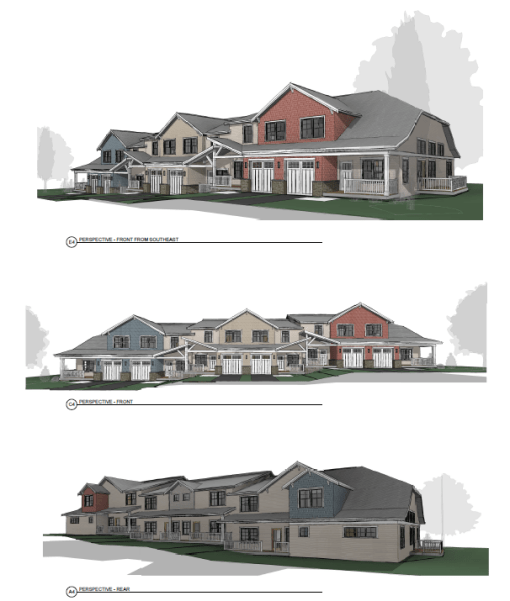
1. The Evergreen Townhouses in Varna was hotly debated at the last town board meeting, per the Times’ Cassie Negley. Linda Lavine, one of the town board members, was particularly fierce in her criticism, calling the solar panels “useless”, and others in attendance expressed concern about appropriate room for amenities.

However, it also seems one of the phrases bandied about was that it wasn’t “family-friendly”. If you’re reading this and one of those folks, do yourself a favor and stop using that term. It’s an enormously baited phrase, historically used to fight affordable housing as a racist/classist euphemism, because people of a certain class or color were apparently less appropriate for families to be around. For an unfortunate example, it was a phrase used with the INHS 210 Hancock affordable housing plan in Ithaca. Think of it as the equivalent of a religious group claiming a TV show isn’t “family-friendly” because it has a same-sex couple, or feminists.

Although this project is market-rate, deciding whether or not something is “family-friendly” is subjective and potentially baited. It gives others the wrong idea on how to discuss the pros and cons of a project, which should be about features, or lack thereof. TL;DR, find a different phrase.

Oh, and on another note – Planning Board member Don Scutt. For someone claiming Dryden is getting an anti-business reputation, your work fighting the solar panels isn’t doing the town any favors. I don’t always (often?) agree with your mirror opposite and board colleague Joe Wilson, but at least I can say he’s consistent in his views.

Anyway, off soapbox. It looks like the public hearing was left open as the project may potentially pursue a modified plan of some form, so we’ll just have to see what happens.

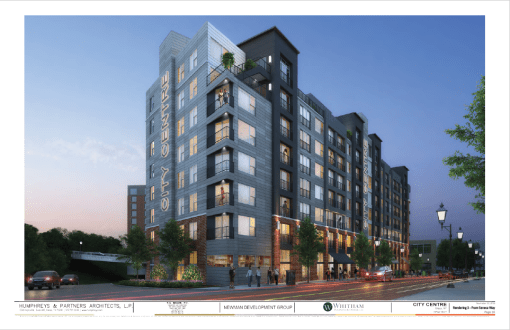
2. The Trebloc property, future home of City Centre, has exchanged hands. 301 East State Street sold for $6,800,000 on April 28th. The seller was “Trebloc Development Company”, the company of developer Rob Colbert. The buyer was “City Centre Associates LLC”, a limited-liability entity created Newman Development. This brings the 8-story, 218,211 SF mixed-use project one step closer to getting underway.

3. A couple of news notes from the Tompkins County PEDEEQ (planning/dev catch-all) Committee meeting:

I. OAR’s transitional housing at 626 West Buffalo Street will be called “Endeavor House”.

II. The county is set to start work on its draft housing strategy. The annual goal figures through 2025 include:

–580 “workforce units” per year, of which 280 are rentals going for 50-100% area median income, and 300 would be for-sale, with 80 of those condos.

–student beds, either dorms or student housing developers, commensurate with enrollment growth

–special needs beds to those making 50% or less of AMI. No quantitative descriptor is given.

–350 units in the urban core, 50-100 in “emerging and established nodes”, 30 in rural centers and 100-150 in “other areas”, which includes suburban Lansing.

https://www.facebook.com/plugins/post.php?href=https%3A%2F%2Fwww.facebook.com%2Fmedia%2Fset%2F%3Fset%3Da.1518721884836040.1073741852.772959889412247%26type%3D3&width=500

4. 607 South Aurora Street is officially underway. Modern Living Rentals posted an update to their facebook page showing site prep for their infill residential project in the city of Ithaca’s South Hill neighborhood. The four new buildings will be two-family units with three-beds each (24 total), similar to those recently completed at 125 and 139 Old Elmira Road. If the statistics are correct, the existing house will be renovated into a two family house – the banner suggests a 4-bed unit and a 2-bed unit to bring the total to 30 beds. This project will get a full write-up later this month, and its progress will be tracked as it heads for an August completion.

5. Looking at the city of Ithaca’s projects memo, it doesn’t look like anything brand new will be coming up. The formal review process is set to begin on Visum Development’s 232-236 Dryden Road project. I’m kinda confused on STREAM’s project description because it references both 191 bedrooms and 206 bedrooms, and some of the numbers don’t match the parenthetical figures -for example, thirty-seven (42) bike spaces. Going off the FEAF, it looks like the number of beds has in fact been increased to 206. The construction timeframe is August 2017 – August 2018, and it looks like both buildings will comprise one phase. Deep foundation, so apologies in advance to the neighbors who may be hearing a a pile driver this fall. The developer is exploring net-zero energy options.

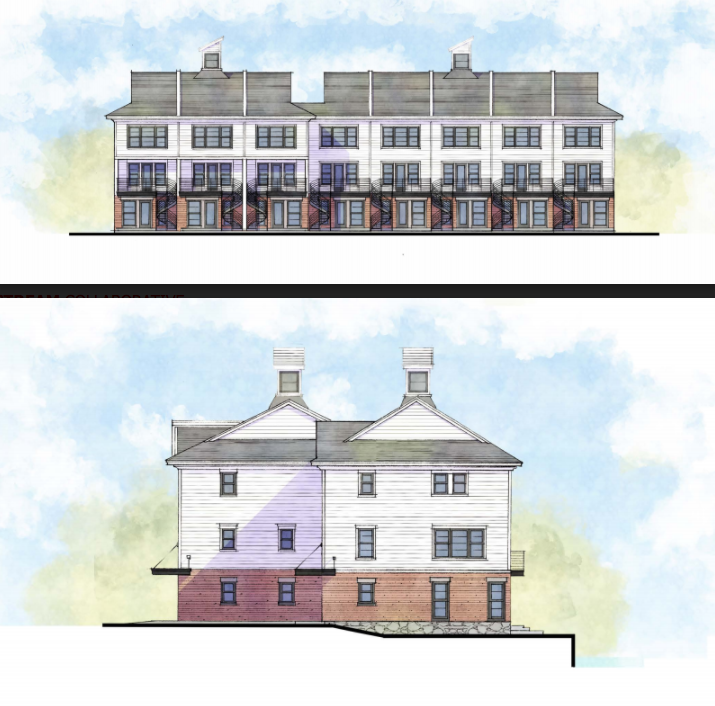
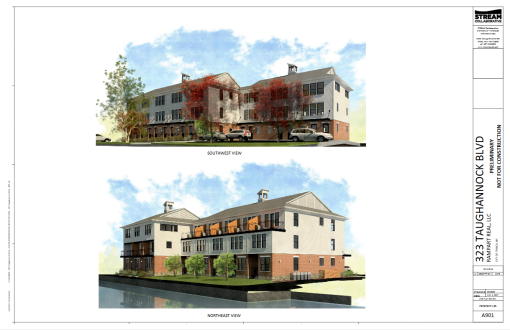
Also of note, 323 Taughannock received some visual tweaks. Gone are the cute sprial staircases leading to the waterfront, and in their place are more standard treatments. The group of five will now have their balconies on the third floor instead of the second floor. The changes on the front are more subtle, with the window fenestration now centered on each unit, and the front doors rearranged (old version here). Overall, the design is still roughly the same, it’s just a revision of a lot of details. Worth noting, given the crap soils on Inlet Island these will be on a timber pile foundation designed by Taitem Engineering. 238 Linden Avenue, 118 College Avenue and Benderson’s 7,313 SF retail addition are up for final approval this month.

6. Meanwhile, from the ILPC, it looks like there are a couple of density-expanding projects planned in the city’s historic districts. The first will renovate a garage at 339 South Geneva Street in the Henry St. John Historic District (part of Southside) into a one-bedroom carriage house. It’s infill, the garage is non-contributing and the design is an improvement, and it looks like a good if small project.

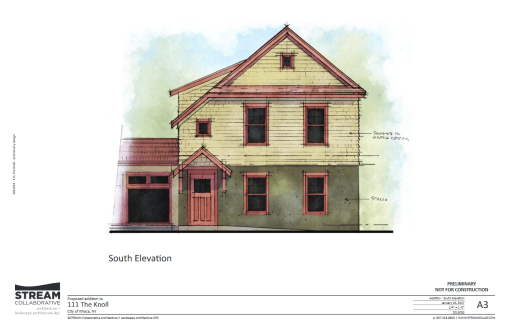
The other is a renovation of a classic Cornell Heights Mansion at 111 The Knoll into group housing for “Sophia House”, a Cornell Christian organization for women. The men’s equivalent, “Chesterton House”, is next door. The plan calls for renovating the five-bedroom, legal for eight-persons house into a 15-bed home. Part of that would entail demolishing the 1950s garage, which is connected by a breezeway to the ca. 1910 house, and replacing the garage with a four-bed addition, still connected through the breezeway.

Both designs are by STREAM Collaborative, as are 232-236 Dryden and 323 Taughannock. Can’t fault STREAM for being good at what they do – if a developer wants modern like 201 College, they get modern. If one wants traditional like the above examples, Noah Demarest and his team can do that too. They know the market and what works in terms of design. Unlike many local architecture firms, STREAM’s business is almost completely in Tompkins County – they did some concept design work in Rome and Utica, and some of the Tiny Timbers kits have been sold outside the county, but otherwise everything else is in or close to Ithaca. Business is good.

harolds_square_v4_new_comparo

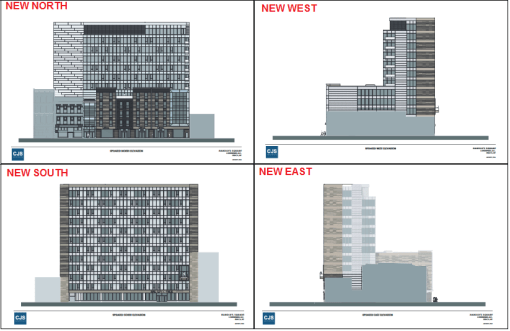
7. Admittedly, this is beating a dead horse, but Harold’s Square will eventually get underway. It appears the problem right now is that the tax abatement approved by the county is insufficient because of the increase in project costs (up 12% to $42.9 million), so the project team is heading back to the IDA to get the abatement revised (the Hilton Canopy did the same thing a few months ago). The project was previously approved for a 7-year abatement, but this time around they are seeking the 10-year abatement. Combined property, sales and mortgage tax abatement would come out to $5.089 million. New property taxes generated over the 10-year period would be $3.4 million (note that is on top of what’s already paid; IDA abatements use the current taxes as the baseline).

The office space and retail space look higher than previously stated (33k vs 25k, and 16k vs 12k), but it looks like that’s because the Sage Building renovations are included in the IDA numbers. The apartment count remains the same (108), although it looks like one 1-bedroom unit has been replaced with a 2-bedroom unit.

Two reasons are cited for the delay- issues with getting the office and retail space occupied, and a premium price on construction workers as a result of the increased local activity. The pre-development costs are clocking in around $800,000, so if it fails to get approval from the IDA’s board, that will be a pretty big cost to swallow.

Should it be approved, the construction timeline is stated as June 2017 through Q1 2019.

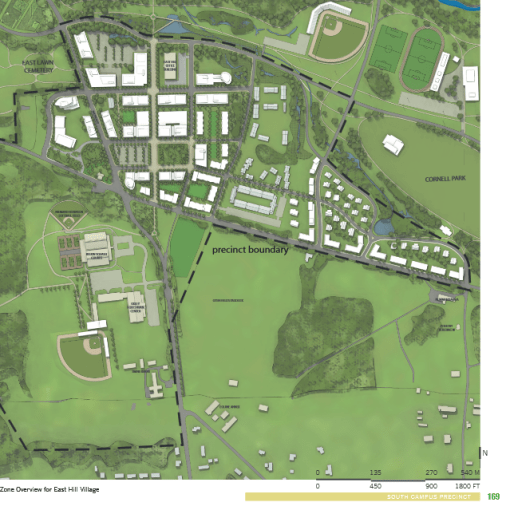
8. Just throwing this in for the sake of throwing this in – mark your calendars for May 17th, when Cornell hosts a forum about the new East Hill Village neighborhood from 5:30-7:30 PM at the East Hill Office Building at 395 Pine Tree Rd. The project website notes that it will start with a 30-minute presentation, followed by breakout groups to brainstorm what people do and don’t want included in the building plans – certain retail uses, housing components, general visions for the site. There will be more meetings over the next several months – the goal is an Autumn 2017 exhibition for the preliminary plans.