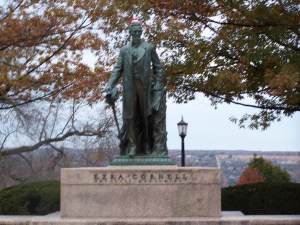
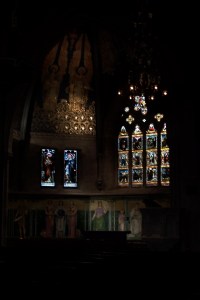
Crazy-As-Hell Alumni Profiles: Erich Holt

17 08 2010

Cornell has somewhere around 245,000 alumni or so. It’s only fitting that an unfortunate few of our alumni err on the side of insanity. They might be acting as if they’re on crack, but most of their behavior can be attributed to them just being out of their damn minds.  This entry details one of our finer members of the batsh*t insane alumni club: Erich Holt, PhD 1914.

Erich Holt is one of several names he went by. He was born as Erich Muenter in Germany in 1871, but would adopt the aliases Frank Holt and/or Erich Holt later in his life. He moved to the U.S. and enrolled as a graduate student at Harvard (already famous for its whacko alums). In 1906 he was an instructor in German at Harvard College, living the life of a quiet and rather shabby looking married man.  His wife died mysteriously of arsenic poisoning, and Muenter felt the sudden compulsion to flee to Texas (a slight discrepancy here; Morris Bishop claims he fled to Mexico), later emerging under his aliases (which from what I’m finding, were pretty interchangeable). Holt launched into a brilliant scholarly career, doing four years of undergraduate work in only one year at the Fort Worth Polytechnic Institute before coming to Cornell to take on PhD work. Holt graduated in 1914 and took on a position as…a German instructor [1]. As you can see, he was really moving up in the world.

Well hell, if this was just about alumni who’ve killed their spouses, I could probably pull a dozen names easily. However, as those late night TV ads would say, “but wait, there’s more”.

1914 was not a great time to be a German guy living in the good ol’ U.S.A. For one, there was that whole war in Europe thing going on. Some folks weren’t too inclined to be polite towards folks who could be showing German sympathies. According to Morris Bishop, on campus alone there were rumors of tennis courts designed to serve as gun emplacements, and stories of bomb-making operations in faculty cellars (428). The professor of Latin tried to expel the professor of German (not Holt) from the “Town and Gown Club” because of German sympathies – namely, he read a New York daily that was published in German.

Well, Muenter/Holt was horrified by the war and all of the killing (not crazy). He decided that if he could stop all the munitions manufacturers, like J. P. Morgan, from selling to the Allies, he could single-handedly stop the war (kinda crazy). After realizing letters and arguments wouldn’t work, he decided to take action by bombing the Senate chambers of the U.S. Capitol (WTF crazy).

He designed a suitcase time bomb designed to work by letting acid eat through a cork, and took the next train to Washington D.C. His goal was to “wake the American people up to the damage which explosives like these were doing abroad”. Well, he went into the Capitol on July 2, 1915 at about 11:40 PM, and with bomb under arm, set it down in a reception room where it wouldn’t hurt anyone, went outside and waited for the explosion, running off to catch a train out of town when the bomb went off. The room was blown apart and a watchman was blown off his seat some distance away, but the story only merited a tiny blurb in the NY Times that attributed the explosion to “gasses”.

Step two in his grandiose plan was to take the train to Glen Cove, Long Island, home of industrial magnate J. P. Morgan Jr. Holt’s goal was to hold Mrs. Morgan and the Morgan kids hostage until J. P. agreed to stop sending munitions abroad. Well, after forcing his way into the house, J. P. stormed towards Holt and was given a warm Cornellian greeting by receiving two Big Red and bloody gunshot wounds to the groin as the British ambassador (Cecil Spring-Rice) and a butler subdued the German madman. This time, Holt earned himself the first three pages in the Times. While taken into custody, a grimmer part of his plan was revealed, as he planned to blow up several munition ships while they were at sea. It didn’t help that while he hadn’t plant any bombs yet, one munition ship (the “Minnehaha”) caught fire, and they thought it was one of his bombs,  and it returned to port in a panic.

Of course, the press had a field day with the story. While Morgan survived without major aftereffects (he lived another 28 years), Holt was exposed as Erich Muenter, the Harvard wife-killer. After trying to kill himself using by using the metal part of an eraser cap to try and cut an artery, he literally launched into a second attempt by climbing over the Mineola jail’s lattice bars and throwing himself head-down to the concrete floor 18 feet below. His second attempt turned out to be successful.

Word to the wise – you may not be the richest or most famous person to come out of Cornell, but things could be a lot worse. This is one alumni club that everyone should avoid joining.

[1] Bishop, Morris. History of Cornell. pp. 428-429


The Hat Clubs of Cornell

13 08 2010

Cornell has always been an institution known for its academics, which is perfectly fine. However, for many years, day-to-day life was a bit of a drag. A hundred years ago, one had few options – if you were rich and/or well-connected (as well as white and Christian), you enjoyed the exclusivity of Greek life; if you were independent, then your options were pretty limited, your social activities confined to the (even then) socially conservative Cornell U. Christian Association’s social rooms, or to the cheap and rather ungainly boarding houses of Collegetown and the city.

Around the early 1900s a movement began that was purely social in nature, vestigial in purpose but attention-grabbing in activity. Hat Clubs were formed by several different student groups. Hat Clubs only existed for one remarkable purpose; they instilled upon their members the right to wear a certain, funny-looking hat [Bishop 409]. Yes, life was that boring. On a deeper level, the clubs were designed to instill a sense of camaraderie among students and to allow friendships to be built among students who couldn’t afford or were excluded from other social societies.

Well, needless to say, campus leaders (read: rich white fraternity men) were not pleased. The presidents of fraternities and the editor of the Daily Sun publicly denounced the existence of these silly groups, and in 1913 they decided to take action against them by drumming up public disapproval and by trying to force them to disband.

It’s hard to try and compare this to today’s Cornell because the idea seems far-fetched. These clubs were nothing more than run of the mill clubs; they rarely maintained a permanent house or meeting place (dues were quite low as a result) and meetings were few and far between. Dinner banquets (often at a boarding house or cheap banquet hall) and social gatherings were their only real activities. Hat Clubs occupied a sort of hazy area vaguely similar to prominent clubs on campus today.

Well, thanks to the work of the well-connected, most of the clubs succumbed to bad P.R. and ceased to exist by the end of the decade. However, two survived. Originally, these two clubs were called Mummy and Nalanda. However, to avoid some of the bad publicity, they changed their names, to Beth L’Amed and Majura respectively. They managed to not only survive the decade, the went on to exist for another forty years.

A Cornell Alumni News from December 1936 provides a little background. Mummy was founded in 1900 by the freshman class (1903). Nalanda began with the following freshman class (1904), and the Class of 1906 had a new club (Stoic) that was quickly taken over and absorbed by Mummy. Mummy and Nalanda would alternate, with Mummy pulling students from classes with even years, and Nalanda from odd years. The two changed their names in 1911 (a discrepancy when compared to Morris Bishop’s account) after their hats were outlawed. According to the article, they were an active part of Junior Week and Spring Day (the predecessor to Slope Day), and did a reunion dinner at the Cornell Club in NYC every year on the Friday before Thanksgiving.

So what happened? Well, their social gatherings did them in. In December 1949, they did a joint initiation celebration for their new members and threw a big jamboree right before the Christmas holiday. Unfortunately, one partier, a Mech E. named Harry Melton, drank for more than he could handle. According to Time Magazine:

In about an hour, he had wolfed down more than a quart of Martinis. At that point he collapsed, was rushed to a hospital where he lay unconscious for 15 hours. For a while doctors feared for his life.

A quart of martinis in an hour? Holy crap. Personally, I can’t stand gin. The taste of gin is like running through a pine forest with your mouth open. But, to each their own.
Well, their actions cost them big time. The acting president of the university, Cornelius de Kiewiet, immediately suspended them. Pending a faculty review and denunciation by the Sun for their foolish activity that almost had fatal consequences, the president made the ban on the last two Hat Clubs permanent. To quote the Sun’s piece:

“Cornell’s doctrine of ‘freedom with responsibility’ had clearly been abused . . . The administration will not and should not allow us to kill ourselves . . .”

…and with that, the Hat Clubs were confined to the dustbin of history.


This Isn’t Your Father’s Fraternity

29 12 2009

So, with Rush Week coming up, I figured it was about time that I did another Cornell Greek System related article.

So, a fair number of guys who come back for rush week do so on their parent’s urging. Which seems a bit funny, considering the stereotypes and all, but it’s likely that the parents who are pro-Greek were in a fraternity or sorority themselves. Sometimes, someone’s father might try to prod them towards the house that they were a member of back in the day.

Well, fraternities are rather preculiar in that the character of a house can change completely in about three years, as members graduate and new brothers are initiated.  So, your father’s fratenity, while it may have been a “small nerdy house in 1970-something” or “a big jock house back in the ’80s”, may be something completely different today.

For this entry, I decided to compare the membership numbers of houses. For one thing, numbers are solid; character is subjective. Secondly, I’m only doing fraternities; sororities tend to be somewhat less elastic with numbers, especially since they operate with a quota system that sets the number of pledges a sorority may have.

The first number is the active membership number from the Spring 2009 semester for Cornell fraternities. The second number is for Spring 2005, selected merely to illustrate the dynamics of change (or lack thereof).  The last number is from Spring 1983, selected because it is a legitimate date that token rushee X’s dad might’ve graduated from college, but also because  it was easy for me to get a hold of the figures (on paper, so no links unfortunately).

A few details: Membership percentages in Greek houses in 2009 was 33.15% of the total undergrad male population, with 47 members on average (50 chapters fell under the “fraternity” designation, but that includes MGLCs – accounting for their typically small number, the reduction is to 42 chapters, then the IFC average is about 54 members). No offense meant to the MGLC folks, but I have no 1983 data for those chapters, so they are excluded.

For 2005, there were 40 IFC chapters, and an average of about 47 members per house (fraternity membership was 28.75%).

For 1983, there were 50 IFC chapters, and an average in the low 50s.The chapters that existed in 1983 that don’t today are

Phi Alpha Omega, a small collegetown-based fraternity started around 1982 and gone by 1986.

Triangle, down to eleven members. Their national would shut them down by 1985.

Theta Delta Chi, which closed in 1999 (to their credit, they have one failed recolonization attempt, from 2003). They failed to submit information in time to be included in the 1983 publication I’m using.

Phi Kappa Sigma, which closed in 1990. They had 35 members in 1983.

Phi Sigma Epsilon, which merged on the national level with Phi Sigma Kappa in 1985, closing the Cornell chapter. It had 73 members in 1983.

Chapter /Spring 2009/Spring 2005/Spring 1983

Acacia 39/29/33

Acacia was on the brink of closing in the late 1990s, when membership dwindled. It seems to have recovered well enough.

Alpha Delta Phi 57/69/56

Alpha Epsilon Pi 35/NA/NA

So, here’s the problem. The first time AEPi closed was in 1984. The second time was in 2005. Way to screw up by stats guys. I looked up their 2004 data; its membership number recorded 29 brothers.

Alpha Gamma Rho 52/63/86

Alpha Sigma Phi 51/56/71

Alpha Tau Omega 75/61/63

Alpha Zeta 55/24/53

Alpha Zeta almost closed in the mid 2000s, so that makes it upward climb more impressive. The 1983 value may be off, since this co-ed fraternity only recognized women on an honorary level at the time, so they were left off the roster. The other two values are combined co-ed.

Beta Theta Pi 30/51/49

Beta is in the midst of reorganizing, hence the low 2009 figure.

Chi Phi 73/72/ 56

Chi Psi 53/47/84

Just…ouch.

Delta Chi 82/27/65

Delta Chi closed and reopened in 2004,  hence the low 2005 figure.

Delta Kappa Epsilon 46/45/68

Delta Phi (Llenroc) 64/41/57

Delta Tau Delta 40/27/56

Delta Upsilon 66/50/60

Kappa Alpha 17/NA/39

Kappa Alpha closed in 1990 and reopened in 2007.

Kappa Delta Rho 39/34/47

Kappa Sigma 71/42/87

Lambda Chi Alpha 67/58/69

Phi Delta Theta 47/54/70

Phi Delt reorganized in 2000, when it threw out the then-current membership and started fresh as a dry fraternity.

Phi Gamma Delta (FIJI) 84/53/93

Phi Kappa Psi 72/61/87

Phi Kappa Tau 56/51/34

Closed in 1994, reopened in 2000.

Phi Sigma Kappa 51/56/65

Pi Kappa Alpha 61/56/102.

Wow. I never knew Pika was once the largest house on campus.

Pi Kappa Phi 65/48/25

Closed in 1986, reopened 1990.

Psi Upsilon 37/57/NA

Psi Upsilon was closed from 1981 to 1985. They also reorganized in 2008.

Seal & Serpent 17/20/35

What happened here was a slaughter of their reputation. That was covered in a previous entry.

Sigma Alpha Epsilon 91/89/35

On the other end of the scale, the rise of SAE is impressive. Who would’ve guessed they were such a small house back in the day?

Sigma Alpha Mu 70/52/21

Sigma Alpha Mu was rechartered in 1983/84.

Sigma Chi 67/61/79

Sigma Chi Delta 12/8/14

An item worth noting- the vast majority (80%+) of Sigma Chi Delta’s membership in the 1980s was of east Asian ethnic groups.

Sigma Nu 55/61/72

Sigma Phi 58/47/45

Sigma Phi Epsilon 51/52/50

Not as stable as it looks. Reorganized in spring 2006, closed for the fall, reopened in 2007.

Sigma Pi 39/83/94

Reorganized in 2008.

Tau Epsilon Phi 59/11/30

TEP must be doing something right.

Tau Kappa Epsilon 31/34/44

Theta Delta Chi 63/40/69

Theta Xi 23/NA/NA

Theta Xi was closed in 1970 and didn’t recolonize until 2008.

Zeta Beta Tau 43/51/NA

They didn’t submit in time for their 1983 data to be published.

Zeta Psi 53/29/43

So in conclusion, although your dad may regal you with stories of his fraternity days, don’t expect to have the same experience if you pledge his old house.


A Blind Eye to Sports

8 11 2009

As anyone who doesn’t live under an Ithacan rock knows, Cornell had its much-publicized and anticipated match against Harvard on the ice of Lynah Rink last night. Much to Cornell’s delight, the Big Red skated to an impressive victory over the Crimson, with a final score of 6-3.

I feel like I’m one of a handful of undergrads on this campus who really doesn’t give a damn.

Not that I don’t have respect for athletes at Cornell. I give them by full respect. It’s just that I have never followed sports, with the slight exception of cross country and track back in junior high and high school because I was on the team (and let’s be honest, they’re just not the same when it comes to skill or competitive spirit). I’m content to sit back and watch everyone else get excited, because I’m just disinterested in Cornell sports. I’m never sat all the way through a Cornell game in any sport.

So, unsurprisingly I never mention sports on this blog, unless there’s historical worth to mentioning it. Which I can briefly do now.

Back in the day of the university founding years, the big sport for students to follow was crew, aka rowing. A.D. White was a member of a rowing club during his own collegiate years at Yale (Bishop 33). The first boating clubs formed in 1871, and a regatta was held the following spring (if you could call it that). The first big victory came at Saratoga in 1875, much to the joy of the school and the town (story goes that A.D. White broke into McGraw Hall Tower and rang the chimes himself). Baseball and football were vague diversions, not even intercollegiate until 1874 (Bishop 134). Cornell actually had its own rules of football that no one cared about, so the university didn’t take a substantial interest in football until about 1886. The Cornell Atheltic Association formed in 1889 (296). The first athletic area, built in the same year, was off campus on what is now the site of Ithaca High School, and was called Percy Field after the donor’s son, who was at the time a student athlete at Cornell. Hockey was recognized in 1900, basketball a year later. Lacrosse started up in 1885, but was  like clothing fashions among students, coming back into and going out of style every few years.

Hockey was originally played on Beebe Lake. The idea of bringing it to Cornell came from a professor of engineering named Johnny Parson. Hecne, the establishment of the Johnny Parson Club. When the lake began to melt, the team would use the Ithaca city ice rink. The team won what might be its first intercollegiate championship in 1911 (417).

So, Bishop’s history of Cornell only mentions hockey twice, and was published in 1962, suggesting the sport was still on the periphery of athletics at that time. That was also the same year that underdog Cornell outplayed perennial powerhouse Harvard. Things started to get more interesting when the Harvard/Cornell hockey rivalry started to heat up in 1973 with Harvard’s tossing off a chicken at Cornell goalie Dave Elenbaas, as a knock against the Ag School (of course, nowadays we can depend on our alumni to knock the ag school). So Cornell students responded later that month by throwing fish onto the rink. As the decade wore on and Harvard’s program weakened, the Big Red wasn’t content to let things slide, so the rivalry has been intensified since the incident.

So that’s why Cornell-Harvard tickets can be so expensive, and why this one game is as close as Cornell gets to the storied rivalries of Big Ten schools. Some of us are more into it than others though.  


The Cornell Daily Sun

21 10 2009

100_1899


So, I first thought about writing an entry on the Sun because of fortuitous circumstances. I happen to write in some small capacity for the Sun, but with the exception of one person (to my knowledge; most everyone else couldn’t care less), no one at the Sun knows that I write this blog. Occasionally, someone will ask “when was Mann Library built?” or “when is Milstein Hall supposed to finish construction”, and it’s really tempting to put in my two cents, but  for the most part I focus on my work and leave when I’m done.

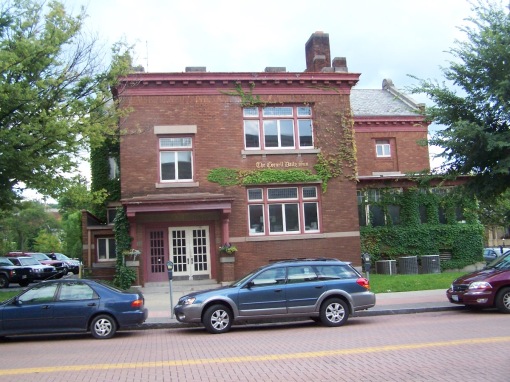
Regarding the Sun itself, the newspaper is based out of the former Elks Lodge building on the 100 block of West State Street, a block west of the Commons. The building itself dates from 1916, and the Sun renovated the building and moved into the 7,000 sq. ft. building during 2003 (prior to that, thsun rented space around the corner on Cayuga Street). The Sun is totally independent of the university, which is great because the school paper of the university I worked at this summer was nothing more than a mouthpiece for the administration and its cultish president, but I digress. The original Cornell newspaper was The Cornell Era, which was founded in 1868 and named as such because it marked the beginning of a great new era. Much to the Era’s chagrin, the Sun appeared on September 16, 1880, in the format of a four-page pamphlet-sized newspaper (Bishop 206).  The Era eventually became more of a literary magazine and shut down permanently in the late 1940s. The Sun has operated continuously since its founding.

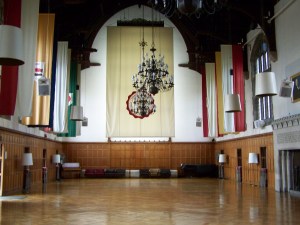
The building itself is an interesting place ot visit. The main work area on the first floor has private offices, and a general work areas for contributors and writers filled with newspapers and article drafts from previous days. The upstairs has a spacious and stately wood-trimmed great room, which I suspect was probably used as a cermeonial/banquet room back when it was the Elks Lodge. I’ve never felt compelled to take photos inside the building, mostly because of the stares I would probably get.

Bishop, Morris. A History of Cornell. New York, New York: Cornell University Press, 1962. ISBN 0-8014-0036-8


Essentials of Campus III: Willard Straight Hall

1 10 2009

100_1464

It’ a a blessing and a curse to have posted mostly news tidbits lately. It saves time for me while it still is pertinent to the general focus of this blog, but posting them feels relatively unsatisfying, especially when I’m comparing them to some of my history entries, like the “Essentials of Campus” entries. I have been planning to do Willard Straight in an entry since about May; the trick was finding the time and resources to do it right. For one, I didn’t have enough photos of the Straight, so I decided to go on a little photo tour of the inside of the building. Secondly, I had debated to what extent I would cover the Willard Straight takeover back in spring 1969. I came to the conclusion that I’ll provide links and brief description of that piece of history, but since there are entire books dedicated to it (which thanks to the wonders of Google, much of Donald A. Down’s meticulously detailed book concerning the crisis can be read online), I decided to not spend too much time on it for the time being.

 100_1459

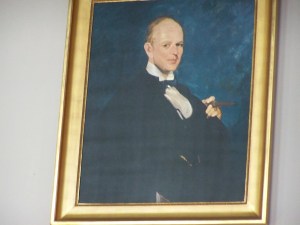
So, let’s start with the man. Willard Dickerman Straight, originally an orphan from Oswego, NY, was a member of the class of 1901 (Bishop 455). During his time at Cornell, he was an editor for the Cornell Widow, which was a popular campus humor magazine at that time, and he was one of the students responsible for organizing Spring Day, which would evolve into Slope Day in later decades. He was also a member of Delta Tau Delta and the Sphinx Head Honor Society. After graduation, he worked in the Chinese customs service (a time when the Qing Dynasty still ruled in China and Anti-Western sentiment ran high) and rose rapidly in his field to become the head of the State Department’s Far Eastern Affairs. He married Dorothy Payne Whitney, member of the incredibly WASPy and wealthy Whitney family.  Willard Straight passed away from complications due to Spanish Flu strain pneumonia on December 1, 1918, while waiting for the Americans to arrive in Paris to negotiate WWI peace treaties. His will asked his wife to do “such thing or things for Cornell University as she may think most fitting and useful to make the same a more human place.” While I have little idea what “make the same” means, it was part of his will to use his money to enhance the quality of life at Cornell. Generally, that was the sentiment he held during his life too; he was one of the financiers for Schoellkopf Field.

Digressing here, but Striaght had three kids: A chairman for Rolls-Royce, an actress, and a KGB spy. None of them went to Cornell.

100_1457

Thing was, back in the day, fraternities were the entire social scene at Cornell. If you weren’t a member of a house, you didn’t exist. There were few clubs, and intercollegiate sports were a diversion for precious few. In that time, if you were an independent student, you probably lived in a crappy tenement in Collegetown of further down East Hill and you led a miserable existence hating the weather and not enjoying the collegiate experience. One can see where Willard Straight was coming from when he said that the place needed to become a little more human.

100_3402

Well, Mrs. Straight didn’t know what to use the money on, so she kinda sat on it for a few years figuring out what would be the best way to fulfill her late husband’s wishes. Enter Leonard K. Elmhirst ’21. A charming englishman and president of the Cornell Cosmopolitan Club (the club [in the sense that coops and frats are clubs] for international students at the time), and when he discovered that his club was $80,000 short of funds (which is like $830,000 in today’s terms; one has to wonder how the hell you get so far in the hole without someone catching it).  Like any proactive student, he went on down to NYC to plead with alumni for money. One of those who pitched his plea to was widow Straight. Well, she was taken by his image of barren student life at Cornell, so she paid off the debt for the club, resolved to donate the money to better student life, and married Mr. Elmhirst. Now that’s a package deal if I ever saw one. Mrs. Elmhirst became a citizen of the crown in 1938, and passed away in December . Considering what happened the following spring, that may have been for the best.

100_1460100_1454

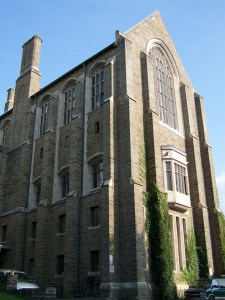
Through consultation with President Farrand, Mrs. Elmhirst came up with the idea of a student union, which was an increasingly popular idea in those days, conjuring images of the schools of Europe while also improving the quality of student life. William Adams Delano drew up the plans and they were presented to the trustees in June 1922 (Bishop 456). The plans called for meeting halls, banquet halls, dance halls, a library, formal dining rooms and a cafeteria, a thatre, guest bedrooms, dorms, campus offices, game rooms, all in one grand Collegiate Gothic package built with the finest craftsmanship and llenroc bluestone. Ezra Winter painted the murals in the grand hall, meant to illustrate Striaght’s life and career (this is why you can see Manchus above the door of the reading room today). The building opened November 25,1925, though to comparatively low-key fanfare (though perhaps I may be comparing this to the dancers dressed up as scientists dancing in the atrium to “Weill Thing” when they dedicating Weill Hall). Mrs. Straight, now Elmhirst, was the first to dine in the cafeteria and the first person to stay in the hotel that existed on the upper floors. The hotel remained on the upper floors until it was closed as a result of the April 1969 crisis. At one time, the building was also home to WVBR, a barbershop, a store to buy your booze, and people actually utilized the different entrances for men and women instead of just walking to the doors that are closest.

100_1461

So…about that crisis. If I sum it up in a paragraph, that would be doing the event, the actions leading up to it, and those involved a great injustice, and as I mentioned, there are far better resources for reading up on the takeover of the Straight than this blog entry. On April 19, 1969, a series of events with regards to racial discrimination on campus led to a takeover of the student union during Parent’s Weekend. All guests and staff were forced out of the building, and several African-American studies held up in the building as other students groups tried to remove them by force, leading some of the students participating in the takeover to smuggle guns into building. After negotiating with the university vice-president, the students left the building, guns in hand, immortalized by a now famous Pulitzer-Prise winning photo by Steve Starr. The event was a public relations disaster for the university, and led President James Perkins to resign his position with disgrace. The event also led to the formation of the Africana Studies and Research Center, and Ujamaa three years later.

100_1456

Today, the Straight is home to the Ivy Room and Oakenshield’s dining facilities, the Cornell Cinema (which replaced the theatre after 1988), the browsing library, lounge areas, various student office and mailboxes for campus orgs, the Dean of Students and Office of Fraternity and Sorority Affairs. The new Asian Student Center has also been set up in the building until the budget allows for them to move to 14 South Ave.

100_1458

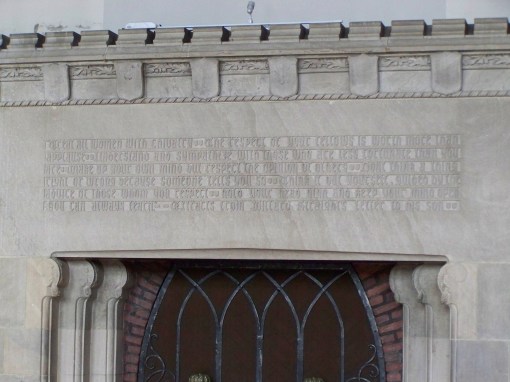
EDIT: So WordPress hates large photos. It says “Treat all women with chivalry** The respect of your fellows is worth more than applause** Understand and sympathise with those who are less fortunate than you are ** Make up your own mind but respect the opinions of others ** Don’t think a thing right or wrong just because someone tells you so ** Think it out yourself, guided by the advice of those whome you respect ** Hold your head high and your mind open, you can always learn ** Extracts from Willard Straight’s letter to his son


[1]http://74.125.113.132/search?q=cache:u79OrjoFVGkJ:en.wikipedia.org/wiki/Willard_Straight_Hall+willard+straight+hall&cd=1&hl=en&ct=clnk&gl=us


The Halls of Presidents

7 07 2009

So, I was in an online correspondence with someone, and the comment was made that “apart from donating a s–tload of cash, the only other way to get a building named after you at Cornell is to be the [school] president”. Technically, that’s not true, as Lincoln Hall was named for Abraham Lincoln, and many other buildings were named for important college presidents, like Mann Library and Thurston Hall.

But, I decided to explore the topic a little further and check the “win/loss record” for Cornell presidents [listed at [1]]. Here’s the results.

1. Andrew Dickson White (1866-1885)

A.D. White is perhaps the most important president in this university’s history, so it seems fitting he had a building that was dedicated to him. North University Hall (built in 1866) was renamed White Hall in 1883 in his honor[2].

Result: WIN

2. Charles Kendall Adams (1885-1892)

Charles Kendall Adams was a student of A. D. White who served seven tumultuous years at the university. Unfortunately, although he was more than capable, no building was ever named for him. This could be for several reasons, according to Cornell historian Morris Bishop; for one, the trustees never really liked him; for two, the students weren’t particularly fond of him either. When he did resign, it was under strong persuasion from old Henry Sage, who had developed quite an interest in Jacob Schurman. On the bright side, Adams would accept the presidency at the University of Wisconsin, where a dorm was named after him[3].

Result: LOSS (for Cornell anyway)

3. Jacob Gould Schurman (1892-1920)

Jacob Schurman saw Cornell through the Gilded Age and a period of rapid growth, and during his presidency Cornell was for a short time the second largest college in the country (Bishop 352). However, the building that was named for him, Schurman Hall of the Vet School, was built in 1957 [4]. Jacob Schurman died in 1942 [1]. I guess this one is technically a win, but it’s not like Schurman lived to enjoy the recognition.

Result: WIN (postmortem)

 4. Livingston Farrand (1921-1937)

Our fourth president, while described as a very likable man in A History of Cornell (451), never had any building named after him. The Farrand Garden near A.D. White house is as close as one gets; even then, although it is formally dedicated to Mr. Farrand, his wife was a very avid gardener, so it might be seen as more of  homage to her [5]. 

Result: LOSS (but tell your wife Cornell says thanks)

5. Edmund Ezra Day (1937-1949)

A fairly obvious win on this one. Day Hall, the Cornell administrative building, was named for Edmund Ezra Day, right around the time he decided to retire due to ill health. Not bad, considering this time perios saw very little permanent construction. Up until his death in 1951, Day served as chancellor of Cornell, a largely ceremonial position [6].

Result: WIN

6. Deane Waldo Malott (1951-1963)

Deane Malott oversaw another construction boom on campus. Malott Hall is named in his honor, perhaps because the main person who financed its construction, William Carpenter 1910, already had a building named after him, so they opted to name the building for the retiring president [7]. Even better, Deane Malott had a building named after him on the University of Kansas campus (where he was president before coming to Cornell [8]), so he deserves a double win.  

Result: WIN

7. James Perkins (1963-1969)

For the record, James Perkins was not a bad guy. He just happened to resign in disgrace after the public relations disaster that was the Willard Straight Takeover [9]. Frankly, he was going up sh*t creek when he realized it was too much for him to handle.

Result: LOSS

8. Dale Corson (1969-1977)

Dale R. Corson, who made his nut working in the field of physics [10], dutifully served out close to a decade at Cornell, before resigning the presidency position, sitting in as chancellor for a couple of years before the trustees gave him title of president emeritus. Corson Hall, just off the ag quad, was named in his honor when it was completed in 1981 [11].

Result: WIN

9. Frank H.T. Rhodes (1977-1995)

Frank Rhodes, a 6’7” Englishman, served 18 years as president of Cornell university. Right as his retirement was approaching, the trustees voted to rename the Engineering and Theory Center building Frank Rhodes Hall in his honor (the building was completed in 1990 [13]).

Result: WIN

10. Hunter Rawlings III (1995-2003)

Hunter Rawlings overtook several large capital campaigns for the university’s endowment, and oversaw construction of much of North Campus [14]. The North Campus effort earned him his name on the large semicircular field between Helen Newman and CKB/Mews. Still, it’s not a building.

Result: LOSS (but only on technicality)

11. Jeffrey Lehman (2003-2005)

Well, serving only two years, and then resigning after citing irreconcilable differences with the trustees isn’t going to help your cause [15]. However, while the trustees may never allow a building to be named after him, the $1,000,000 of hush money they paid out to him in 2006 provides a little consolation.

 Result: LOSS (but enjoy the consolation prize)

So, our final tally indicates 6-5. If Skorton rides it out a few more years, maybe we’ll be hearing about the dedication of Skorton Hall someday in the alumni news.


[1]http://www.news.cornell.edu/campus/presidents.bios.html

[2]http://www.cornell.edu/search/index.cfm?tab=facts&q=&id=798

[3]http://www.housing.wisc.edu/halls/history.php

[4]http://www.fs.cornell.edu/fs/facinfo/fs_facilInfo.cfm?facil_cd=1150C

[5]http://en.wikipedia.org/wiki/Cornell_Central_Campus

[6]http://en.wikipedia.org/wiki/Edmund_Ezra_Day

[7]http://www.cornell.edu/search/index.cfm?tab=facts&q=&id=487

[8]http://www.kupedia.org/wiki/index.php?title=Deane_Malott

[9]http://74.125.47.132/search?q=cache:u79OrjoFVGkJ:en.wikipedia.org/wiki/Willard_Straight_Hall+willard+straight+hall+takeover&cd=1&hl=en&ct=clnk&gl=us

[10]http://en.wikipedia.org/wiki/Dale_R._Corson

[11]http://www.fs.cornell.edu/fs/facinfo/fs_facilInfo.cfm?facil_cd=1019E

[12]http://en.wikipedia.org/wiki/Frank_H.T._Rhodes

[13]http://www.cornell.edu/search/index.cfm?tab=facts&q=&id=624

[14]http://en.wikipedia.org/wiki/Hunter_R._Rawlings_III

[15]http://en.wikipedia.org/wiki/Jeffrey_S._Lehman


Cornell’s Founding Fathers: Andrew Dickson White

29 06 2009
100_2070
Continuing the Founding Fathers entries, we’ll stop at the other man who helped the university go from a pipe dream to a stone and mortar reality, the illustrious Andrew Dickson White. Once again, the primary source is Bishop’s History of Cornell, with the page numbers in parentheses.

In terms of upbringing and character, White was quite much Cornell’s opposite. White was born in 1832 in Homer, which is also in Cortland County (30). The family moved to Syracuse when he was seven, and his father was a prominent banker. He rejected his Episcopalian upbringing, so his father tried to rectify that by sending him to a church school, Geneva College (now Hobart and William Smith), where he was a sophomore at the age of 16. Since the school was esssentially a bunch of drunken partiers (31), he left after one year (try to imagine studying for an exam while your classmates had barricaded themselves in a room and were attacking the president’s house. It was really that bad).  Although, I find it odd that the entire college had 37 students, and he still joined a fraternity (Sigma Phi). Frats were different animals in those days. Anyways, his father wanted him to go back, but when he showed up, he promptly left school and hid with a former teacher of his while he studied up for Yale’s entrance exams. At this point, old Horace White was furious, and said he would’ve rather received news of his son’s death. Well, A.D. passed the exams with flying colors, and entered Yale as a sophomore, spending a few happy years there, being a member of Skull and Bones and Alpha Sigma Phi (which was a class society back then, before it became a social fraternity — although, he was a tremendous asset to both fraternities as they established themselves at Cornell). After graduation, he hung out in Europe for a couple years, attending German and French schools and becoming all worldly and multifaceted. He arrived back in New Haven in 1856, where he obtained an M.A. and almost became professor, were it not for his anti-church sentiment. He was accepted as a professor at the progressive University of Michigan in 1857 (35), and married Mary Outwater of Syracuse that same year (38). After Horace White died (leaving him $300,000, an astonishing sum in 1860) and the Civil War broke out, White took a long leave of absence and came back to Syracuse in 1862 (41). Being politically inoffensive yet well known in Syracuse, he was nominated for and elected to the State Senate in 1863, hardly 31 years old. Here he met Ezra Cornell.

Skipping the university and focusing on White, he served as university president from 1866 to 1885. During and after that time, he served as ambassador to Germany, minister to Russia, and comissioner to Santo Domingo in the Dominican Republic. He was suggested for the Republican presidential nomination in 1884, and for vice-president in 1900. White passed away in November 1918 at the age of 86.

A.D. White’s oddities are so quirky to provide juicy details to any biography about him.

-For one, he was quite short, about 5 feet 5 inches. He was really sensitive about his height, and likely wore elevator shoes (he never admitted it) (43).

-White loved the ideals behind a great university, loved designing buildings and promoting Cornell qualities in print and in speeches—but he hated running the day-to-day affairs. Such work bored him. For a guy know to be excitable, nervous and emotional, routine affairs were not in line with his interests.

-He often dreamed of being an architect or journalist (his architectural designs were based off of  his adored Oxford, which he would’ve made sweet love to in a hypotheical world). He felt that red brick made a building look cheap, hence his distaste for Lincoln and Morse. This is why they were built when he was abroad. [5]

-He only really considered three men his social equals – Goldwin Smith, Willard Fiske, and W.C. Russel (the vice-president of Cornell in the 1870s and 1880s) (45). He hated to be overshadowed and outdone (47), and while he was a sucker for flattery, he would dwell on criticism for days at a time.

-He was known for being very high-minded. One student publication (47) in the 1870s referred to him as “Andy Deity White”. Friends and accquaintances would mockingly refer to him as “You Majesty” and “Saint Andrew”. This high-mindedness was probably why he hated pranks.

-His wife hated Ithaca. Prior to 1874, he used to go up to Syracuse on the weekends. In those days, that involved a steamer on the lake during the warmer season, or in winter a buggy trip to Cortland to catch a train. This was no fun in the CNY blizzards. (100)

-He threatened to resign many times: in 1870, 1871, 1872, 1873, 1879 and 1883. Even when he didn’t resign, he was abroad so often that trustees and staff were begging for him to come back and actually do this job (200).

-Although he was an avid rower at Yale, he never watched Cornell sports matches. He never saw a football, baseball or basketball game (he considered football barbaric), and only saw a Cornell crew race five years after he left the presidency (48).

-He loved animals. He expelled a student in the 1880s for killing a chipmunk with a cane (49). He would allow squirrels to run through his library, even when they chewed on his books.

-His commisioner job in Santo Domingo was because he had to decide whether or not the U.S. should annex the Dominican Republic and make it into a “refuge for colored people” (103). We’re going to assume that his progressive nature, and the fact that the Dominican Rep, was never made into a second Liberia, to mean that he recommended a “no”.

-White’s ultimate grudge came from where he felt he wasn’t given enough credit. When Charles Adams took over as president, he gave an 86-minute inaugural speech, of which 12 were dedicated to White. He was gravely offended because he felt his work was ignored (he expected Adams, a former student of his at Michigan, to glorify him). (258)

-A.D. White met Leo Tolstoy while working in Russia. Tolstoy shared his fascination with Mormonism with White, who then also became fascinated, and amassed a collection of Mormon literature second only to that of LDS and Brigham Young U. itself. This was possible beause the Mormon faith was founded near Rochester, hardly an hour drive from Ithaca, so he raided local collections. [2,3]

 He was a great man, of course. But White would’ve been the old guy to tell lone, rambling stories that would put people to sleep, full of his own pomp and circumstance and still trying to share his ideals with anyone who had two ears and half a heart to pay attention. He was rather needy and attention seeking, and begrudged those whom he felt didn’t give him proper credit.

Our founders are only human.

[1]http://www.cornell.edu/president/history_bio_white.cfm

[2]http://www.absoluteastronomy.com/topics/Andrew_Dickson_White

[3]http://en.wikipedia.org/wiki/Life_of_Joseph_Smith,_Jr._from_1827_to_1830

[4]http://www.fullbooks.com/Autobiography-of-Andrew-Dickson-White1.html

[5]http://www.chem.cornell.edu/history/laboratories/Morse.htm


Cornell’s Founding Fathers: Ezra Cornell

27 06 2009


100_2075

So, one of the comments received recently on this blog suggested I write an article on an individual. I thought about it, and then  decided against it. I’m limited in what I can say, as I’m sure people have both good and bad opinions of this person, as they would anybody. I write about Cornell and groups that comprise it, but with the extraordinary exception of Mary Tomlan ’71, I generally limit myself in comments on individuals.

However, I decided to take the idea and run with it in another direction, by revealing a little of the history of the founders who shaped much of the university in its formative years. This entry will cover Dear old Ezra Cornell himself. Any citations within the entry will refer to Morris Bishop’s History of Cornell unless otherwise noted.

A lot of Cornellians know bits and pieces about the founders of Cornell. Dear old Ezra himself, born in 1807 in downstate New York to a quaker family (Bishop 8), moving to the Cortland County town of DeRuyter at 12, and then to the boomtown of Ithaca in 1828. According to Bishop, he was a tall, gaunt gentleman, disinclined to show emotion or to talk more than necessary. He married Mary Ann Wood in 1831 (12). Initially, Ezra made his living operating a flouring mill for Col. Jeremiah Beebe (flouring mills would ground up gypsum to be used in fertilizer). After the Panic of 1837 (akin to today’s economic crisis, only craploads worse), he lost his job and tried his hand at several ventures, including selling plows in Maine and Georgia, which failed (15). When he went back on another trip to Maine in 1843, he lucked out, and an accquaintance asked him to design a machine to lay telegraph lines. Being a self-taught mechanic, he built it, received a contract to lay the wire, became convinced it was bad method, and read up on electricity, coming to the conclusion that overhead wires were best (16).

As a builder of wires, he made his fortune, and by 1849 had laid one-third of telegraph wires operating in the U.S. (17). Since he took his payment in stock, when Western Union bought him out around 1855, he was a made man. He went back to Ithaca, bought the land where CU sits today, and ran a model farm. He became president of the NYS Agricultural Society, and used some of his money to donate a library to Ithaca City (which was built at the SE corner of Seneca and Tioga it was demolished in 1960 as part of urban renewal. It was turned into a parking lot). He was the oldest member of the State Senate when he was elected in 1863 (persumably in the days before they had political gridlocks that accomplished nothing but gave everyone a mighty headache). It was here that he met A.D. White, when he was getting a bill of incorporation for the library (White, as the head of the Literature committee, had to approve the bill). I’ll be covering Andrew Dickson White in an entry in not too near future.

So anyways, the basic facts are great and all, but Ezra also had his oddities and faults. These are the facts Cornell probably doesn’t share so much. Can’t blame them-

~Ezra was extremely self-righteous, which led to him being scorned by most of the Ithaca community. He was also extremely forgetful with regards to his debts, and his family’s needs (Bishop 13). People did not trust him, especially with money. For many years, his wife and kids had to live off her father thanks to his lack of provisions.

~He was apparently quite tactless as well. Col. Beebe, and later Samuel Morse (of Morse code fame) would have a hard time dealing with his demeanor. Beebe called him “coarse and impudent” (13), and Morse referred to him as “the plague” (17).

~Carl Becker just out-and-out called him a bad businessman. The fact that he managed to make a fortune in the telegraph industry was astounding to even his own family and friends. He beat competitors by “starving them out”, even if it meant keeping himself in the poorhouse. (18)

~Family and friends did not pronounce his last name Cor-nell. They pronounced it Corn’ll. His own pronounciation of his name changed sometime in the late 1840s or early 1850s. (19)

~Cornell hated Syracuse. He referred to as “that Gomorrah” (11) after he was cheated out of some wages when he was young. Kinda funny that A.D. White represented Syracuse in the State Senate. When White proposed using a large hill to the south of Syracuse, Cornell threatened to withdraw from the proposal unless the university was moved to Ithaca, which he had hopes of becoming a major city. Well, it didn’t, and the proposed hill was where Syracuse University established itself in 1870.

~Cornell’s vision of the campus was that of an industrial campus, egalitarian in nature. Namely, anyone could work their way through school, in the chair factory and shoe factory he proposed to set up on campus (126),like a trade school. One could not have been farther from the classical college educations of that time, or from A.D. White’s vision of CU.

~Perhaps tying to Cornell’s unorthodox nature, a Rochester newspaper concocted a story in October 1869 that Cornell sought to make a huge personal profit out the university (183). Doesn’t sound too different from the stories you find in editorials in the Ithaca Journal about how Cornell ruins the city. It came up again in 1873, when a Schuyler County legislator accused Cornell of defrauding the Morrill Act in order to make a $22 million profit, which resulting in a formal state invesitgation (it cleared Cornell in April 1874[186]).

~Cornell loved to invest in railroads as much as he did his own university. His desire to make Ithaca a major city resulted in a constant investment in new railroads in and around the area, such as the Elmira-Ithaca-Cortland route and a proposed route to Auburn. He invested so much that White and Cornell’s attorney thought he might go bankrupt if something were to happen, like the Panic of 1873. Uncle Ezra lost a lot on those failed railroads (187).

~In what I can only describe as completely creepy, Ezra had nine kids [1], and sadly, one of them, Charles Carroll Cornell, died at the age of 4 in 1837. So Two years later, his wife had another son. They named him Charles Carroll Cornell. This child died at two years of age, so at least he never had to realize the utter sketchiness associated with named after one of your dead older brothers.

Long story short, Cornell could be stereotyped as the rather crotchety old man who would scare small children at a glance and launch into stories of “when I was your age” to be shared with the students.

http://en.wikipedia.org/wiki/Ezra_Cornell

http://rmc.library.cornell.edu/Ezra-exhibit/time/ECfa.timeline.html

[1]http://www.nndb.com/people/456/000135051/


The Essentials of Campus III: Sage Chapel

29 05 2009

100_0923100_3407

Moving on to yet another fixture of the Cornell Campus, we have the first religious building constructed for the university, Henry Sage Chapel.

So, most Cornellians are at least aware of why the chapel was built- Cornell, being founded as a nonsectarian university, was often attacked by its detractors for its lack of religious emphasis, earning itself the nickname “the heathens on the hill”, or “infidel Cornell”. A.D. White could’ve cared less, as he was enormously proud that the university touted nonsectarianism and voluntary church attendance (White always made the claim that Cornell was the first to have voluntary chapel, but that distinction actually goes to the University of Virginia (140). Regardless of opinion, however, the vast majority of students at the time were church-goers, so Henry Sage, one of the original trustees (and an enormously wealthy benefactor of the university), donated money to construct a chapel so that students may be able to attend church services on campus rather than having to venture down to the various houses of worship in the city.

Lore has it that when Mrs. Sage was looking through the plans for Sage College in 1872, she noticed a small corner of the building was to be set aside for a chapel. Supposedly, she turned to her husband and exclaimed, “is that the only provision in that great university which is made for chapel services?”, and the following day her husband approached A.D. White with the idea of build a proper chapel (193). Look ins back towards the facts, Sage had originally proposed a university chaplain, which White staunchly opposed (194), suggesting a lecture series in Christian ethics (along with other faiths) instead. So when the chapel was first built, it had a lecture series given by both local and well-travelled preachers, but no permanent clergyman.

The original Sage Chapel was completed in 1875, about the same time the first student handbook finally suggested that services were merely voluntary. Over subsequent years, Sage was remodeled and expanded numerous times (1884, 1903, 1939) before the construction of Anabel Taylor in 1953 did away with the need for further expansion. The original Sage looked something like this:

Sage Chapel as it appeared in the late 1870s.

Sage Chapel as it appeared in the late 1870s.

The original construction was less than half the size of the current Sage Chapel, and sat 500 worshipers (194). The house to the right (east) was home to Professor Charles Babcock, who also happened to be the person who designed Sage Chapel. According to Morris Bishop, morning services were usually poorly attended as students preferred churches closer to their boarding houses in the city, but afternoon services were often packed. Electric lights were installed in the belfry of Sage Chapel in 1879, the first in the Ithaca area (a fact that they included in the free agendas you picked up at the registrar—or (202)). The Mortuary Chapel, where John and Jennie McGraw, Mr. and Mrs. Henry Sage, Willard Fiske Ezra Cornell, A.D. White and E. E. Day all lay at rest, was completed in 1884 (all are bodies except Day, who was cremated and had his ashes interred in the chapel in 1951). A.D. White was known for giving much attention to the details of the chapel exterior, so that students would have a good moral impression (236). It should be noted that Fiske, who died seven years after Henry Sage, was interred during a football game with Penn, so hopefully no one would pay much attention (356). This was an epic fail, because Sage’s two sons were a little angry that their father’s enemy was allowed to be interred in the same mortuary room, so they resigned their trustee positions four days later in disgust, and severed all ties to the university.

So, that largely fulfills our little history portion. Cornell has a nice little book out there for those who are interested in some of the finer points of Sage Chapel, but for those of a more casual interest, going inside the ornate chapel is a real treat, especially if you can sit in on a session on the organ.

100_3408

Many of the windows are dedicated in memoriam to those whose lives were cut short. Among examples are students who died during the smallpox outbreak of the late 1800s, and the Cornellian who was killed during the Civil Rights protests, Michael Schwerner ’61 [2].

100_3400

I’ll be honest; as someone who doesn’t regularly attend services here in college but still considers himself a Christian, I do not nor have I ever been greatly comfortable with even taking photos in churches, because to me it feels disrespectful. Hence the relative lack of them.

[1]Morris Bishop, A History of Cornell. Ithaca: Cornell University Press, 1962.

[2]http://en.wikipedia.org/wiki/Mickey_Schwerner