The Cornell Master Plan, Part 3 of 5

27 07 2008

So, picking up where we left off, we’ll be covering some of the more eye-opening parts of the Core Campus master plan.
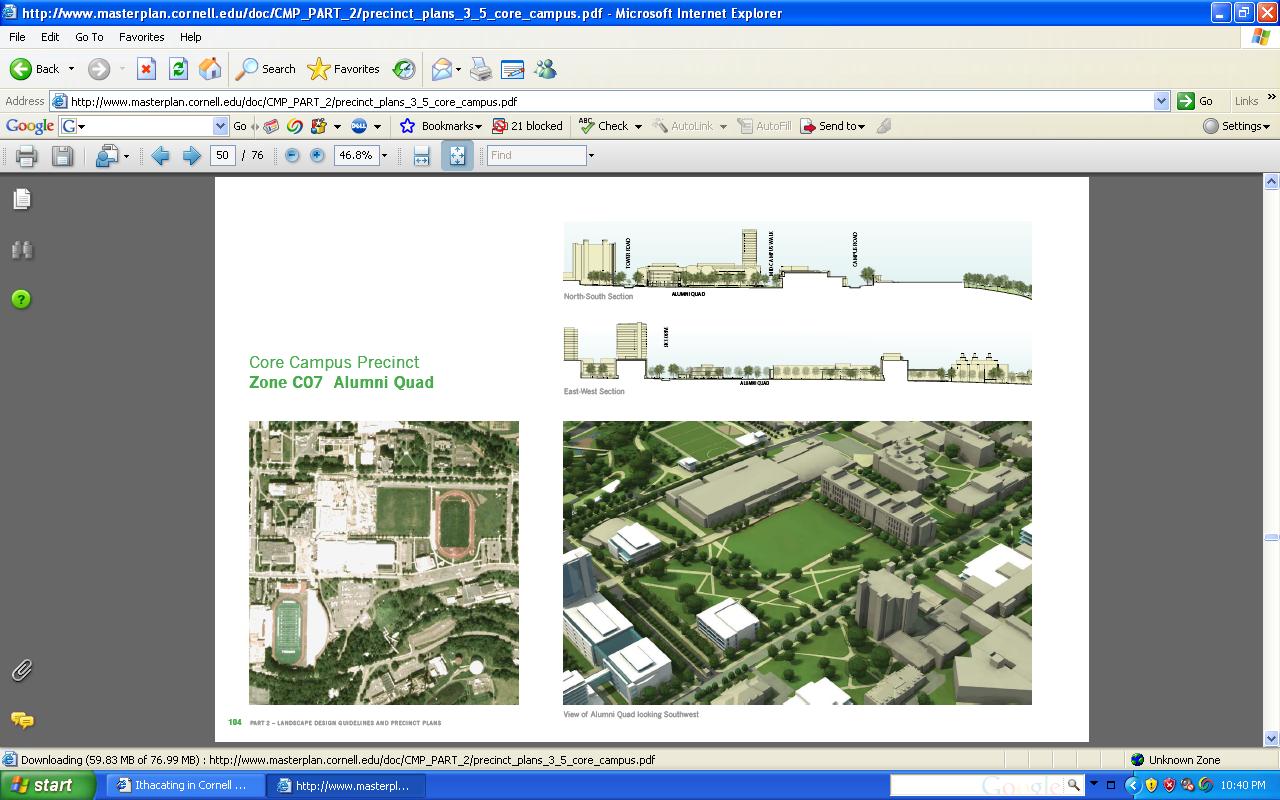
So, this is one of the brand new ideas being churned out by the brains designing the master plan. Precinct 7 is known as the Alumni Quad (my brown-nosing sensors are going off). As most may be aware, the alumni quad is currently the site of the atheltic fields (Robison). A new road (Rice Drive) is built where the western edge of the track currently sits, and so Friedman Wrestling Center ends up sitting at an intersection. The proposed mid-campus walk runs through the alumni quad, and renovation of Schoellkopf’s facilities are suggested to accomodate some of the athletic uses lost due to the elimination of the track. Additional facilities would be built at Kite Hill (which even I have barely heard of).
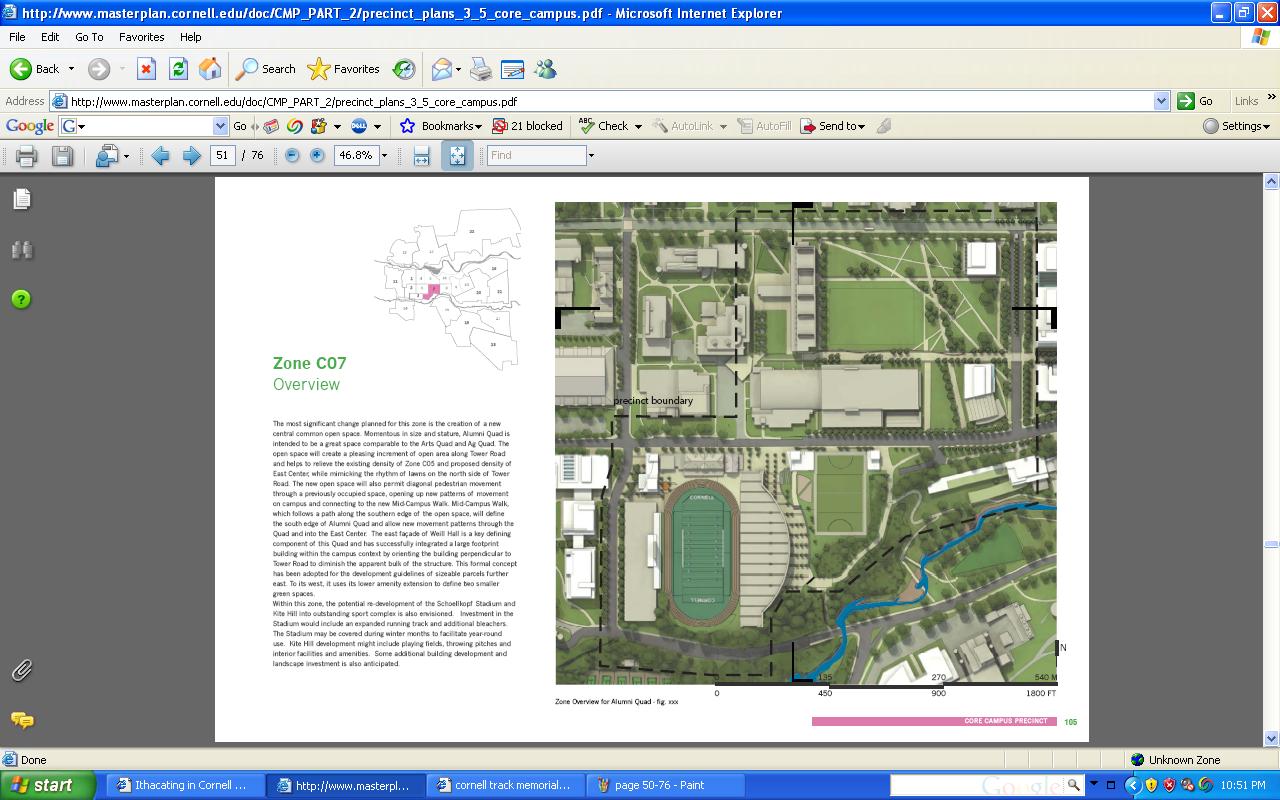
Apparently, the master plan thought it would be pretty cool to put Schoellkopf’s parking lot underground and build athletic facilities (not to mention their would be a huge parking lot below the alumni quad). I wish them the best of luck, because with all of their planned subterranean parking, I’m sure hell will be raised at some point (ex. safety concerns).
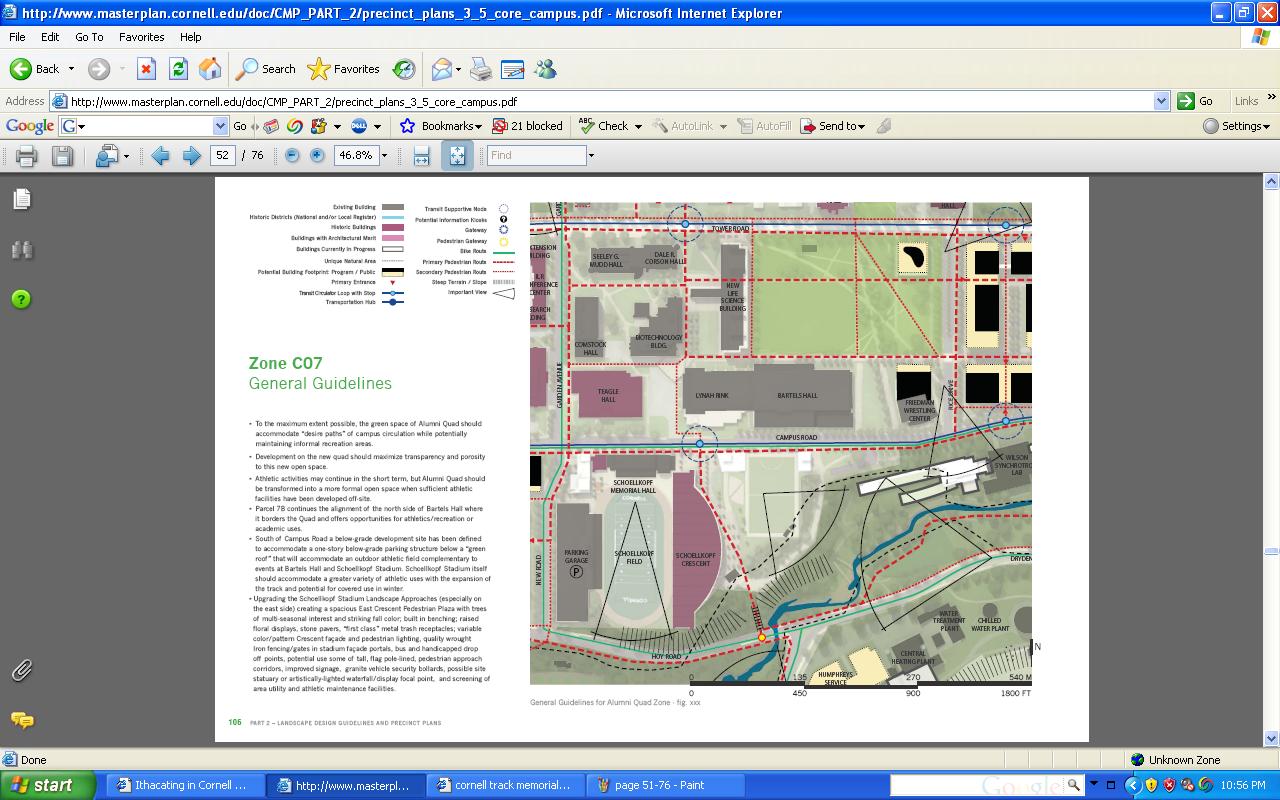
Like with the building planned for Day Hall’s site, they gave one of the two new buildings defining the quad an odd footprint to minimize its usage of space. their goal in the design of this quad was to break up the density between the ILR-Biology Quad area and the proposed East Campus. Also, it would appaear that whatever that is planned next to Wilson Lab is currently in currently underway at some level, and another building, the 16,000 sq. ft addition to the heating plant, is also shown to be underway at the edge of the slide. The other building appears to be an addition to Friedman, which is quite curious considering Friedman is less than six years old [1]. Neither building would be more than a couple of floors, with a sq. footage between 37,000 and 93,000 sq. ft. total.

here’s my one minor critique; the backside of Bartels, which would be facing this quad, is neither interesting nor visually appealing. unless some renovation of the backside is planned, I’m not sure I would want that fronting the new campus green space. You might just as well but up a stone fence on the entire southern edge.

I look at precinct 8 and I don’t even know where to start. The proposed east center is a very large, massive set of new facilities that by any guess would run into the billions.

Footprint-wise, the area East Campus would cover is the area from the track field to Judd Falls Road, which is the next intersection just beyond the Dairy Bar. That’s a fairly large chunk of real estate. Withthe exception of the historical front portions of Stocking Hall and Wing Hall, all other current structures in that area would be demolished to make way for the new complex.

Most of the ten buildings in the complex have large footprints, and four of them feature tall, slender towers of slightly varying heights. Even before checking the parcel listings, you can look at the elevations and determine that they are slightly taller than Bradfield. With four to five story buildings on its perimeter, the place would be built up like a fortress, yet they try to maintain spaces between the buildings “to maintain porosity”.

Now, I remember hearing on one occasion that after the monstrosity of Bradfield Hall, Tompkins County would never allow any more tall buildings to be built on Cornell Campus. But, I’ve yet to see anything distinctly say as much, and I doubt that Tompkins County could reasonably exclude tall structures as long as they are not in the way of takeoff or landing patterns over at the airport. If you never noticed, look up at Bradfield during the night, and you’ll see the red warning lights on the roof to warn planes of its presence.

This isn’t the first time a building taller than Bradfield has been proposed either.  Fomr Blake Gumprecht’s Fraternity Row and Collegetown study (he studied Cornell for his research):

“Collegetown has undergone profound changes over the last quarter century.City officials began to press for the redevelopment of the neighborhood in 1968. The following year, a city-sponsored urban renewal plan called for theheart of Collegetown to be demolished and replaced with a massive, multipurpose development. It recommended construction of a large building on College Avenue that would include 375 apartments, 600 parking spaces, retail on the first and second floors, two movie theaters, a restaurant, and nine floorsof office space. It also called for the construction of six to eight high-rise apartment towers, the tallest eighteen to twenty-one stories. The plan went nowhere [2].”

The master plan states that the buildings would consist of classrooms and academic space on lower floors and residential/dorm space in the residential towers. Although I applaud the concept of “mixed-use”, I’m not exactly sure how well the idea would go over with the potential residents. However, it would seem the residential towers are meant for grad students, post-docs and professors. I’m not sure if this sounds more like an educational area or a self-enclosed research facility (I would sit back and watch as the city starts demanding taxes on it because they come to the same conclusion). The ground floors of the  building would have restaurants and cafes, and lounge spaces; the intention is for this area to be a vibrant 24-hour space. I would hope that all of the eating areas wouldn’t all be run my Cornell dining- the same set of baked goods and drinks gets real old, real fast.
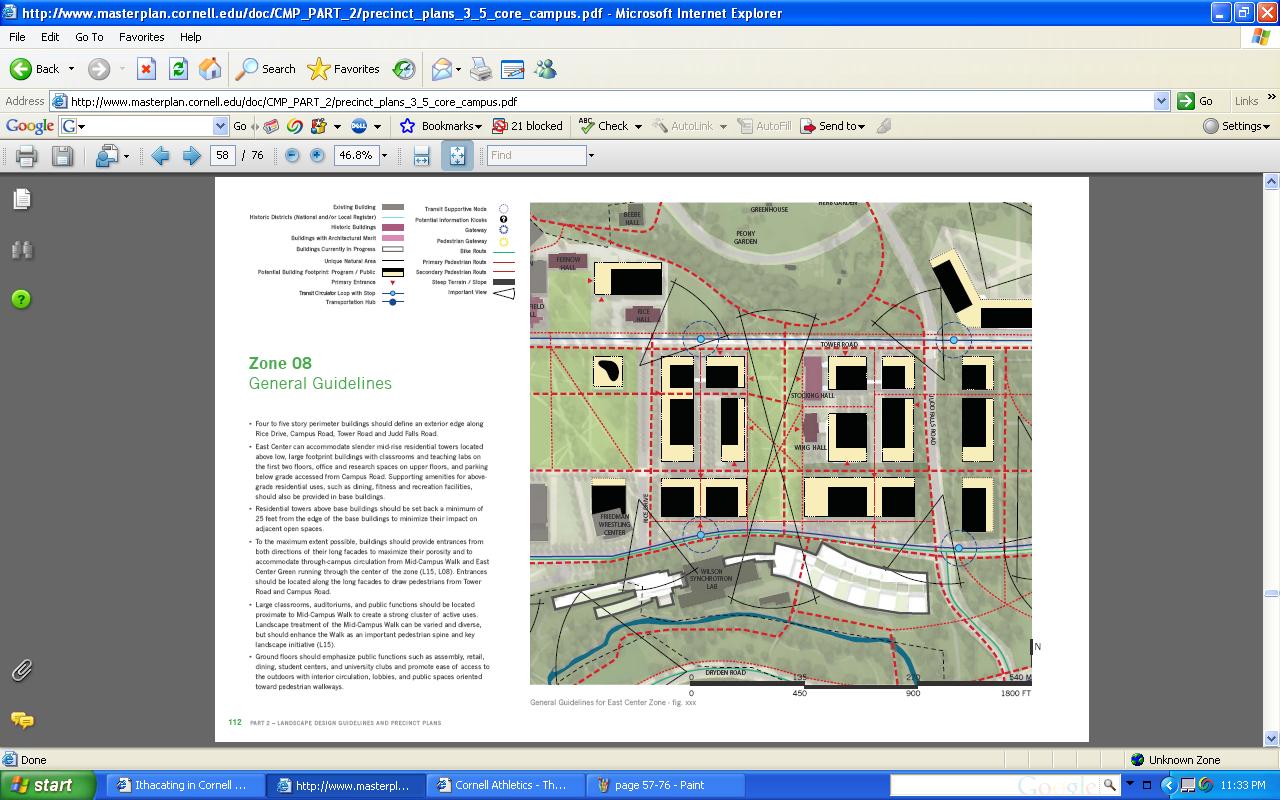
There would be 85 to 120 units per resident building. Take that through eight to ten floors, and you have ten to fifteen units per floor. A major question that would have to be answered in the deisgn phases would be how much residentil space will be provided per unit; I can imagine that grads, post-docs and professors would want more living space than the 200 sq. ft rooms in some of the dorms. The max height of a single building entity would be about 210 feet, the same as a typical 20-story apartment tower, or a fifteen-story office building, to put it into perspective. The final square footage would be 1.5-2.2 million sqaure feet, at least six times the amount of space in Weill Hall (which is 262,000 sq. ft.).

At least 850 parking spaces will be located underneath the East Campus. The primary purpose for them is to provide parking fore the residents of the complex, but the plan also suggests that when they empty out in the evenings, they can be used by others in the Cornell community to maintain the vibrancy of the area. I just can’t get through the impression I’m getting that this isn’t so much academic as it is research, and while we are a research institution, I wonder if how much we’re trying to blur the line between Cornell the school and Cornell the research organization.

To be continued…part 4 will cover the last of the Core Campus.

[1]http://www.cornellbigred.com/Sports/general/2007/FriedmanWrestlingCenter.asp

[2]http://www.adphicornell.org/adphicor/files/FraternityRow.pdf


Yet Another North Campus Photo Tour

27 07 2008

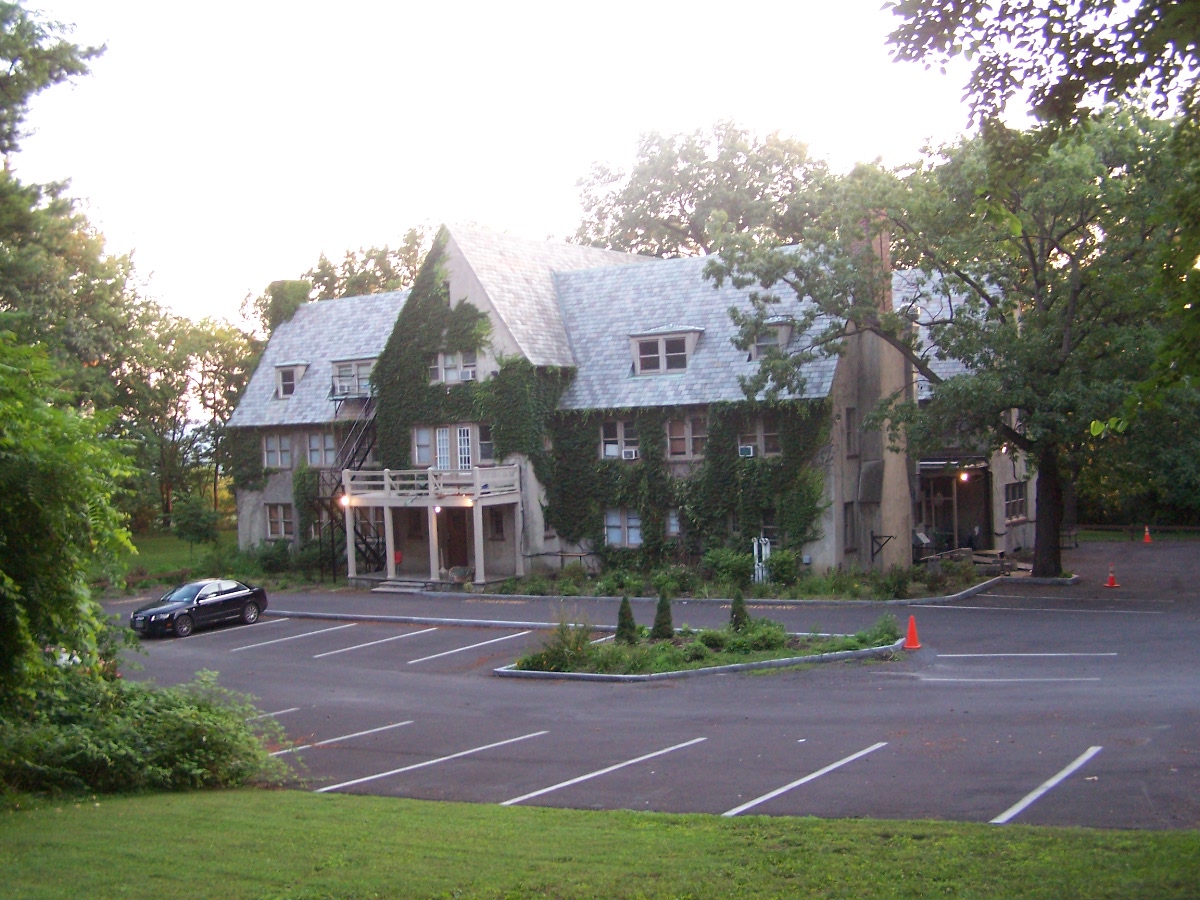
The house of Zeta Beta Tau. This fraternity wins my commendation for having the most difficult house to find.   Like seriously, it’s tucked away at the end of Edgecliff Road, which is hard enough to find at the end of Thurston near the Stewart Ave. bridge. The letters Z.B.T. hail from a ritual phrase of the fraternity (that was publicly revealed  on its one-hundreth anniversary): “Zion Bemishpat Tipadeh” [1], which translates means “Zion shall be redeemed with justice”. In case it hasn’t clicked in yet, the house was founded as a Jewish fraternity, and still has a strong Jewish presence in its membership. The house itself dates from the 1900s. (fun fact: ZBT absorbed four other fraternities over time: Phi Alpha, Kappa Nu, Phi Epsilon Pi, and Phi Sigma Delta. At some point (prior to 1959), all had houses at Cornell. Phi Alpha’s old house is now a rental house next door to my apartment).

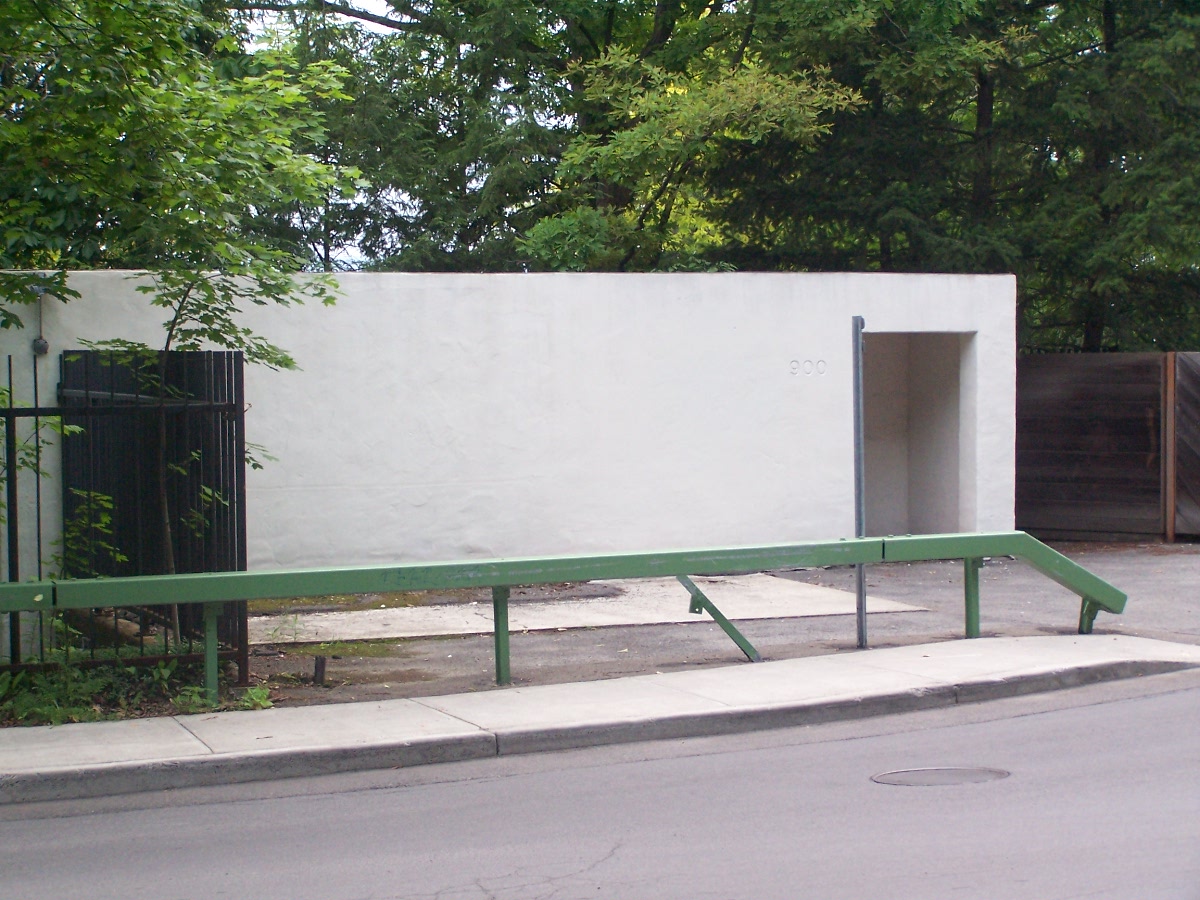
Carl Sagan’s House, prior to his death in 1996. The property sits at 900 Stewart Avenue- the first photo is the entrance area from the street, and the second is from the other side of the gorge. Originally, one of Cornell’s two major secret societies, Sphinx Head, built a windowless meeting chamber on the site in 1926 [2]. Well, upkeep proved to be a hassle by the 1960s, so they sold it to their neighbor Professor Robert Wilson in 1969, who in turn sold the tomb to Professor Steven Mensch in 1979. Mensch built a house on the site in the style of the tomb, which he sold to Carl Sagan. Currently, the house is considered to be the property of the Sagan estate and its heirs.

The house of Sigma Chi Delta, a local co-ed fraternity founded in 1981 [3]. It has no letters on the outside, so this is how I confirmed it as their house:

Yes, the composite is purposely blurred so I don’t receive nasty e-mails. I’m sure I’ll be in enough heat for taking photos through their street-facing windows.

The two 7-unit houses that represent the retirement facility “Bridges at Cornell Heights” [4]. My jaw drops when I look at how lovely these houses are. I believe they were renovated in the late 1990s. In case anyone’s wondering, the price is about $7500/month. That’s actually more than I make in a year…

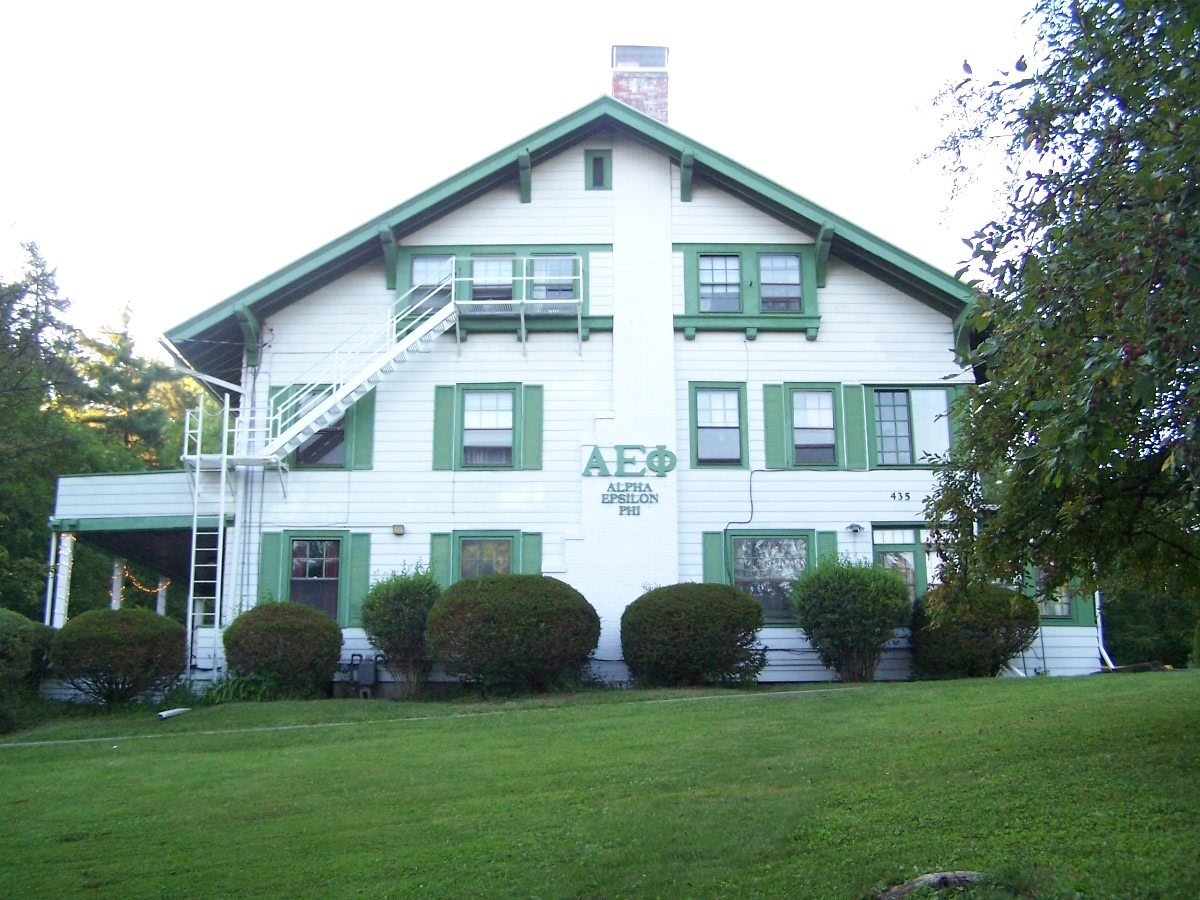
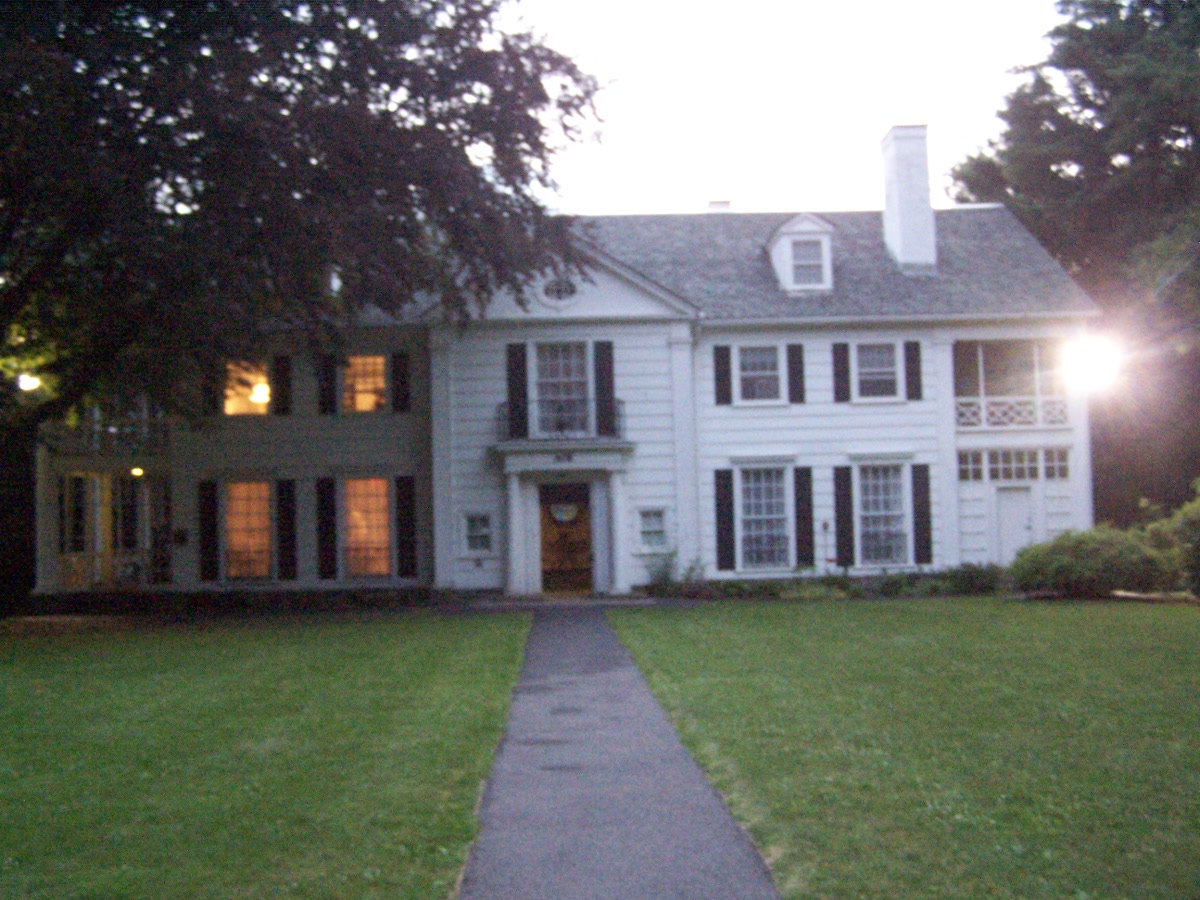
Similar in concept to Zeta Beta Tau is Alpha Epsilon Phi, a sorority with a strong Jewish background. The Cornell chapter was established in 1920. It amazes me how little information I can find about the chapter itself, apart from token facts like house color and flower. I’m not looking for that, I’m looking for the history. It is perfectly possible that the house, which dates from the 1900s, has always been their house. Looking through a copy of 1943 Cornellian suggests they have been in the house at least 65 years, so there’s some support to the idea. If an AEPhi could confirm that, it would be appreciated.

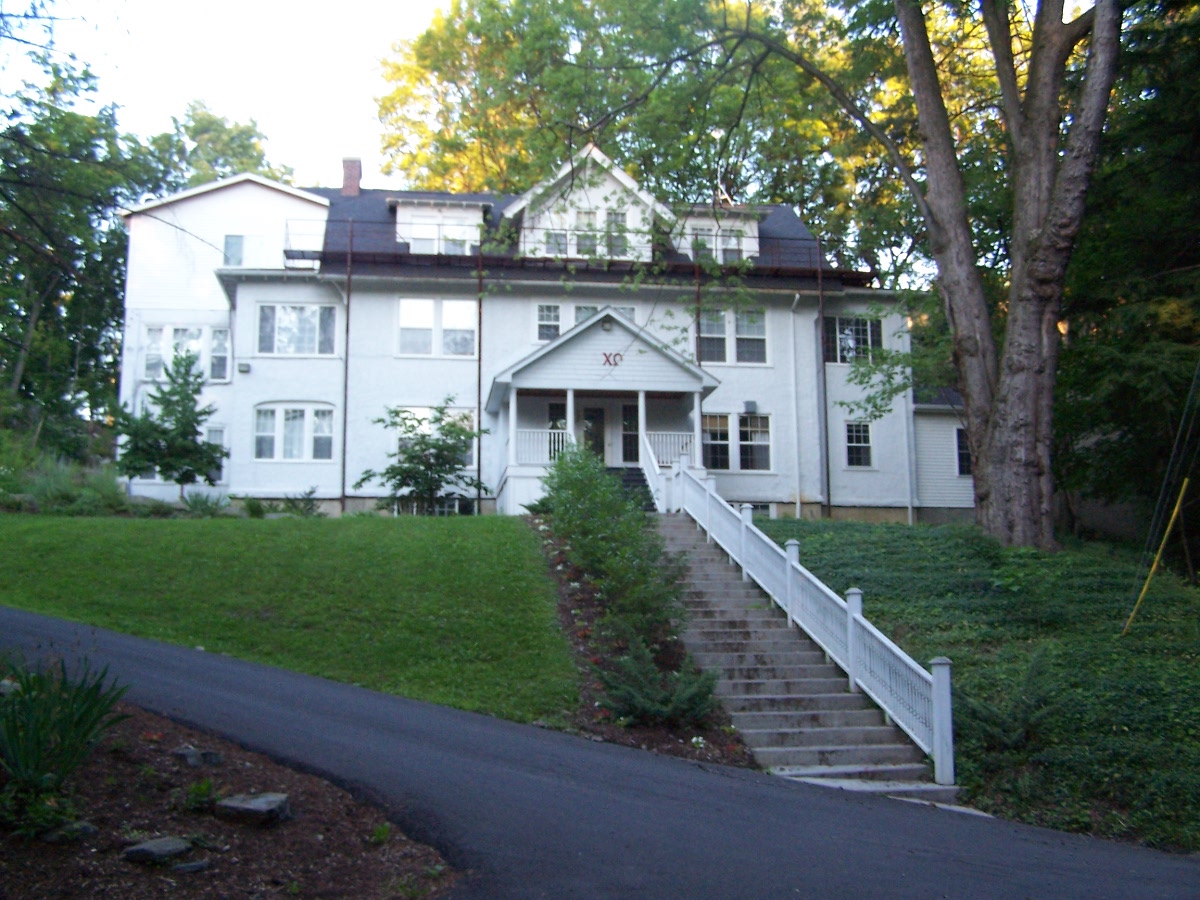
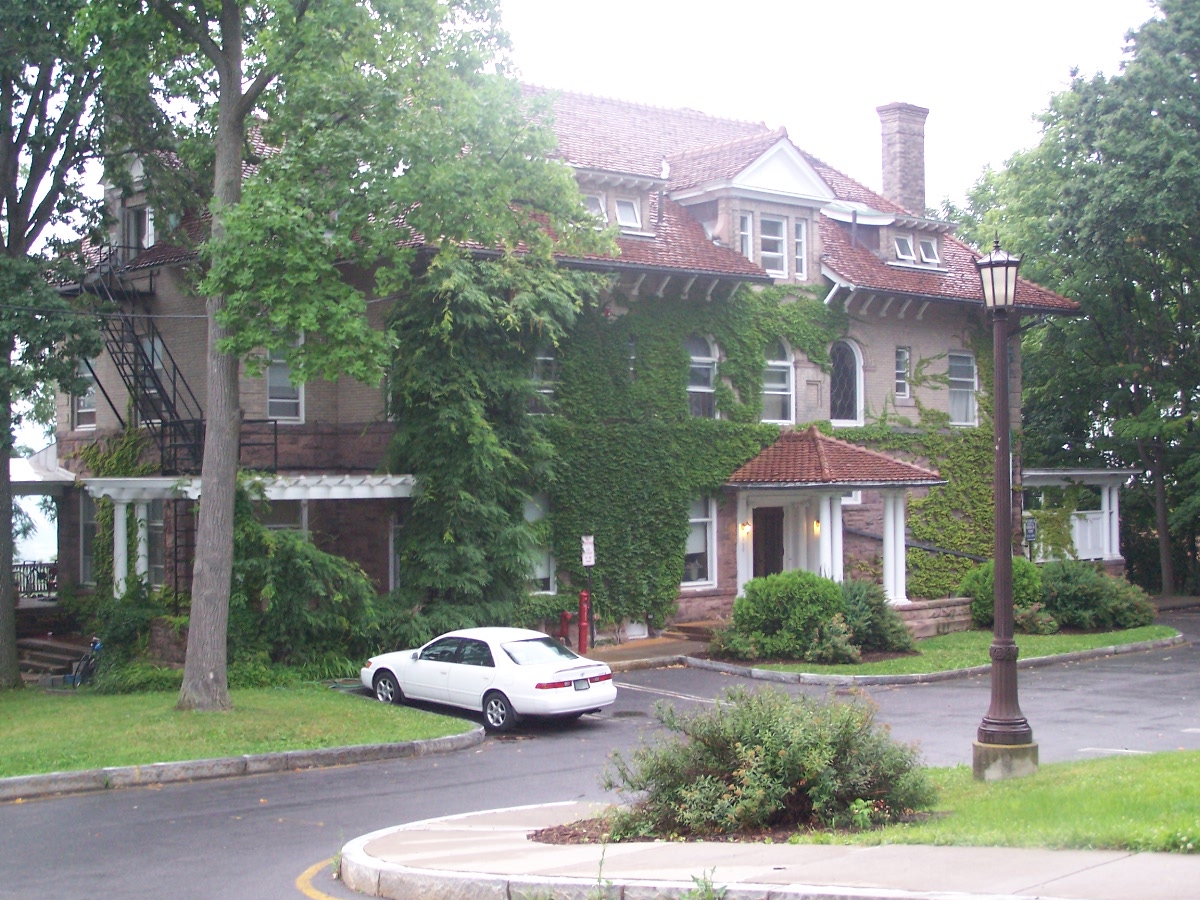
Formerly the house of merged fraternity Phi Sigma Epsilon, today this is the house of the sorority Alpha Chi Omega. This is not to be confused with Chi Omega, which closed in 2003 and once lived at 10 Sisson Place. Alpha Chi Omega reestablished itself at Cornell in 1984 (Chi Omega did the same thing in 1987, but it appeared only one has managed to survive up to today). In 1985, another sorority, Alpha Gamma Delta, tried to establish itself, but closed after 1990. They also lived at 722 University Avenue (what is that, the token Greek house?) [5]

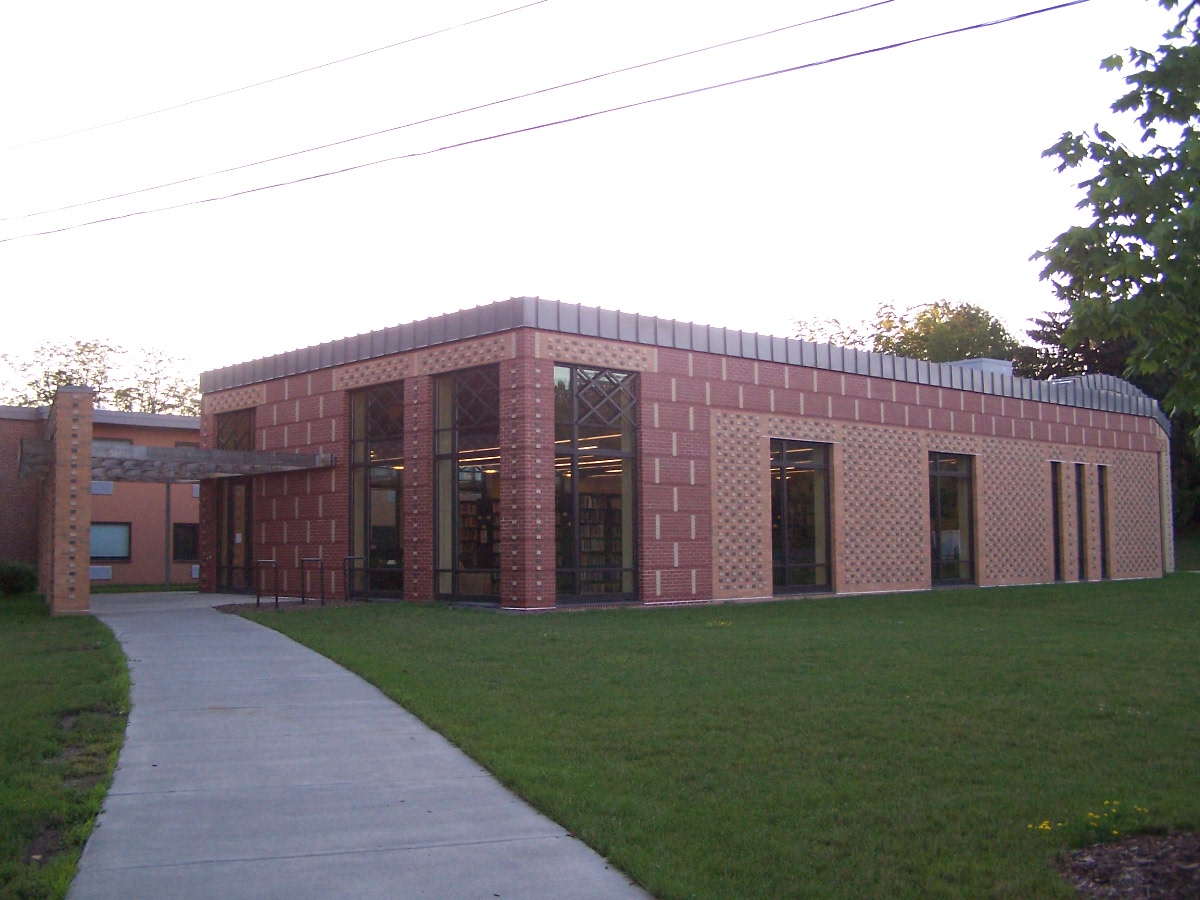
The Africana Library. built in 2005. The original library was part of the Africana Center that was burned in 1970 (in response, enraged students stormed the new Cornell Store, ransacking and heavily damaging the facility. They burned many of the stolen items in a large bonfire a week later). The center (in the background, you can make it out on the left) was then relocated to 310 Triphammer Road, just off North Campus. The building was dedicated to John Henrik Clarke in 1985, the same year that the Africana Libe became a part of the university library system. The building was previously renovated in 1990 [6].

[1]http://en.wikipedia.org/wiki/Zeta_Beta_Tau

[2]http://ezra.cornell.edu/posting.php?timestamp=1207807200

[3]http://www.sigmachidelta.org/Site/Home.html

[4]http://www.bridgescornellheights.com/

[5]http://alphagamhouses.blogspot.com/2007/10/cornell-university.html

[6]http://www.library.cornell.edu/africana/about/history.html


The Cornell Master Plan: Part 2 of 5

24 07 2008

So, picking up where I left, part 1 was meant to only cover the arts quad and provide an introduction. In part two, we’ll reach a little deeper into the details of the plan.

The next section focuses on the Ho Plaza area. The primary components of the plan for this area include the reconstruction of Gannett and Day Hall and the demolition of the Cornell Store. I’m going to say that because I’m an employee of the store, there’s a certain sense of attachment one develops after a couple years, so I wasn’t very pleased to see this. Also, Olin Hall and Willard Straight are set to gain additions. The massive new development to replace Hollister and Carpenter Halls will be discussed later.

Here’s a surprise; all the proposals on this page are currently in development already, with the exception of the Straight addition and Day Hall’s demolition. There’s the law school additions, which first appear on page 21; the courtyard-plan makes me raise an eyebrow, because you never know what Cornell is exactly planning. The Law School has seen major construction in four decades (Myron Taylor, 1930s, Anabel Taylor, 1950s, Hughes Hall, 1960s, and the Foster addition to Myron Taylor, 1980s). They have remained relatively cohesive in appearance and massing, and I would hope that any further plans keep it that way.

Then there’s Gannett. Gannett was built in 1958 with an addition in 1979 that sticks out like some cancerous growth from the main building (off topic a little, but when designing new buildings, I hope Cornell never hires Frank Gehry. Look at what he did at MIT as a warning[1]). The discussion for the replacement structure suggests it work with the neighboring intersection to engage activity, which seems to me like it would probably have a plaza in front of it. The replacement structure would be 4-5 floors.

The addition to Olin isn’t a surprise, and will probably blend in with the structure as the east addition did in 1987. I’m not up in arms over that one. I admit that I’m none too cheery about the store’s demolition, but that’s because the main reason seems to be sight-lines. What the hell, demolishing a 53,000 sq. ft facility because it obstructs views. The store was built in 1968-69, and was originally supposed to be 10 feet deeper, but they didn’t expect to hit shallow bedrock. So they compromised. I’ve talked about this with customers, and the concern seems to be where else can they put the store where it is still easily accessible. Moving it out east won’t work unless there’s a lot more out there by that time. But, at work they’re already talking of looking at locations to move to within the next couple years; Collegetown is coming up a lot.

The Day Hall proposing is laughable. Curving the base to match with Wee Stinky Glen is probably not going to be as harmonious as suggested. The idea of student activity at the base of Day sounds nice, but I doubt Day Hall’s staff will appreciate it. Day Hall is administrative, so trying to mix the functions of the student union with the administration in one footprint is not going to go over well. My thought anyway.

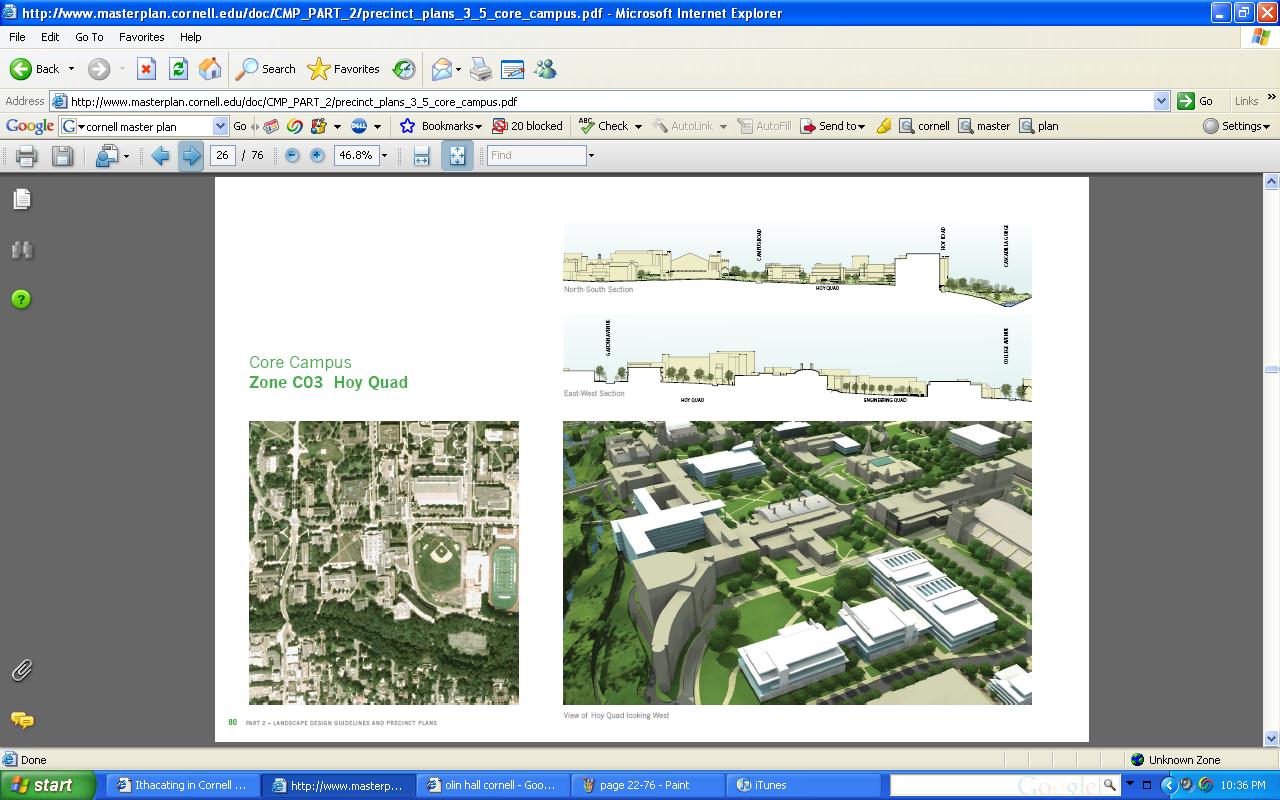
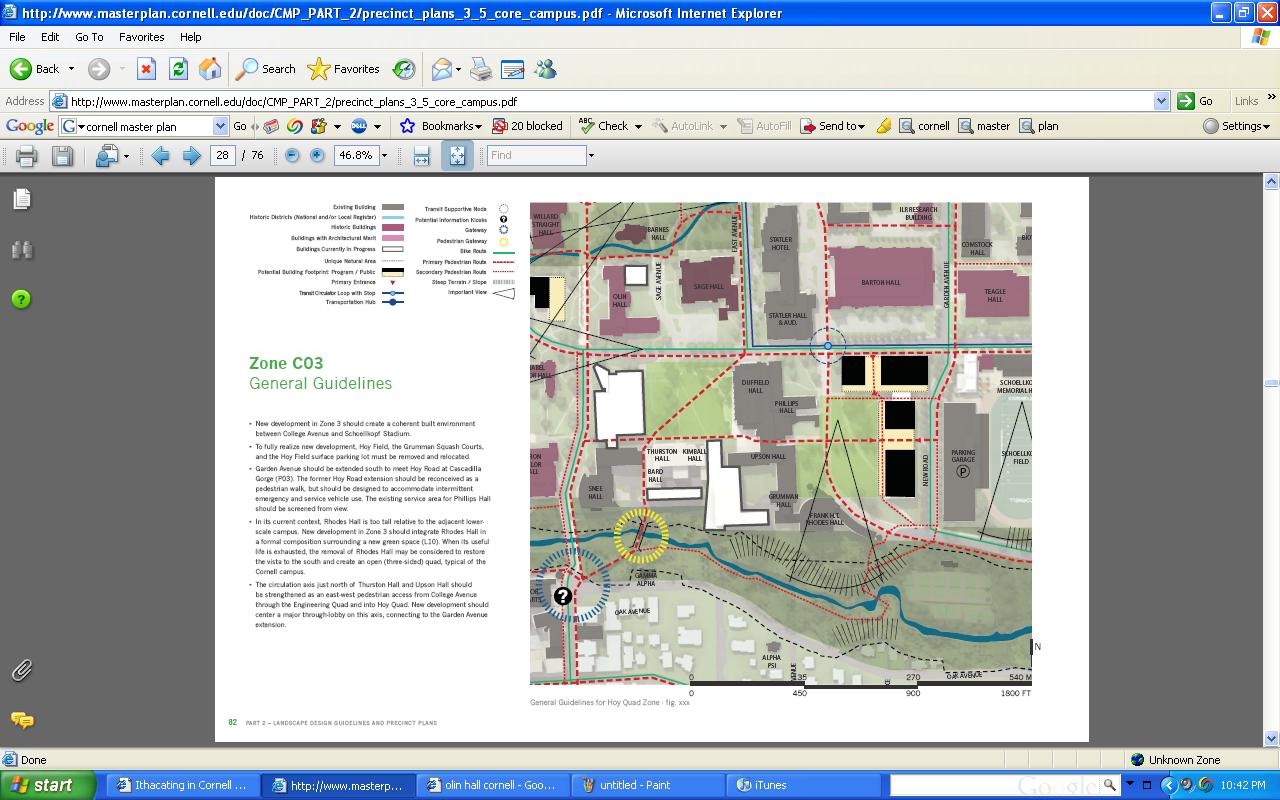
Precinct 3 is the Engineering Quad and Hoy Field, referred to in the plan as the “Hoy Quad”. Compared to the previous two precincts, the changes here are numerous. Hollister, Carpenter, and part of Thurston are gone (so is Ward Center, but I’ve met engineers who didn’t even know that was there). A massive building replaced the former two, and the latter is incorporated as part of a new set of building, a large addition next to Grumman Hall and a small slender building directly behind Thurston (a design massing of Gates?). Hoy field is gone, replaced by four medium-sized-footprint structures making up a partial quad.

The plan suggests Rhodes is too tall for its location, so the new development next to Grumman builds up to it. At the end of its useful life, the demolition of Rhodes is suggested. Wow, not even twenty years old and Rhodes Hall is already having its demolition suggested. Garden Avenue would be extended between the parking garage and the new quad. The space created in the new quad would be between 249,000 and 378,000 sq. ft of space- about the same if you combined the new Physical Sciences. I’m kinda fond of Hollister Hall,  (I know, it’s a box, but it’s a decent international style box), so I’m a little disappointed to here it’s slated for demolition, but in general I’m more concerned with who Cornell hires to design the new building (I vote for Robert Stern).

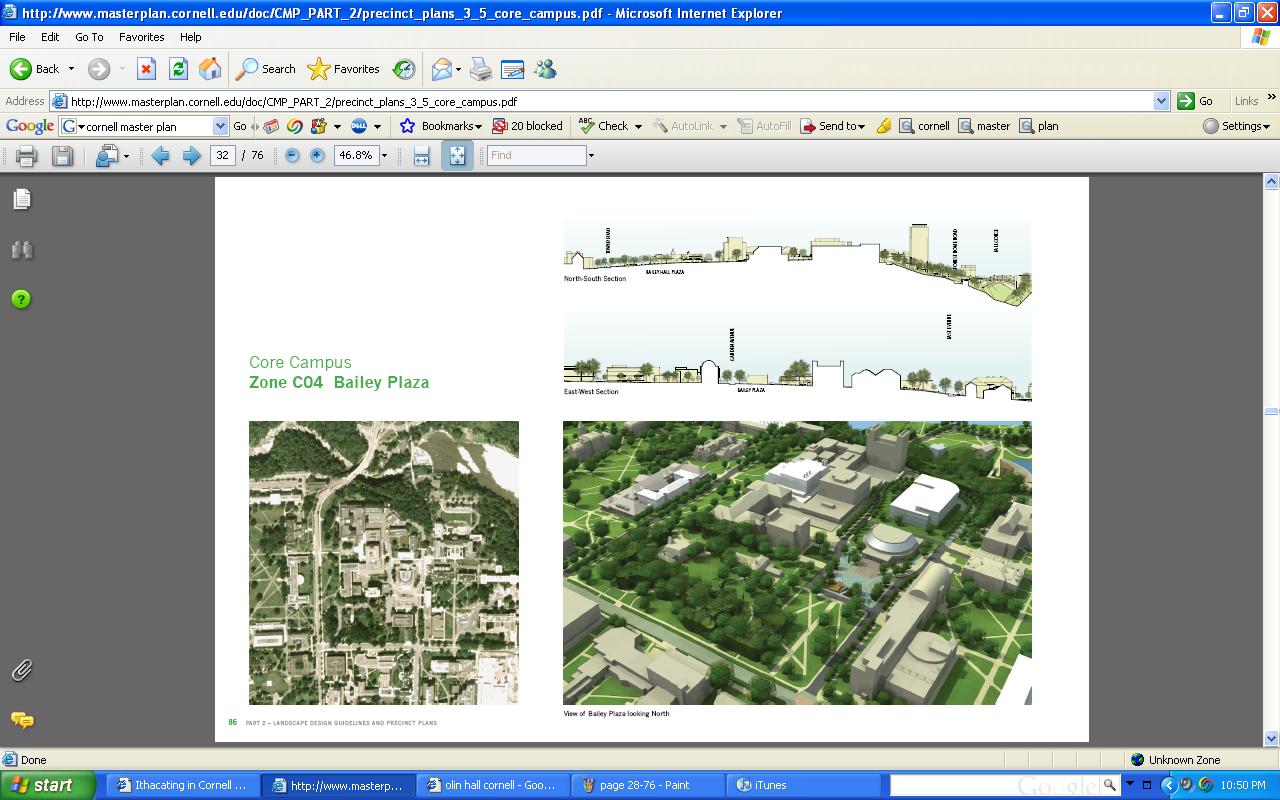
Precinct 4 is the Bailey Plaza precinct. Here, Malott Hall has been demolished. I’m not too fond of that; I find the north wing to be a great example of 1960s architecture (to hell with the south wing). Again, it’s because of sight-lines; they want Bailey Hall and Plaza to be the focal point of this area. The plan goes even further to suggest the demolition of Roberts Hall once it goes beyond its useful life to enhance sight-lines even further.

Much to the disappointment (or delight, in some cases) of nutri sci majors, Savage and Kinzelberg would be demolished for a new structure, around 150,000 sq. ft in size and 3-4 floors. Newman Lab would also see the axe. The new building could be either research labs or a performing arts center to complement Bailey. But at the research institution that is Cornell, I have an idea which one would be preferred.

Precinct 5, the Garden Avenue area, has nothing new planned, nor nothing planned for demolition. Here’s an idea; use some of the steel and aluminum from Duffield’s facade and put it on Uris. But, I’m being unfair. Uris, built in 1972, was named for Percy and Harold Uris ’25; the libe was also dedicated to them in 1962, the first time it was renovated. Well, story goes that when Cornell gave them carte blanche on design preferences, they were in Pittsburgh, and noticed how amazing the (then new) U.S. Steel tower’s facade looked (which uses cor-ten steel). They wanted to see that on the new building [2]. So that’s why it was chosen. Cor-ten steel turns gold-yellow when it reacts with common air pollutants; well if Ithaca can claim anything, the air is pretty clean. So, no gold hues anytime soon (the last I heard, maybe 100 years).

Fully Weathered COR-TEN steel

Fully Weathered COR-TEN steel

The last precinct I’ll cover tonight is the Ag Quad. The Ag Quad is important to me because this is where I spend a good chunk of my life (that and the bowels of the engineering school, where engineers remind me every day why I study meteorology and not engineering). In particular, I live at the top of Bradfield. We think it’s the best view because of the height and the fact we don’t have to look at it. It’s like a pug, so ugly you can’t help but love it (it grew on me over months…okay, years). The additions to the ag quad are a new building over the gravel lot currently between Kennedy and Plant Sci, and the front of south side of Plant Sci. Really, we wouldn’t even need a new building on the parking lot if they hadn’t demolished East Roberts Hall in the late 1980s.

L to R: Roberts, Stone, East Roberts Halls

As for the Plant Sci addition, I was never fond of the front anyway. It was built in the depression, and it looks that way too. But no glass box, please. This precinct also includes the new MVR north, being built right now (there was an old MVR north; just search this blog for the story). It looks life Caldwell and Warren get back additions on their parking lots, and Bruckner Lab sees the wrecking ball to make room for a building that dwarfs neighboring Rice and Fernow Halls. They say Cornell builds in a style is fashionable at the time. If that’s the case right now, then stay off the Ag Quad. My trust with Cornell’s building proposal designs is quite low.

Thankfully, none of the plans are currently underway. I admit, if William Henry Miller were alive today, I’d be begging for the university to hire him. I’m not big on progressive architecture, but maybe that’s because I just don’t understand it. I like the traditional styles just fine.To be continued…[1]http://en.wikipedia.org/wiki/Stata_Center

[2]http://ezra.cornell.edu/searched.php – see 12/27/2005


Another Random Cornell Heights Tour

23 07 2008

The house of Acacia fraternity. It was built in 1907 for a prominent professor, and designed by architect Arthur Gibb in the Prairie House style.  Gibb was also responsible for the design of Baker Lab on campus (which was technically designed around 1910, even if it wasn’t completed until 1921) [1]. The house, called “Northcote”, was first occupied by Acacia in 1934, with an additional dorm wing constructed around 1958. Today, in terms of distance from campus, Northcote is probably one of the farthest.

Greystone Manor, the house of Sigma Chi fraternity. It is been my observation that Sigma Chi is probably one of the most low-key fraternities of Cornell. There’s only a flag to announce their existence at their house, they have no house web site, etc. However, this doesn’t mean that the house doesn’t have a history worth sharing. The house was the home of silent-film star Irene Castle around 1919, when the silent-film industry was still thriving in the Ithaca area. It was bought by Sigma Chi in 1923, and has been in their possession ever since.

EDIT: So, a kind reader was generous to share this extra bit of information about the history of the house:

“The Greystone house was built by Alice G. McCloskey (of the Nature Studies department and editor of the Rural School Leaflet) and another woman. By the time Alice died 19 Oct 1915 she was the owner of the house. She left the house to her assistant, Edward Mowbray Tuttle (my husband’s maternal grandfather). Edward married in October 1919 and sold the Greystone to the silent film start in 1919. So there is more history than you think.”

On that note, Irene Castle was married to one of Treman family, but left Ithaca (and him) in 1923.

Not a frat house, but this is an amazing looking house regardless. Zillow.com indicates it was built in 1910. It’s across the street from Sigma Chi.

The house of Phi Delta Theta Fraternity on Ridgewood Road. The house dates from the 19th century, but Phi Delta Theta has made it home for the vast majority of its life. Phi Delta Theta is a dry fraternity, meaning that in its house, there is no alcohol consumption; for that, they can go to their annex at 210 Thurston. The house went dry in 2000, and all 40 current brothers at the time resigned in protest. If any of you are familiar with author Scott Conroe’s It Takes Just Pride, then you’ll recognize that this is one of the fraternities covered in the book. I also want to say that this is one of the two houses where someone chased me off the property for taking photos. Someone was in a foul mood, I guess.

The house of Alpha Omicron Pi sorority. AOPi moved in in fall 2006. Prior to that, this house served as the home of Theta Chi for about 25 years. Theta Chi was expelled from campus in 1999, and then the house was briefly occupied by AEPi and former Theta Chi pledges, and finally AEPi moved back to their Thurston house in fall 2001. Theta Chi attempted a reorganization in 2003 but it did not last, and the house sat vacant until AOPi bought the facility. AOPi first came back to Cornell in 1989 after a 25-year hiatus; they lived briefly in AXiD’s house and 210 Thurston before moving into 14 South Avenue on West Campus in 1991 [2]. Prior to Theta Chi, this house was the home of a fraternity by the name Tau Delta Phi. While the house has been home to a number of GLOs, it was originally built in 1925-26 for Professor Ernest T. Paine[3].

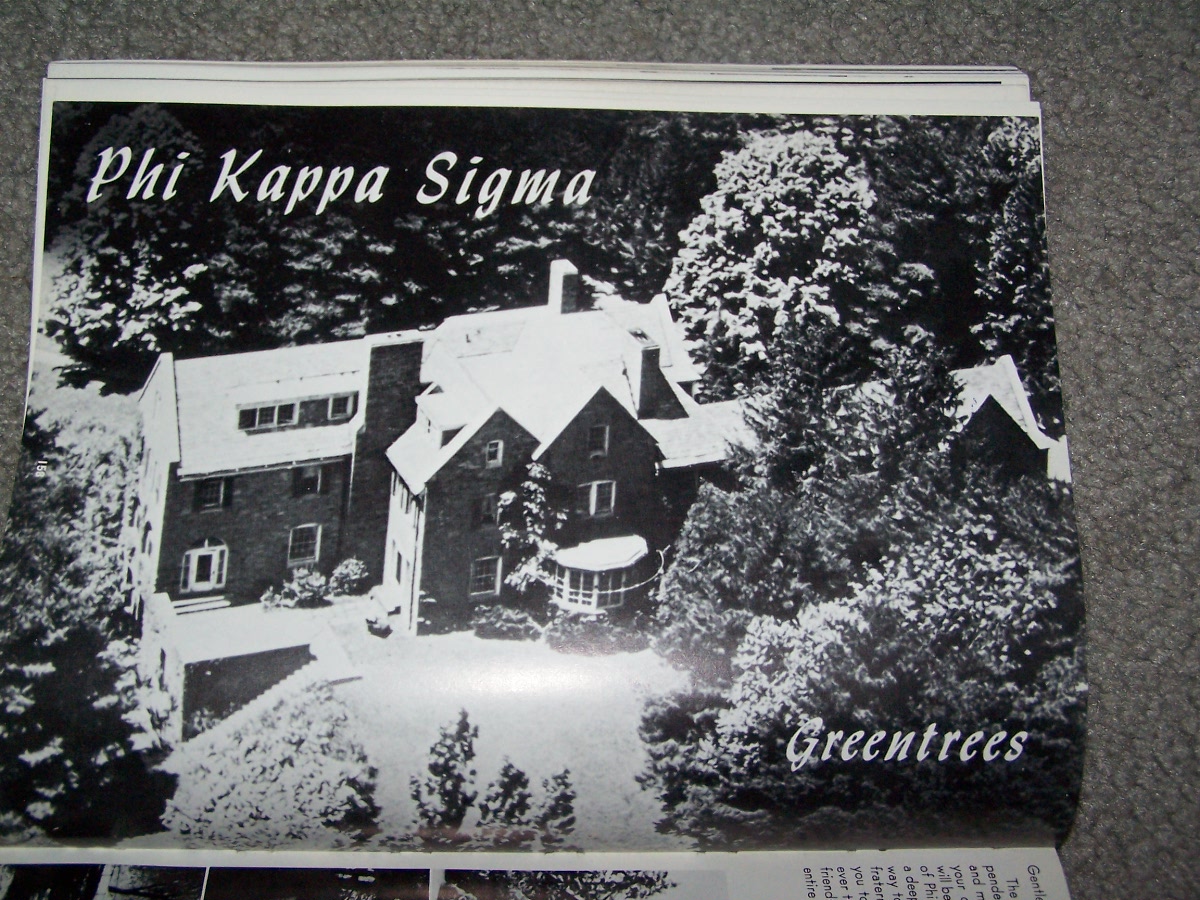
Continuing up Ridgewood is Pi Kappa Phi. The house is affectionately known as “Greentrees”, a name that hails from its days as the house of Phi Kappa Sigma before they folded in 1991. The name comes from the seven forested acres the house sits on. The property also at one point maintained an in-ground pool, a rarity for Ithaca. The house was originally home to George Morse of Morse Chain Company (now Emerson Power Transmission, a major private-sector employer in Ithaca). Phi Kappa Sigma, the Skulls, lived in the house from 1935 to 1991. In the meanwhile, Phi Kappa Phi lived at 722 University Avenue from 1949 to 1986, when the chapter closed; it was reorganized in 1990, and moved into this house the following year [4].

Across the street is Beta Theta Pi fraternity. Now, I must say that this house is spectacular from the outside; but I was appalled the few times I’ve been in there (a couple of my friends are brothers at Beta). Anyways, Beta (originally Alpha Sigma Chi), lived in Pi Kappa Alpha’s house until about 1906, when “Castle on the Rock” was constructed [5].

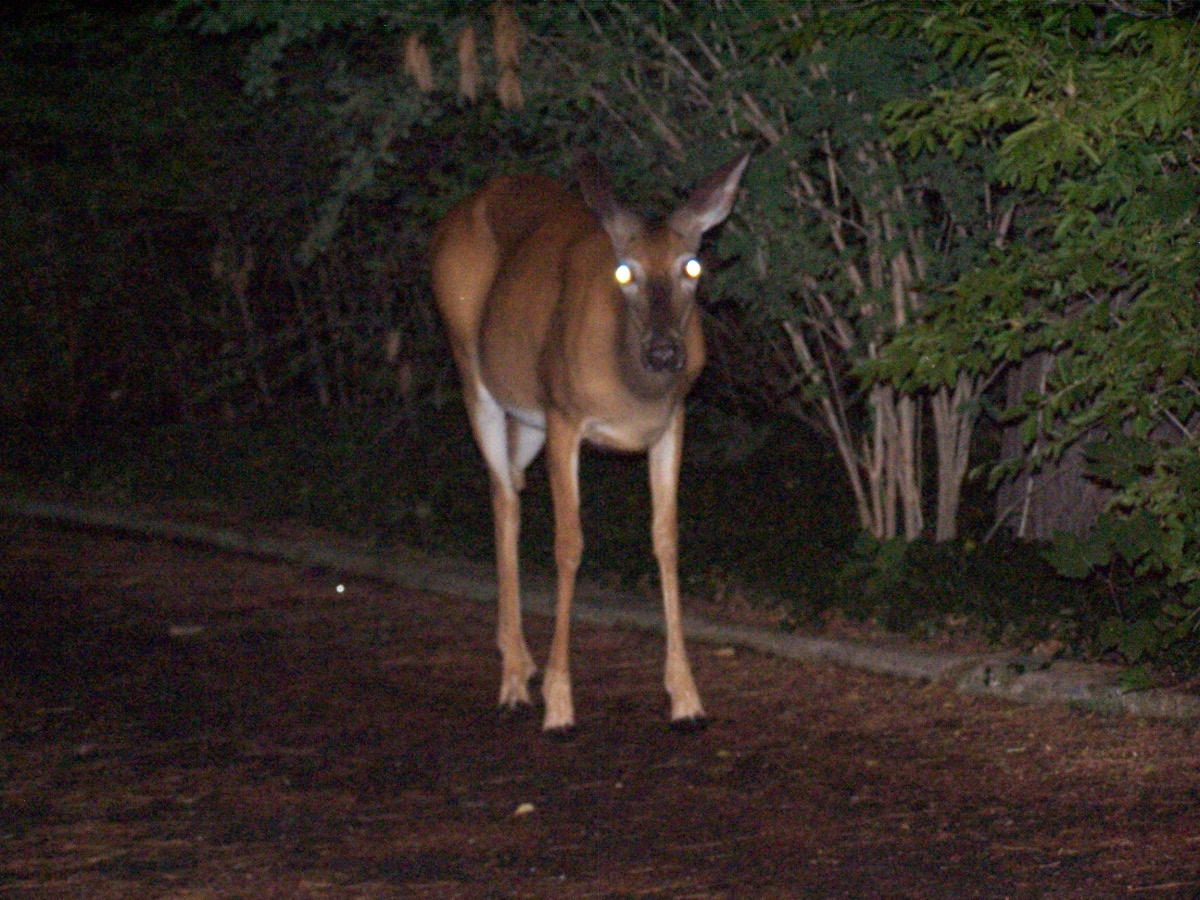
Venison Anyone?

Wrapping up Ridgewood is Sigma Delta Tau sorority. The Alpha chapter was founded in 1917 as Sigma Delta Phi, but changed when it was founded the letters conflicted with another organization (that seems to happen quite a bit) [6]. The house has a stunningly unattractive addition that probably dates from the 1960s, and I tried my best to not photograph it. The rest of the house looks very classy, dating from 1900-1910.

[1]http://www.cornellacacia.org/index.php?a=info

[2]http://www.aoiiepsilon.com/centennial.html

[3]http://www.news.cornell.edu/stories/Oct12/GreekTour.html

[4]http://www.cornellpikapp.com/history.php#Psi

[5]http://www.betadelta.org/about.html

[6]http://www.dos.cornell.edu/dos/greek/chapter_details.cfm?id=3282


Historical Rush Booklet, Part 3 of 3

21 07 2008

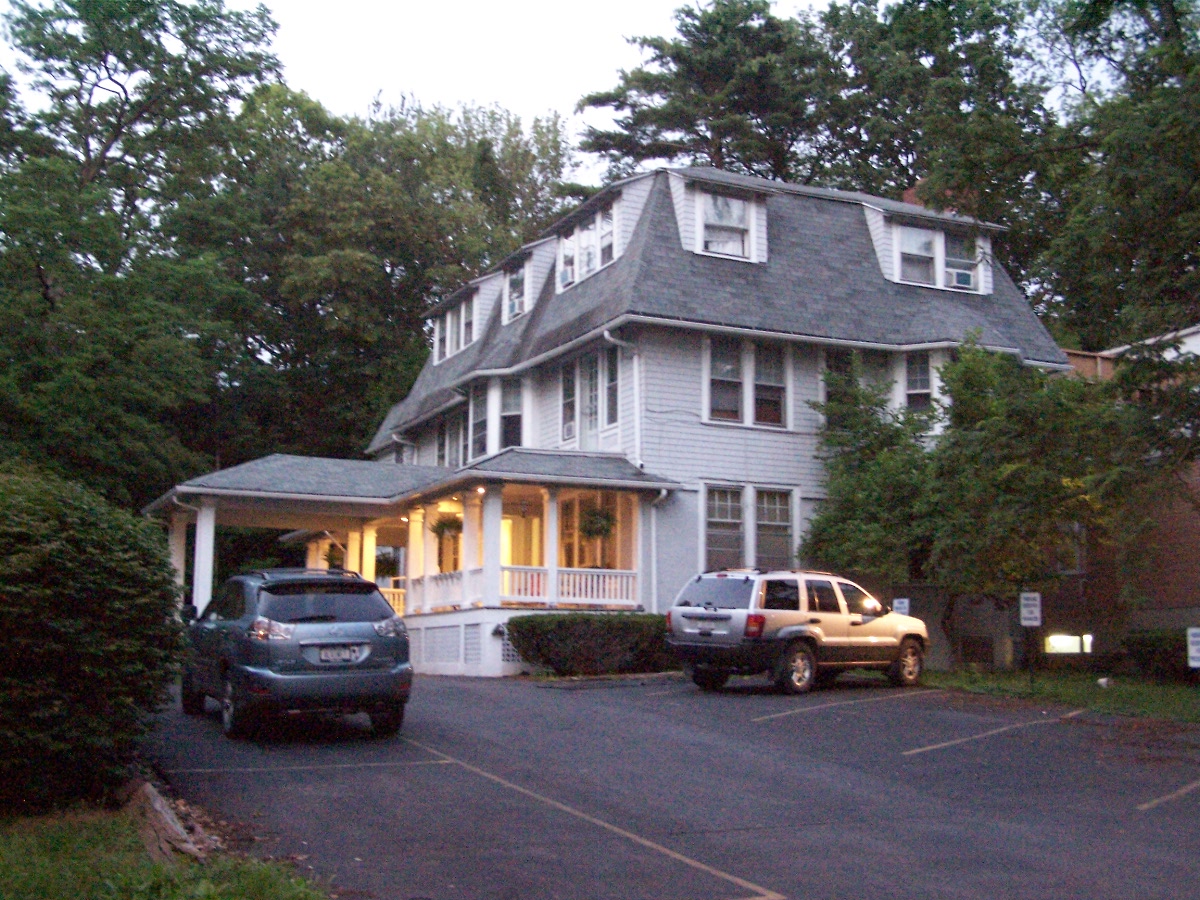
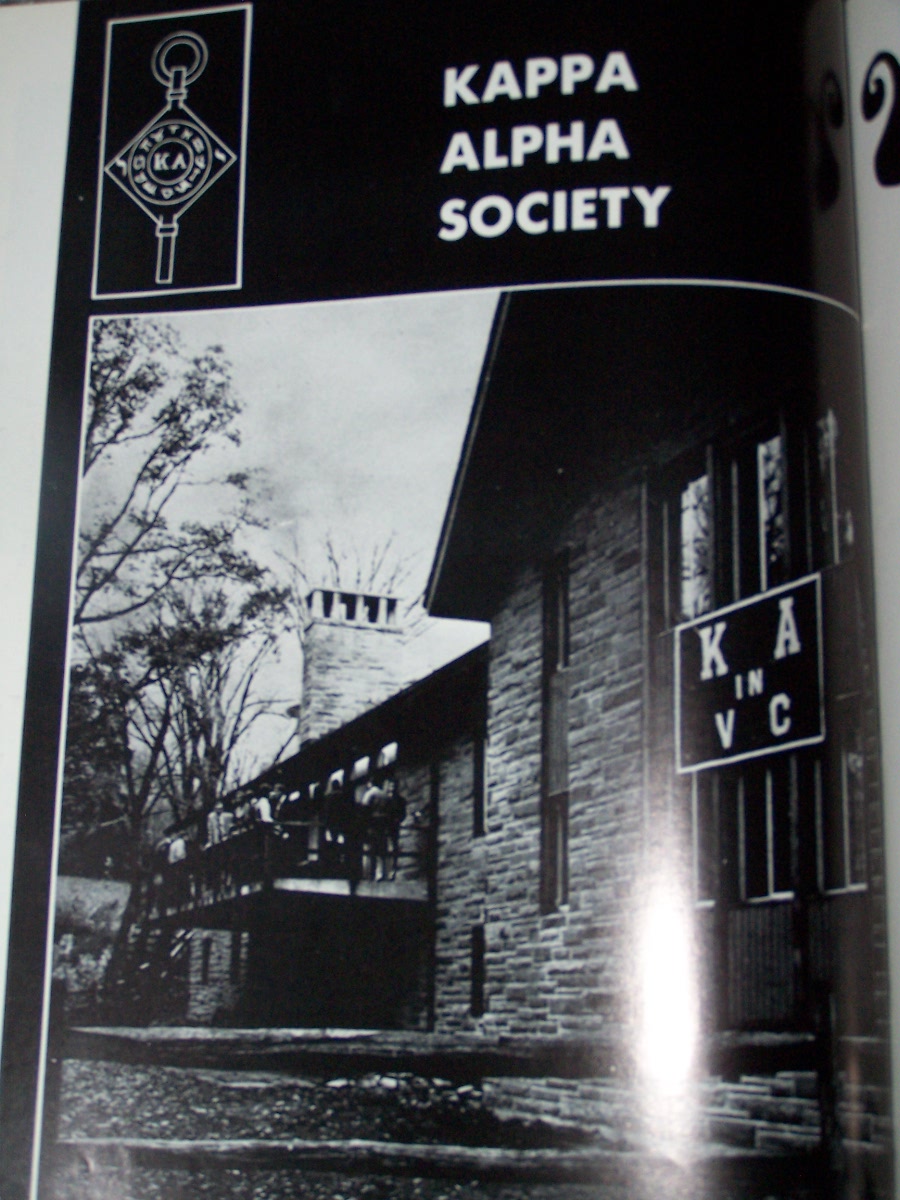
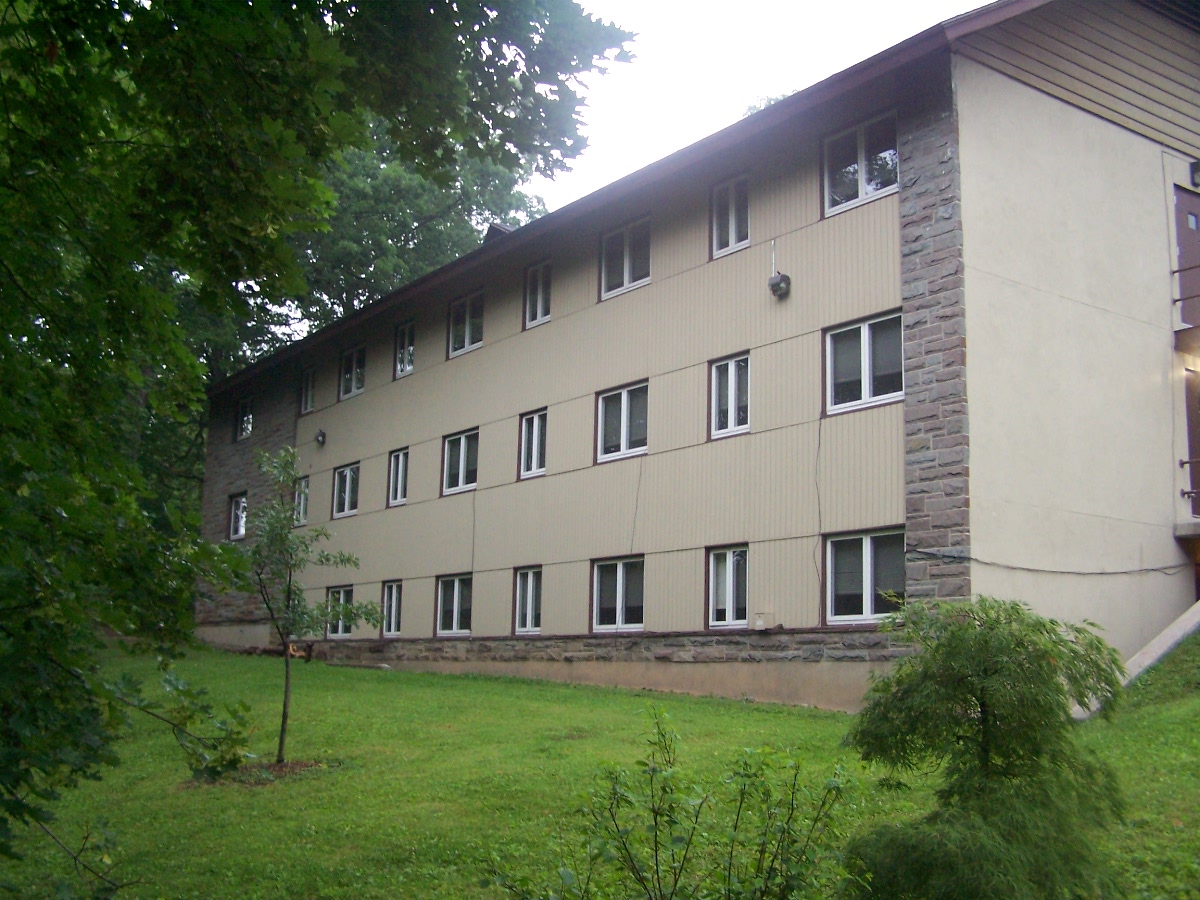
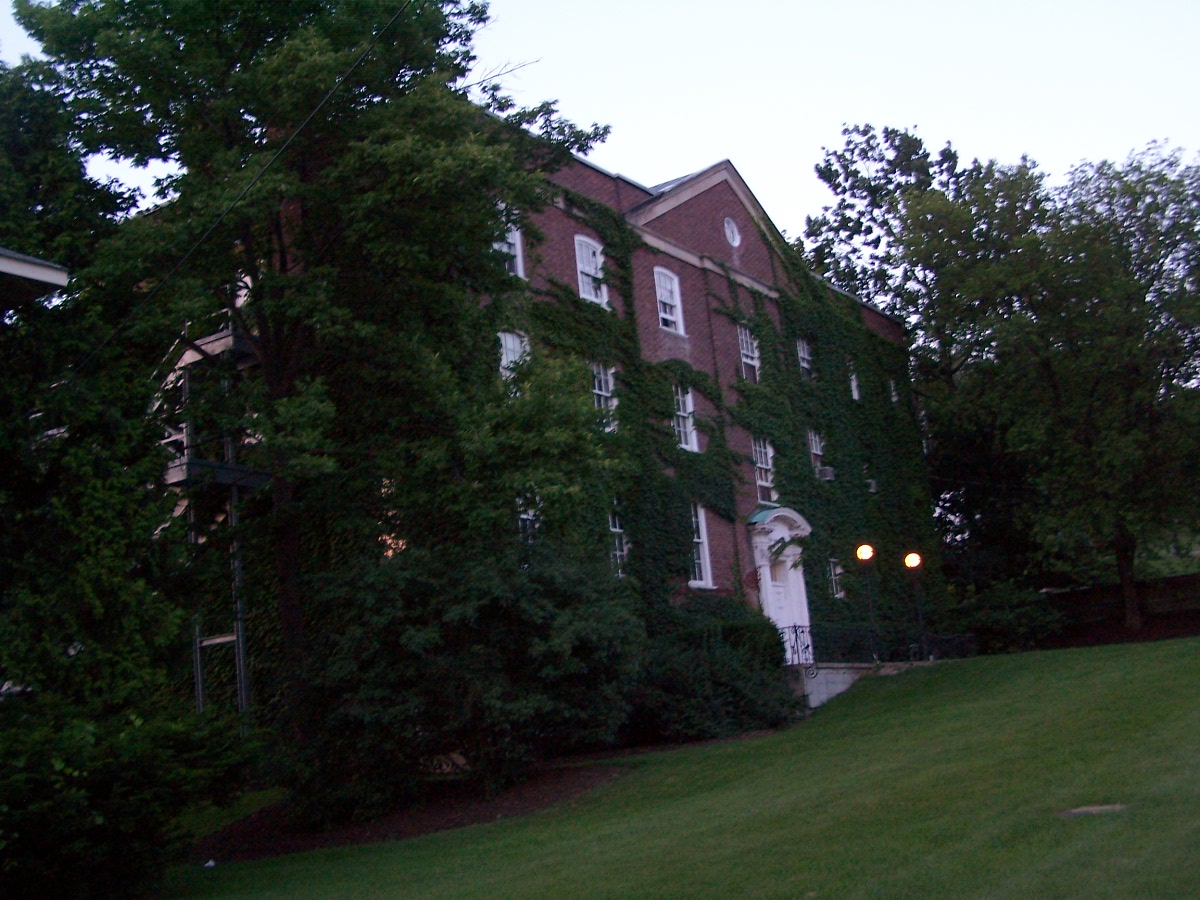
Kappa Alpha in 1970. At the time of this book’s publication, they were located at 14 South Avenue, which was designed by Vincent Cerasi and built in 1957 [1]. After they left in 1990, Alpha Omicron Pi sorority moved into the facility in 1991 and lived there for 15 years before moving to North Campus. Presently, the building is operated as a small dormitory by the university.

These are photos I have taken of the house. I took both photos to give an idea of the massing on the site. The building was designed to emulate the architectural style of a Swiss chalet.

~~~

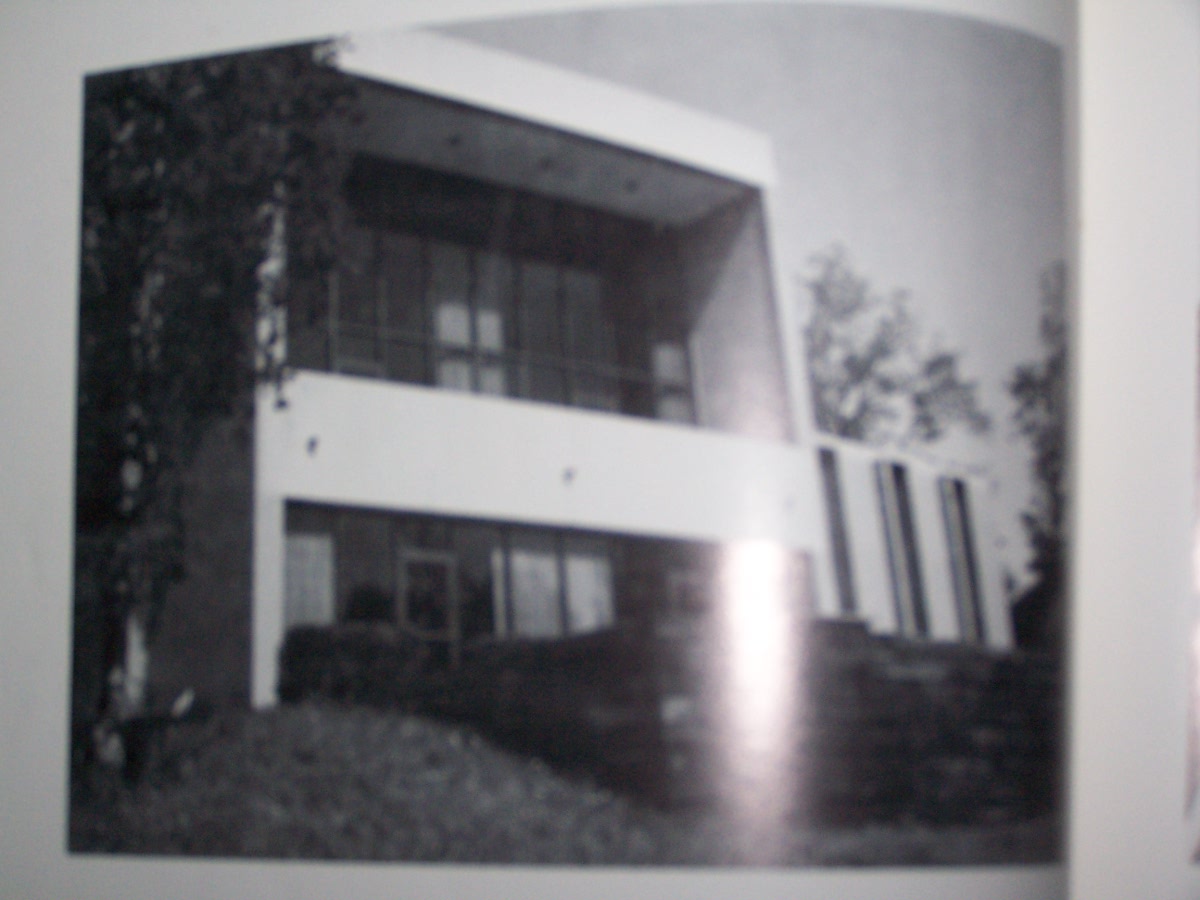
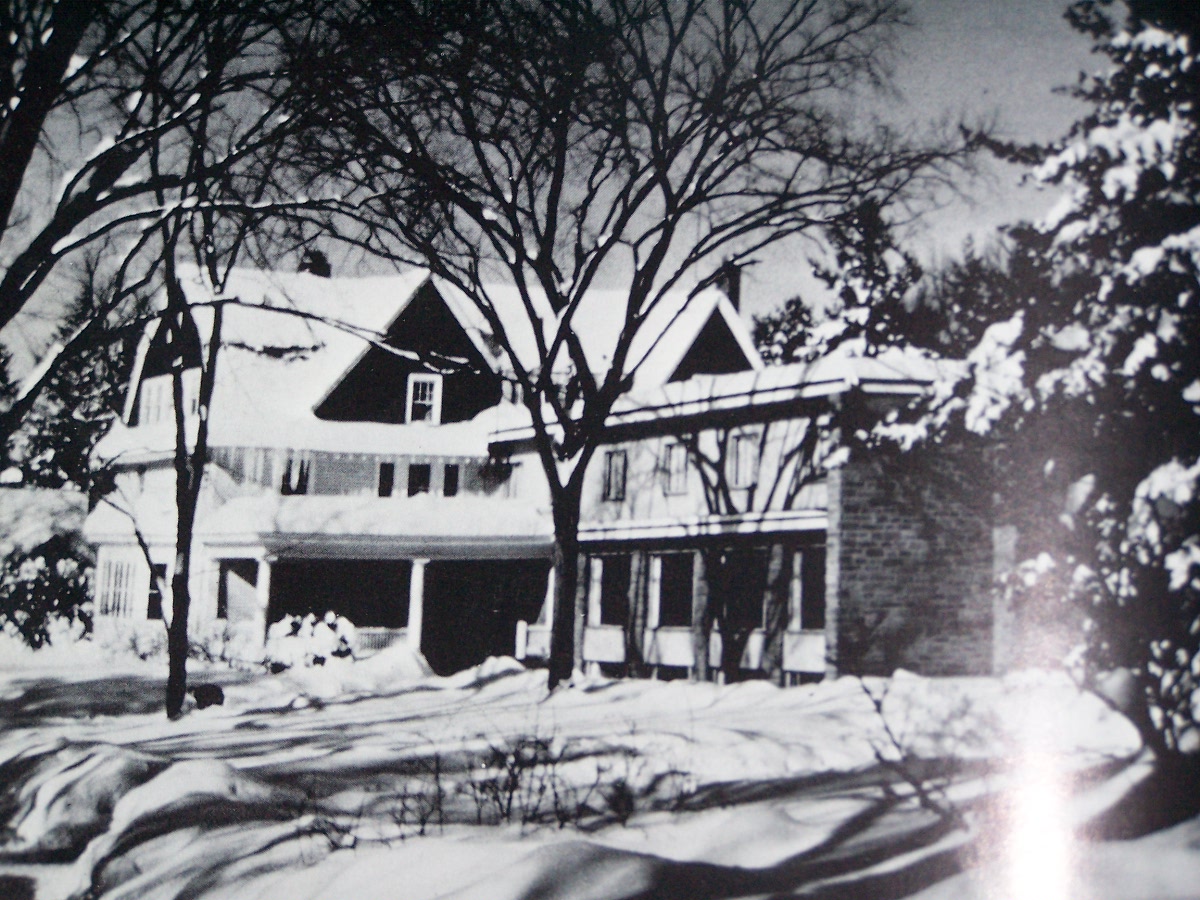
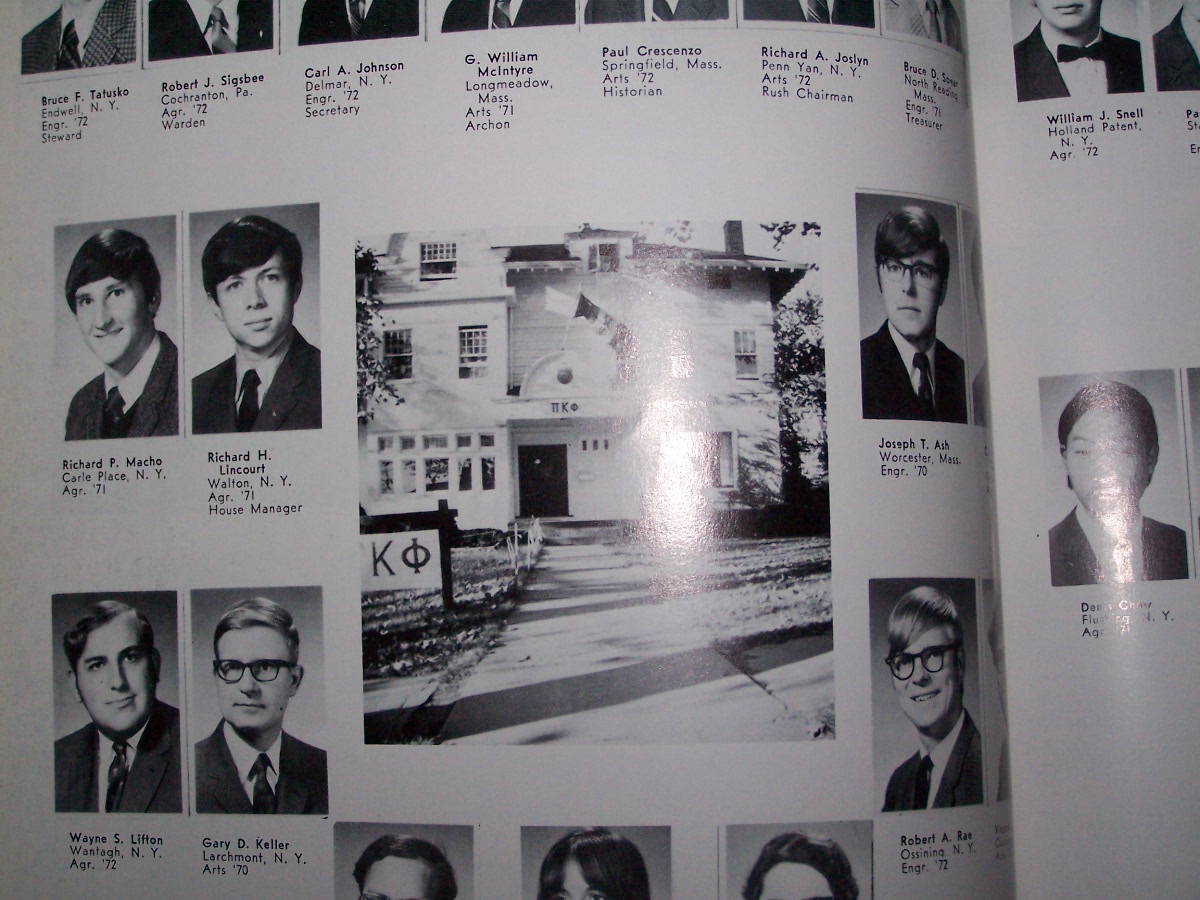
A photo of Phi Kappa Psi Fraternity house in 1970. Yes, some truly god-awful structures were designed in the 1960s (1964, in this case [2]). Thankfully, the house was renovated substantially in the past several years.

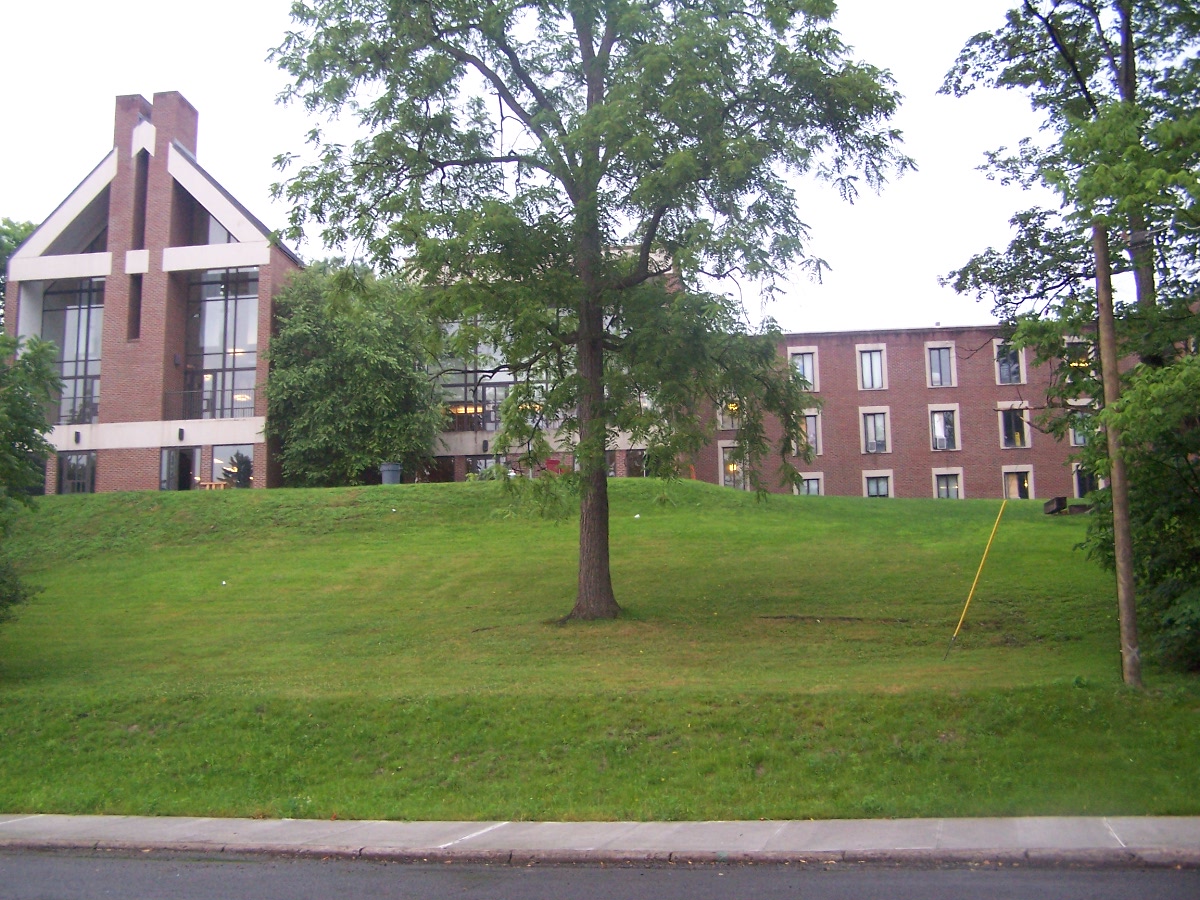
I dare say that looks a bit better. They affectionately call the building “The Gables”.

~~~

The house of Phi Kappa Sigma in 1970, which they called “Greentrees”. This has to do with the house sitting on seven heavily forested acres (a nifty youtube video by a former Skull is where I draw that from [3]). The house also apparently had a pool. Today, the house is the property of Pi Kappa Phi, who purchased the 12,000 sq. ft property for $300,000 in 1991 (apparently though, renovations set them back another half million dollars [4]).

~~~

The house of Theta Chi Fraternity in 1970. The chapter had been here since 1924 [5]. Sometime afterward (between 1972 and 1993, from what I can find), they moved to their Ridgewood Road location. Kappa Alpha Theta moved into this house sometime after 1980 when they came back to campus. (My personal guess is 1980, but I was the idiot who thought he could just pull out a Cornellian and double-check at Olin Libe this evening. Ironically, Olin doesn’t have them right now).

EDIT: Apparently, I was also dumb enough to think I would find it through the Cornellian. Theta Chi never had a picture taken for the 1970s or early 80s, and Theta’s are all interior photos. It looks like a trip to Kroch’s Rare Manuscripts might be in order. If they weren’t open the same hours I worked…

~~~

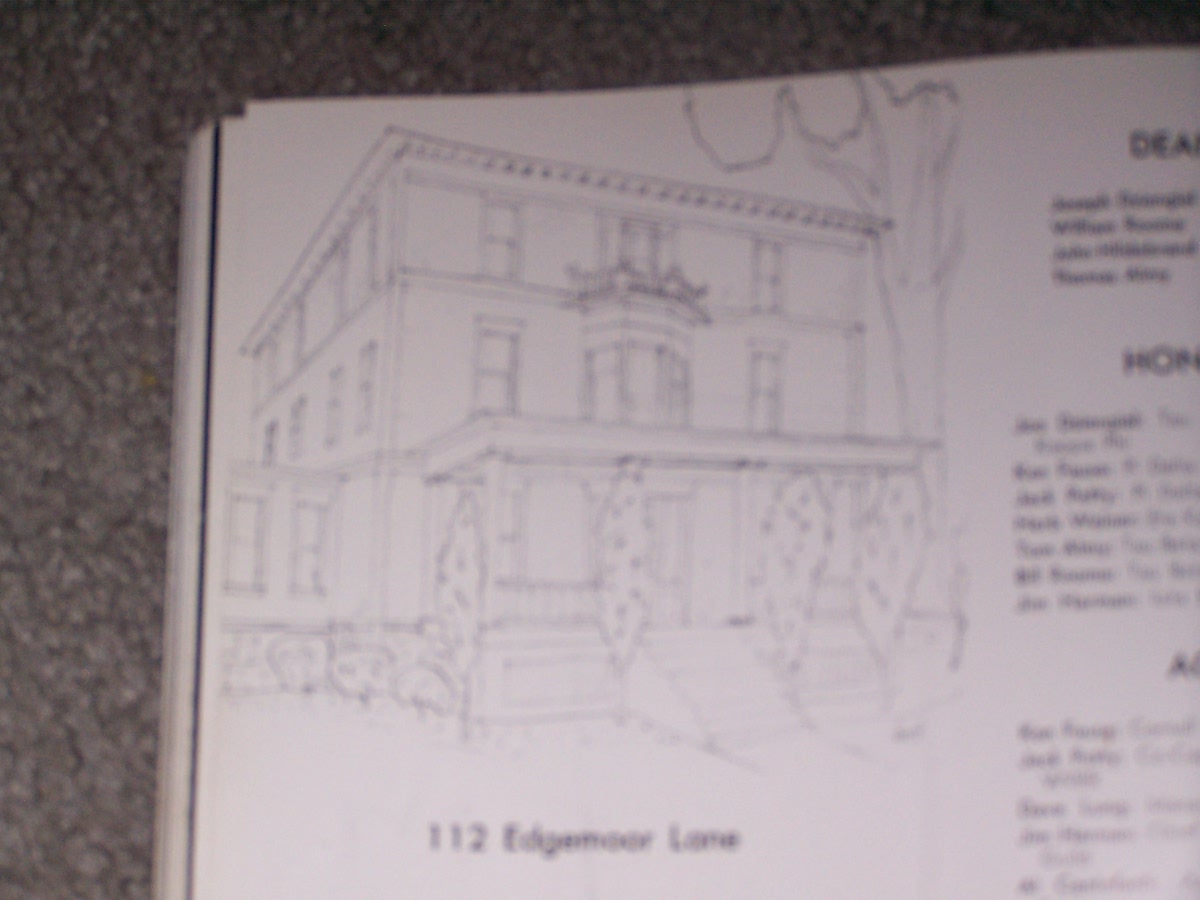
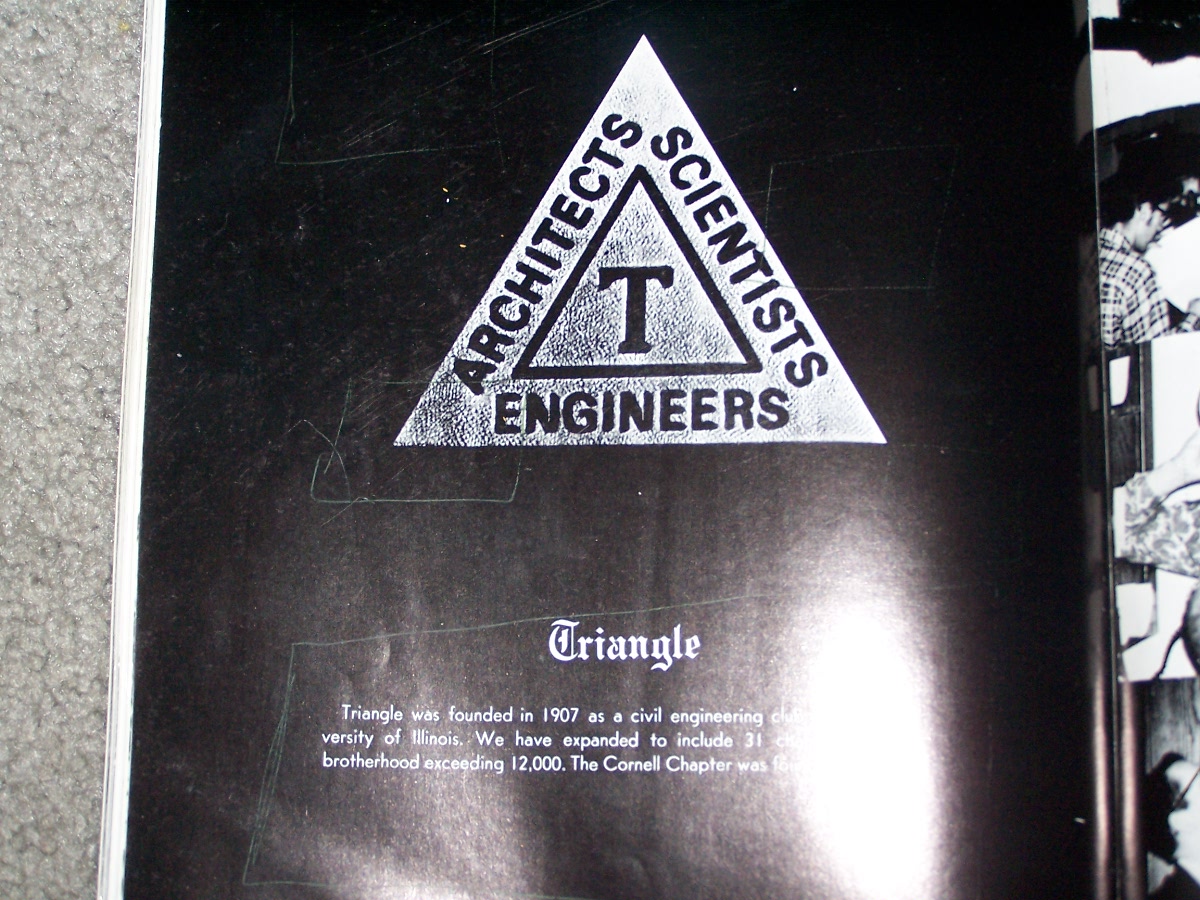
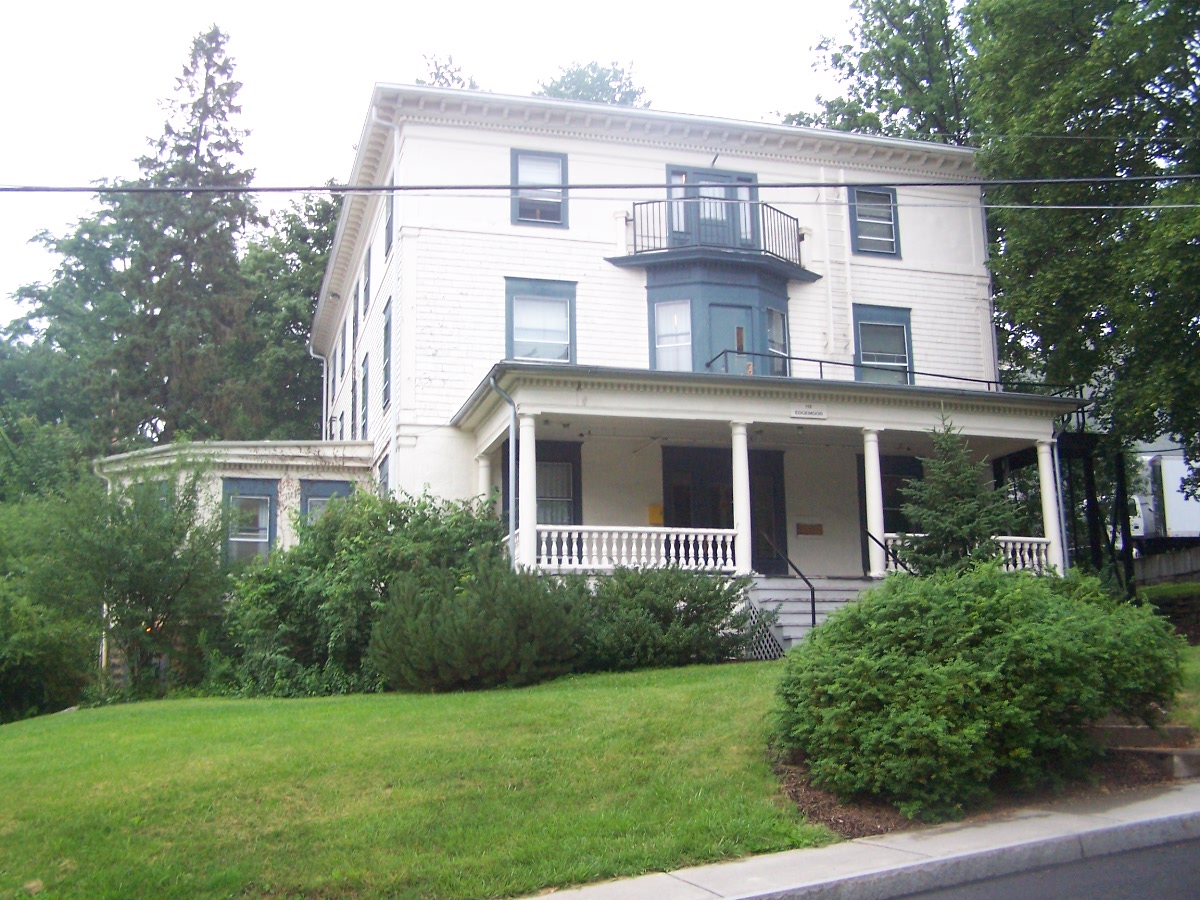
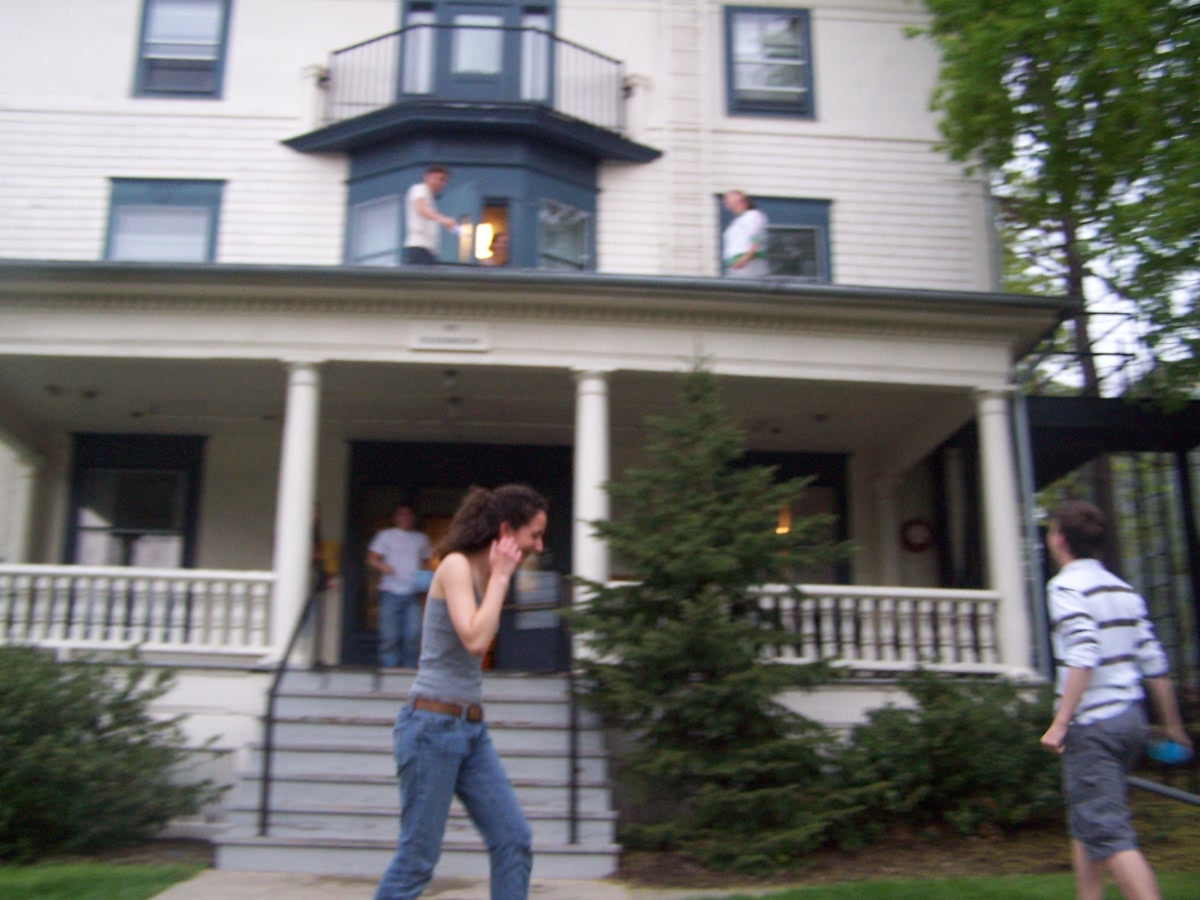
Triangle Fraternity was developed under an interesting premise. The fraternity was open to architects, “scientists”, and engineers. For example, an atmospheric science major could join, but a hotelie could not. Nor could biology students, for that matter. I’m sure it made for interesting arrangements in deciding if certain individuals were eligible. Regardless of the complexities of their membership, the fraternity resided at 112 Edgemoor until they folded in 1985 under order of their National, because their numbers were so low at Cornell (we’re talking single digits here). Today, 112 Edgemoor is a 21-person dorm owned by the university (and I spent a lot of time there; the ‘wife’ lived on the third floor, and I was in her room more than my own sophomore year. It helped that five people in my major called Edgemoor home during their sophomore year.

~~~

Lastly is Zeta Psi.  Zeta Psi was in the process of moving from 660 Stewart to Theta Xi’s old house in 71-72, so this was published just before the move [6].

Here is the same house today. It is currently used as co-op.

[1] http://www.fs.cornell.edu/fs/facinfo/fs_facilInfo.cfm?facil_cd=4724

[2]http://www.phikappapsi-cornell.org/public2.asp

[3]http://www.youtube.com/watch?v=jpC6vx7LTI4

[4]http://www.cornellpikapp.com/history.php

[5]http://www.thetachi.org/REPOSITORY/UNMANAGED_CONTENT/History/pdf/p147-p149%20Lambda_Cornell.pdf
[6]http://www.psiofzetapsi.org/History.html


Random North Campus Photos

20 07 2008

For the prefrosh—

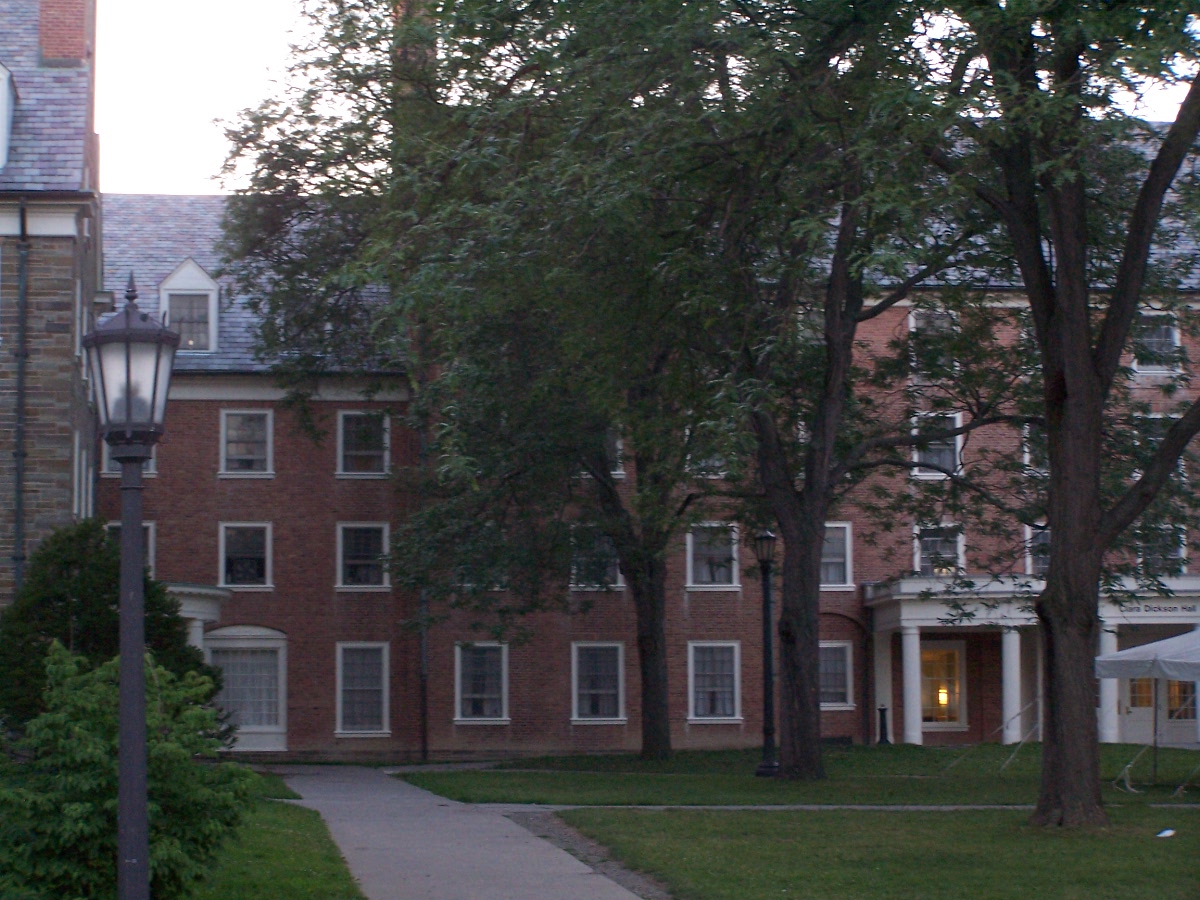
Clara Dickson Hall (left interior corner)

Bauer Hall

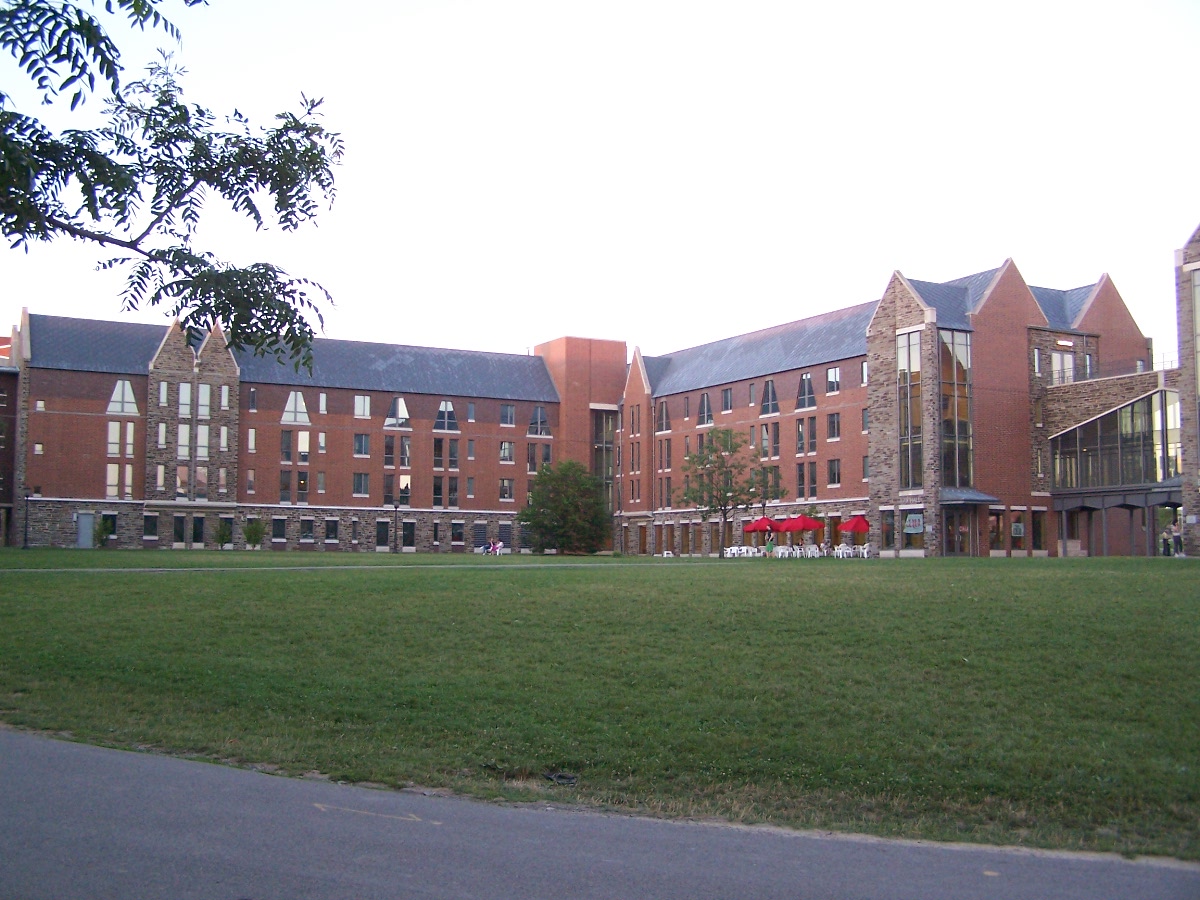
Court Hall (left) Kay Hall (right)

Mews Hall

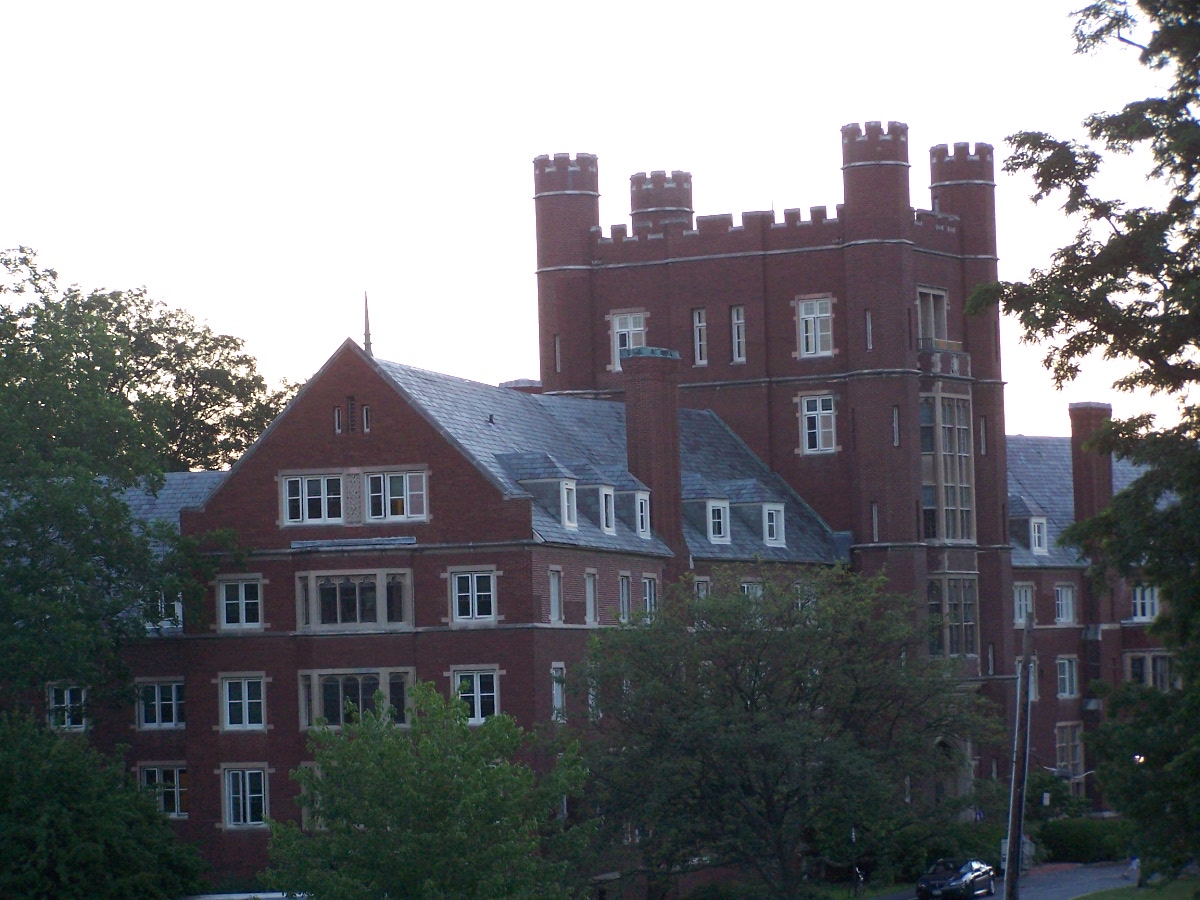
Balch Hall (NE corner)

Risley Hall (with a berry tree in the front, and new brick entry ways)

Akwewon (prononuced Ah-GWAY-go, I think). 

Jameson (High-Rise 5 looks exactly the same).

Hurlbert House (EcoHouse)

The Low-Rises; since they all look the same, one photo is all that is necessary.

Appel Commons (left) and Helen Newman Gym (right).

For more info on these buildings, please see the north campus blog entry.


Historical Fraternity Rush Booklet, Part 2 of 3

18 07 2008

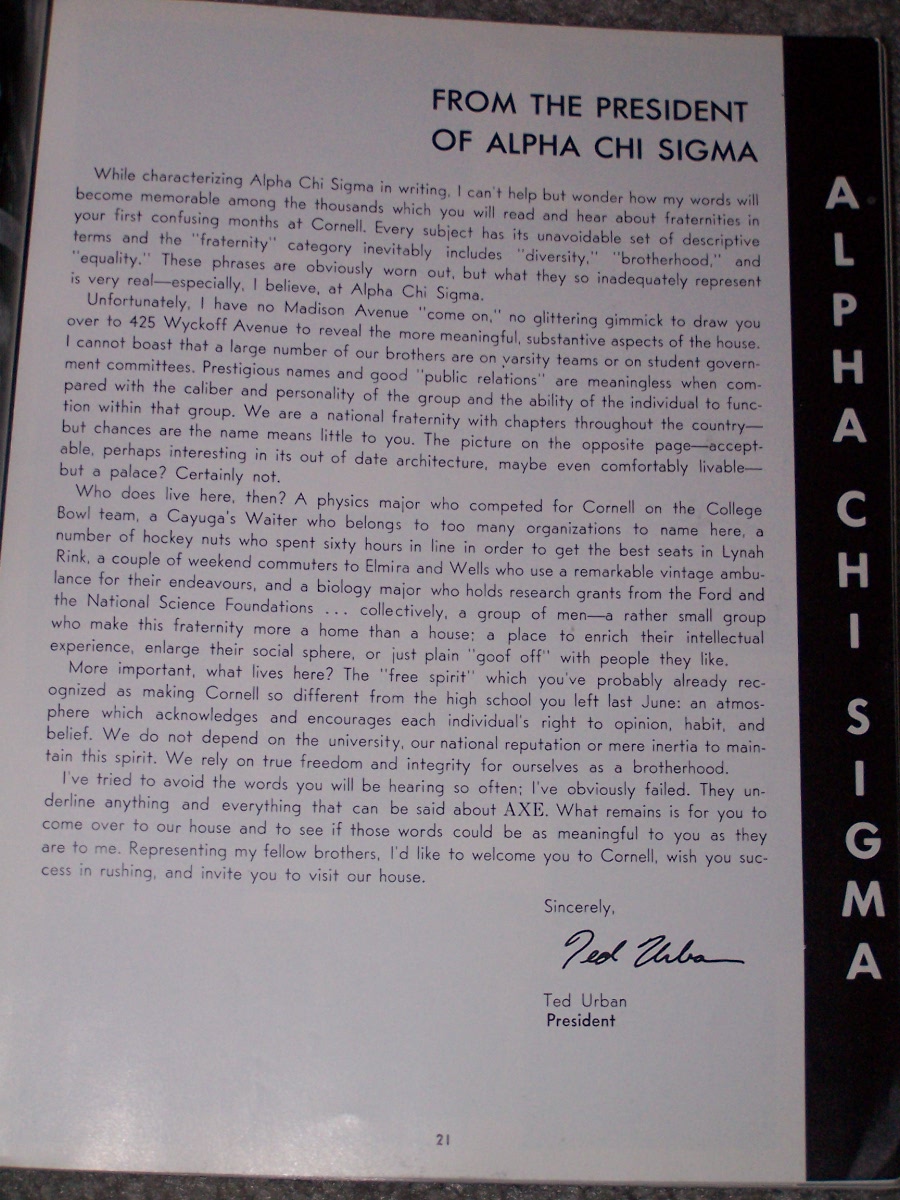
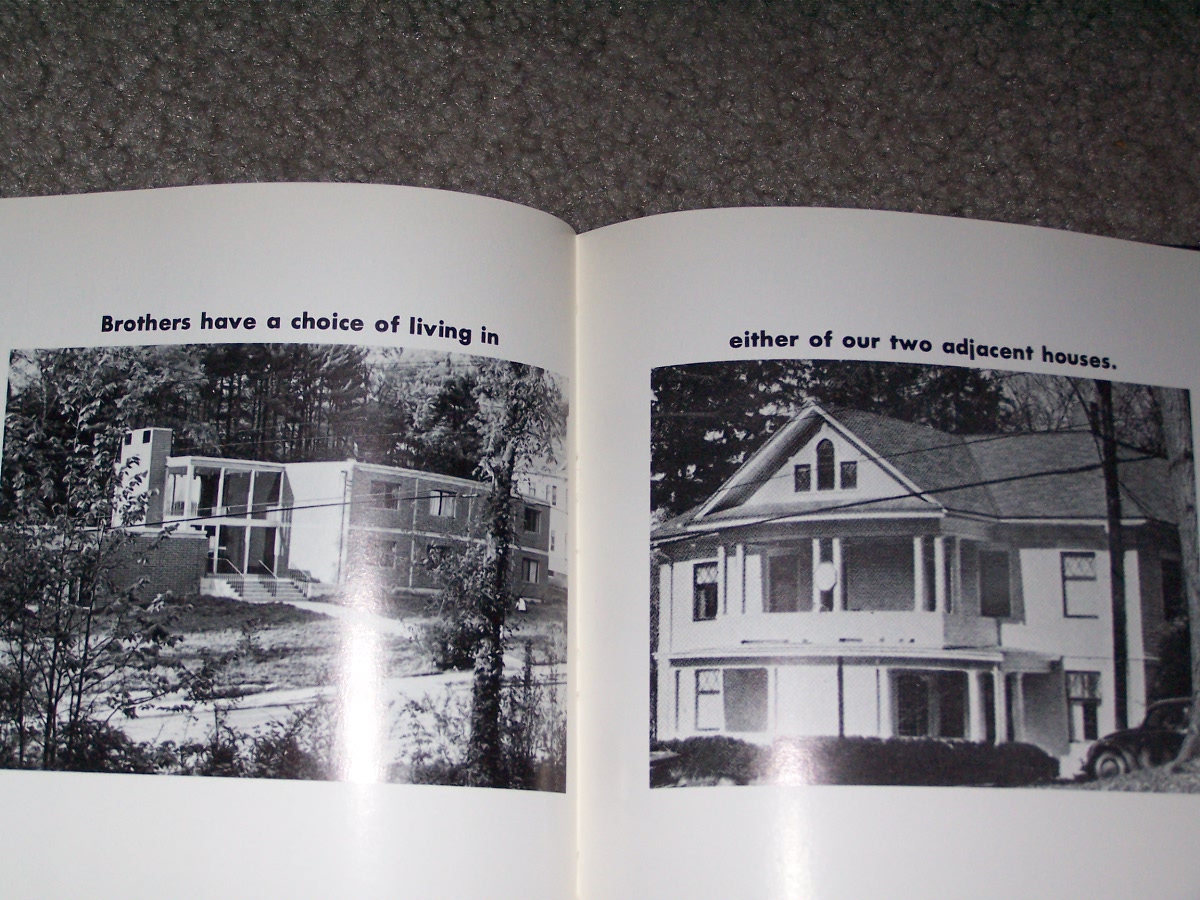
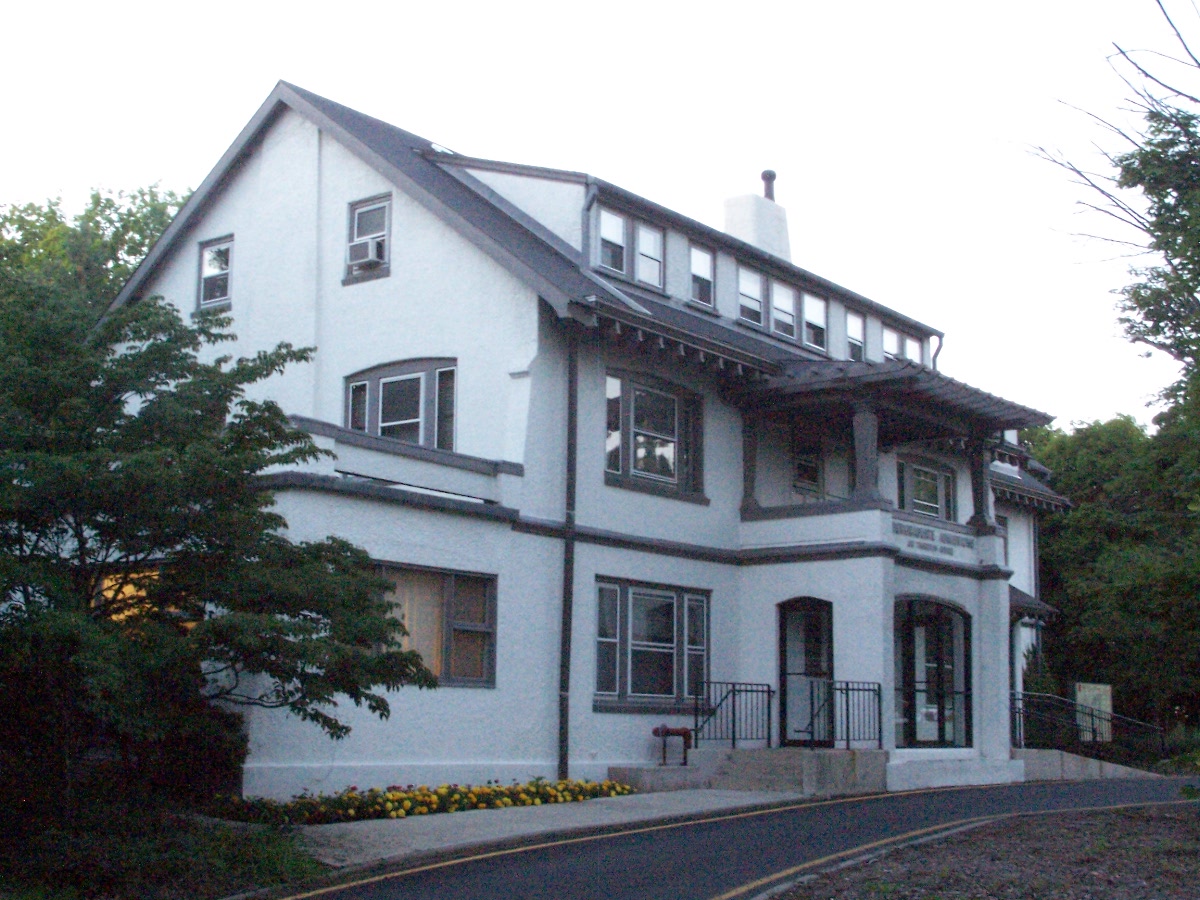
Going back to our fantastic fraternity guide from 1970, here’s the entry for Alpha Chi Sigma, the chemistry fraternity, located at 425 Wyckoff Avenue on North Campus (since 1955). According to the Tau chapter website, the house previously belonged to a sorority, and was built in the “silent-film era” [1]. The third floor rooms were added after the initial construction. The house became co-ed the year after this was published, in 1971.

The “demise” of Alpha Chi Sigma as an IFC Chapter is a bit unique. By the 1980s, the brotherhood consisted mostly of graduate students, and they lost interest in being a part in the IFC. From their website,

Tau lore suggests that the brothers nominated a dog to be their IFC representative at one point during this era.”

By the end of the 1980s, membership was virtually nothing, and the chapter withdrew from the IFC. By 1994, it was revived, but as a professional organization alone. Today, members still live in the house, but members of other frats can join, and it is not a member of the IFC.

***

The above photo is that of the Phi Sigma Epsilon house in 1970. The fraternity and all of its chapters merged with Phi Kappa Sigma in 1985, one of the largest mergers of fraternal organizations ever recorded. In the case of Cornell, where both existed, the result was that ΦΣΕ closed its house.

The house belongs to Alpha Chi Omega Sorority today.

***

Between 1967 and 1984, when AEPi was inactive, Sigma Alpha Mu utilized their property. Here we can see that both of these houses on the 200 block of Thurston Avenue are technically “Sammy” houses; as history would have it, AEPi would regenerate in 1984, and SAM would move to the Phillips House by 2004.

The current house is known in some documents as Phillips House, but I am unable to locate the source of the name. Possibly, it has something to do with the former landowners of where the house, at 10 Sisson Place, sits now. It was built in 1956 for Chi Omega sorority [2], and functioned as their house (save for a period when Chi Omega didn’t exist) until they folded in 2003. Sigma Alpha Mu bought the property shortly afterwards. The hipped roof is a later addition to the house (the original roof was flat).

***

The house of Phi Lambda Phi Fraternity, in 1970. As mentioned previously, this historically Jewish fraternity merged with Beta Sigma Rho within a couple years of this publication (by 1972-1973). Well, the house was eventually used by Cornell for its undergraduate admissions office (imho, the happiness inside died with each rejected application—the place is rumored to be haunted [3]).

[1]http://rso.cornell.edu/alphachisigma/history.htm

[2]http://www.fs.cornell.edu/fs/facinfo/fs_facilInfo.cfm?facil_cd=4766

[3]http://en.wikipedia.org/wiki/Cornelliana


Milstein Hall: Just Build the Damn Thing

16 07 2008

So, continuing with my ongoing fascination with proposed facilities for the university, it would be impossible to forget Milstein Hall. Wait…yes it would. The building has been through so many redesigns and so many hold-ups that if it takes any longer, I won’t be here to enjoy the finished product. And that makes me sad.

But anyways a brief review. Milstein Hall is the proposed addition to the neverending red tape architecture school, curently in its third rendition, a $40 million, 43,000 sq. ft box [1].

In Koolhaas’s own words, “It is a box that is contaminated by its neighbors and will contaminate its neighbors.” Um, I’m not exactly sure that’s the best way to put it. I’m no architecture student, but I get this vague uneasiness of another Uris Hall situation.

But this is the third rendition. And the other two weren’t exactly pretty either. The saga starts in 2000, when Paul Milstein, a prominent NYC developer, donated $10 million towards the construction of a new facility in February 2000 [6]. Milstein himself did not attend Cornell, but two of his kids did (a third sorta did, she transferred to Yale).

The first design was chosen in a four-way competition that concluded in April 2001. The winner was Steven Holl, for his proposal to build a seven-story cube on the location of Rand Hall, which would have been demolished. The project was set at $25 million, and to be completed in late 2004 [2] (fun tidbit: chair of the selection jury was James Polshek of Polshek Architects, the same firm responsbile for the design of Gates Hall).

Well, the demolition of Rand Hall didn’t sit too well with people, and a lot of people had some critiques for the design (more renderings at http://www.stevenholl.com/project-detail.php?type=educational&id=73). It was a box with cutouts on the west side. Once again, I’m not an architect, but it looks to me like taking a pair of scissors to a paper cube and calling it a design. This is cutting edge…?

So, the university dropped their deal with Holl in July 2002, and by November had selected Barkow Leibinger Architects as the firm to design the building. With a pegged completion date of fall 2006 [3]. Once again, the design was rather…interesting.

For a larger photo, go to www.barkowleibinger.com, and go under competitions, 2003. There you can see that this cutting-edge building also planned to tear down Rand Hall. And once again, there were issues with the design. I can’t say I’m personally too fond of it either, though I like it more than Holl’s design. It says this was to be 6000 sqm, or about 65,000 sq. ft.

Well, that didn’t pan out either, so by September 2006, Rem Koolhaas, the designer of the much celebrated (and 15x more expensive) CCTV tower in Beijing, was announced as the lead architect of the Milstein Hall Project. The square footage had shrunk by a third, and the price tag was up 75%, but there was hope that the damn thing might be built by 2010 [4]. Well, until the City of Ithaca and Cornell decided to have a fight over who controls University Avenue [5].

Long story short (unless you like hearing about SEQR determinations and environmental reviews), the fact that Milstein is designed to stand on both sides of University Avenue 15 feet above the ground kinda posed some issues. Namely, who owns University Avenue, since the current design doesn’t fly with city guidelines. After much arguing, the city decided to sell Cornell the portion of University from Chi Psi up to the intersection with Thurston for the price of $2 million, provided that much needed repairs were completed. Also, Milstein would be cantilevered over the street, to avoid building on both sides. Hopefully, now all the obstacles have been cleared.

So here we are, eight years later and nothing done but a lot of hot air being blown around nevertheless. While I would hope that something is done eventually, I can’t say I’m holding out much hope (especially for a design that I like, but I guess I just don’t understand architecture).

[1]http://cornellsun.com/node/18396

[2]http://www.news.cornell.edu/Chronicle/01/4.26.01/Holl_Architects.html

[3]http://www.news.cornell.edu/releases/Nov02/Milstein.Hall.arch.html

[4]http://www.news.cornell.edu/stories/Sept06/Milstein_design.dea.html

[5] http://cornellsun.com/node/27051

[6]http://www.news.cornell.edu/chronicle/00/2.3.00/Milstein_gift.html


Historical Fraternity Rush Booklet (Part 1 of 3)

15 07 2008

So, as a special treat, I managed to get a hold of the 1970-1971 fraternity rush booklet. I figured it would be interesting to see some of the changes between the present Greek system and the system nearly forty years ago. I’m dividing it up into portion because there are some features I want to cover before I show them from a historical perspectives (i.e. certain photos have to be taken before I post the old photos). Sorry for the glare on the pages!

So, without further ado…

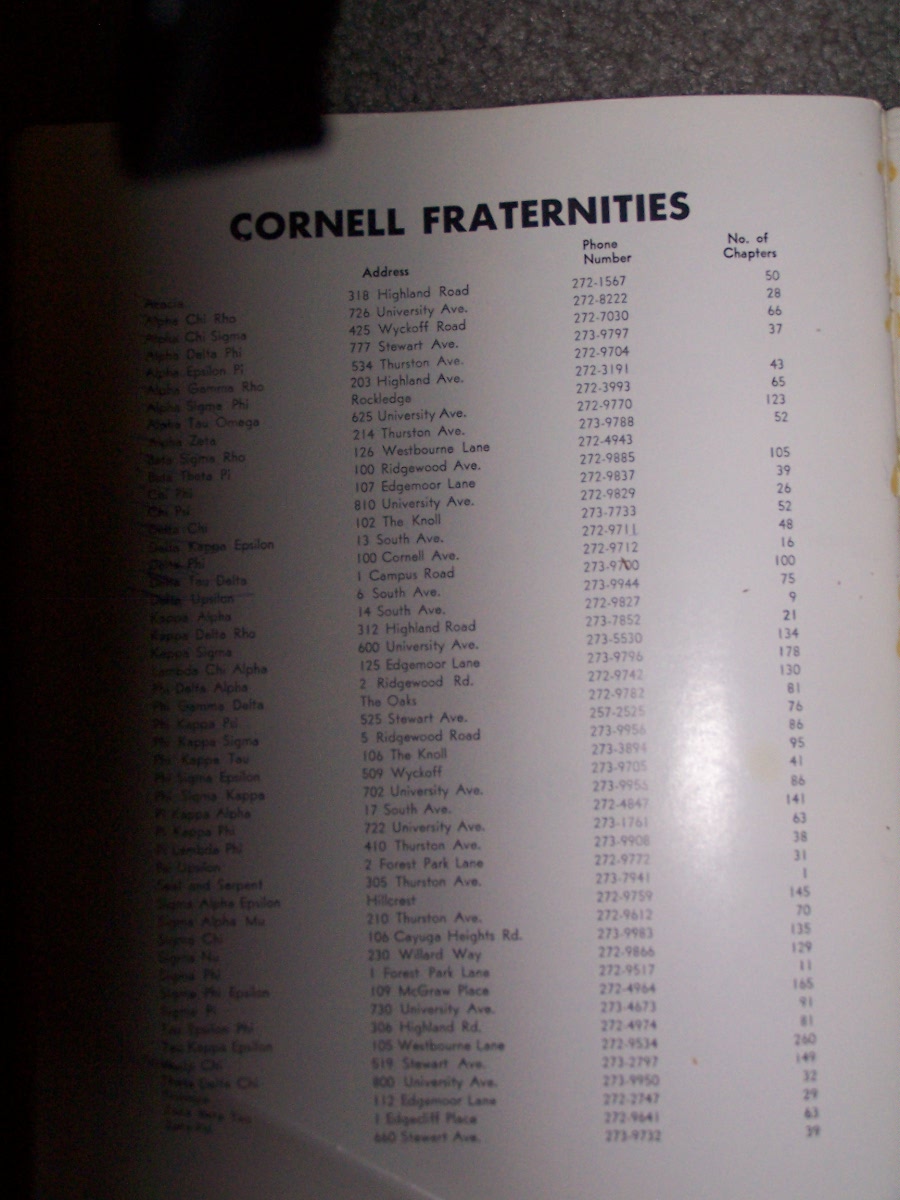
This was the list of fraternities on Cornell campus at the time of publication. There are 48 total, and the MGLC didn’t exist at this time either. This was published after Theta Xi announced it would close in 1971, but before Beta Sigma Rho and Pi Lambda Phi joined together in 1972-73. Kappa Alpha closed in 1990 (see the other entry concerning its recolonizing), and Triangle’s national council suspended Cornell chapter in 1985, never to return [1]. Phi Kappa Sigma closed in 1991, Theta Chi left in 1999, although they attempted to recolonize in 2003 [2] (my guess is that it didn’t work out), and Phi Sigma Epsilon merged with Phi Sigma Kappa in 1985 [3]. I’ve already gone over Alpha Chi Rho in a previous entry, so I think that covers the losses.

The Alpha Chi Rho entry for fall 1970. Please note that clicking the image enlarges it. It mentions how they’re experimenting with going without a house. I’d like to remind folks here that Alpha Chi Rho would close within a few years of this publication.

The old Alpha Zeta house. This was also back when the fraternity was still men only (It went co-ed in 1981).

The Beta Sigma Rho house in 1970. This was the side of the apartments that I didn’t take with my camera; I’m pretty sure that staircase is no longer there and its heavily wooded, which made that angle difficult to take pictures from.

That worn down house, 722 University Avenue? In 1970, it was Pi Kappa Phi’s House (like I mentioned previously, Alpha Chi Rho was next door at 736 for a time, and we can see they had no house at this point in time).

This is the house next door, 736 University Avenue. It was built in the 1920s.


[1]http://www.triangle.org/about/history/chronology/

[2] http://www.highbeam.com/doc/1P1-71478145.html

[3]http://en.wikipedia.org/wiki/Phi_Sigma_Epsilon


When History Repeats Itself (Somewhat)

13 07 2008

So, I was glancing through the Cornell Sun website, and came across this article:

http://cornellsun.com/section/news/content/2008/07/06/alumni-board-deactivates-current-members-psi-upsilon-fraternity

July 6, 2008 – 10:37pm
By Sam Cross

In an attempt to protect the prosperity of the fraternity and the safety of its members, the alumni board of Psi Upsilon decided to shut down the fraternity until the board deems it fit. Though the members of the campus fraternity have been deactivated, the chapter maintains its official recognition in the eyes of the University.

“While Cornell University still recognizes Psi Upsilon as an active fraternity on campus, the alumni have de-activated all of its members,” said Travis Apgar, associate dean of students for fraternity and sorority affairs, in light of the recent events.

Mike Bergelson ’95, alumni president of the chapter, explained the alumni’s decision to temporarily suspend the fraternity.

“The principles of the fraternity are to foster intellectual and social environment,” Bergelson said. “While we don’t want to be too prescriptive, the alumni saw that a far too great emphasis was being placed on the social aspects and not the fraternity values of brotherhood, responsibility and democracy.”

Brothers of the fraternity did not respond to The Sun’s inquiries.

Bergelson said he did not see the decisive move as a surprise and said the alumni have been trying to resolve problems with its current members for over a year.

“Last year at our annual meeting, the alumni told the current brothers that the house had some problems,” Bergelson said. “The physical house was not being properly kept, many brothers were not involved, along with other things. We spent a lot of time with the undergraduates to help them keep the fraternity in good order. Toward the end of the year, the leadership of the fraternity came to us and it was clear that a significant change could not be established in the current environment.”

Bergelson recalled an alumni meeting two weeks ago, during which the group discussed the chapter’s members and their leadership abilities. According to Bergelson, the group decided they would begin by rebuilding the chapter around a few key members.

“The alumni saw the fraternity not moving in the right direction and had to do something to resolve the situation,” Bergleson said. “It could eventually have put brothers in harm’s way. Psi Upsilon can still be fun and social but the brothers must do it in a safe way.”

The alumni did see the fraternity heading down a slippery slope. Bergleson emphasized that this was a “pre-emptive or pro-active” decision and the undergraduates had not committed a terrible transgression. Instead, the alumni saw the potential for trouble and sought to eliminate this possibility before anything occurred.

The fraternity’s alumni saw that the process of instilling brotherhood in its members had to be fundamentally changed to ensure that Psi Upsilon was a safe environment.

“We want guys to bond but we could meet our objectives in a better way,” Bergelson explained. “Brothers can participate in other activities like wilderness trips or community service to bond … Some of the rituals of the fraternity need to evolve.”

The University, which is not playing a prominent role in the matter, supported the alumni in their decision, asserting that the alumni’s chief concern was the well being of their undergraduate members.

“Psi Upsilon has had some judicial problem in the past few years,” Apgar said. “The University is in a role of support and advocacy for the alumni’s decision.”

When looking towards the future of the fraternity, Bergelson explained that the alumni are planning on carrying out the fraternity’s reorganization.

“Through individual interviews with each brother, we will determine brothers who should be activated again and others who should not,” Bergelson said. “Many of the brothers, even those creating problems initially, have stepped forward jumped on board with the alumni’s goals of rebuilding. Others, however, who still counter the alumni’s philosophy, will have to remain de-activated.”

Since the fraternity has not been kicked off campus by the University, the fraternity could be up and running by the start of this year. The decision of when to resurrect the chapter, however, remains at the discretion of the alumni.

“The rebuilding process could take us the summer and Psi Upsilon could be an active fraternity by the beginning of the school year,” Bergelson said. “It could be ready by the first semester, the second semester, or maybe in a year. What is more important is that the fraternity is heading in the right direction, upholding the rules of the state and the University as well as the ideals of fraternity men.”

***

But, this is not the first time in recent history that the fraternity Psi Upsilon has been in trouble. Here’s a Dear Uncle Ezra letter from October 11, 1988 (okay, maybe not so recent history- that was the month I was born).

http://ezra.cornell.edu/posting.php?timestamp=592545600

DEAR EZRA,
WHY WAS THE FRATERNITY PSI UPSILON THROWN OFF CAMPUS ABOUT SEVEN YEARS AGO?

                                                    SIGNED, CURIOUS

Dear Curious,
According to Randy Stevens, Coordinator of Greek Life, Psi Upsilon was not actually thrown off campus by the University, but rather the Psi Upsilon National Organization removed their charter.  Psi Upsilon had various problems which led to this.  Their membership was dwindling, they were very destructive to their house (which the University owns), they had problems with alcohol abuse, and miscellaneous other “behavior problems”.  But, as you may know, Psi Upsilon is now back on campus.  After about 4 years they petitioned for their charter, and, according to Randy, have been doing very well since that time. It’s nice to know people can learn and recover from mistakes.

***

http://cdsun-test.library.cornell.edu/cgi-bin/newscornell?a=d&d=CDS19810210.2.1.3&e=——–20–1—–all

Indeed, as the Sun Archives state, Psi Upsilon was removed in June 1979 for two years due to a number of infractions. The house, which was primarily football players at the time, was removed for “noisiness, general rowdiness, and a deteiorated financial status”.

The primary difference between the two cases is that one was initiated by the national organization, and the other by the local chapter’s alumni. But compare these quotes:

The principles of the fraternity are to foster intellectual and social environment,” Bergelson said. “While we don’t want to be too prescriptive, the alumni saw that a far too great emphasis was being placed on the social aspects and not the fraternity values of brotherhood, responsibility and democracy.”  The physical house was not being properly kept…

“Psi Upsilon has had some judicial problem in the past few years,” Apgar said. “The University is in a role of support and advocacy for the alumni’s decision.” (2008 article)

Their membership was dwindling, they were very destructive to their house (which the University owns), they had problems with alcohol abuse, and miscellaneous other “behavior problems ( 1988 DUE)


This is why you know your history. So you don’t make the same mistake and let history repeat itself.


P.S. So, I know one of the IFC Exec Board members is a Psi Upsilon brother. How does this affect his status with the board? Anyone have an answer to that?

http://ifc.cornell.edu/eboard.htm

VP for Judicial:
Matthew Dubbioso ’09 ___@cornell.edu Psi Upsilon