Can a Polluted Past Have A Future?

21 02 2013
Image Property of Welch Construction Inc.

Image Property of Welch Construction Inc.

Real estate in Ithaca is fairly warm as markets go (I refuse to call it hot). But there are still some gaping issues in the metro market.  One of the biggest examples is one that can be seen from just about any southward vantage point above the lake lowlands – Emerson Power Transmission.

The property started as Morse Chain, which dates back to 1880 and began the manufacture of automobile chains in 1906.  Morse Chain was acquired by locally prominent BorgWarner in 1929, and the facility continued industrial production until BorgWarner built a new facility near the airport in 1983, selling the factory to Emerson Power Transmission. Throughout the 1960s and 1970s, several chemicals were used for “cutting oils”, removing oils from the manufactured automotive gears, shafts and chains at the tail end of the process. One of those was trichloroethylene, or TCE. TCE is a known carcinogen, and I’ll come back to this in a moment.

Unfortunately, the era of traditional manufacturing was fading in the Ithaca area. Emerson Power Transmission moved about 55 of its corporate senior staff to a suburban Cincinnati facility in 2007 (and I remember reading about it while a student at Cornell). The death knell came in August 2009, when Emerson announced it was closing up shop in Ithaca, putting 228 people out of work (the factory had over 500 people on site as recently as the mid-2000s, and had received tax incentives not long before closure). The closure was recent enough that this blog was already going, and the original entry is here.

At first glance, the property would appear to be potentially salable. It’s a large property in a well-populated and growing area with a substantial uptick in the real estate market. However, there’s one very, very big issue – the TCE contamination.

Although TCE use stopped by the late 1970s, the damage was done, and unknown quanities of it leaked into the groundwater and sewers. The site was declared contaminated by the state in 1988.

Since then, it’s been a series of long and contentious debates about who to hold responsible for what degree of clean-up. The city, the state DEC, and BorgWarner and Emerson had volleyed back and forth on who pays for what. 35 years after the chemical usage is stopped, yet nearby sewers have had to be replaced, soil tested constantly and excavated if contaminated, and groundwater / vapor testing in nearby properties. Essentially, a major environmental headache.

Although the brunt of the burden has fallen on government and Emerson to clean up (BorgWarner gets blame but seems to carry little if any of the cleanup cost), the site has been marketed for sale – $3.9 million for 94 acres plus structures (note that just the groundwater is contaminated, not the structures themselves – this isn’t Ithaca Gun). It was no surprise that with the remediation and continual testing, the site has been a tough sell.

All the more interesting, then, that the local chamber of commerce announced at a recent luncheon that someone is agreeing to purchase the property. Emerson’s in the final steps of reviewing the offer.  The property could be host to a variety of activities – the IJ article mentions a possible small business incubator like the one at the South Hill Business Campus (itself a former factory). Given the location, any number of industrial or commercial applications are possible, maybe even partial/total tear-down and redevelopment. The biggest obstacle apart from the lingering environmental concerns might be the fact that the property is split along the city and town of Ithaca, so both would have to accept any proposed redevelopment.  But still, any progress on the looming, decaying facility would be one of the surest signs of a “reinvention” of the area.



Holochuck Homes Does A Belly Flop

14 02 2013

holo2

Well, as I said not too long ago, not all projects can be expected to succeed. Here’s this little gem from Edelman RE:

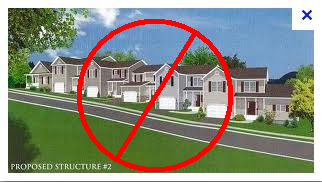
“Location, Location, Location! 106 LOTS APPROVED SUBDIVISION!Project is situated in heart of the Fingerlakes, minutes to the city of Ithaca and home to CORNELL UNIVERSITY and ITHACA COLLEGE. Dynamic LAKE views, abutting forever wild Black Diamond Trail compliments this rare opportunity. Adjacent to hospital and other professional services. Buyer has option to use designated plans or to use their own. This is your great investment!”

I thought about this for a moment. What project do I know that was approved for 106 units and abuts the Black Diamond Trail, and is close to the medical center? It’s not like there were many choices.

The project was finally approved last April after jumping through a larger number of bureaucratic loops, mostly because it’s in one of the most rapidly developing parts of the county. Among the requirements for approval including an unrestricted bus pass for each unit, and that 10% of the clustered one-and-two story townhome units be made affordable. So now, no units, no extra traffic…and no affordable housing, no extra tax income, and rising real estate prices and property taxes for an area that does not have enough supply for demand. At the very least, a waste of time for a lot of stakeholders in the project.

For the record, the land, project, and all its approvals, could be yours for a cool $7.75 million.


From Suburbia, A Town Center

6 08 2012
Image Property of HOLT Architects

Image Property of HOLT Architects

Just about any reasonably-sized city in America has its suburban hinterlands – in Ithaca’s case, this is dominated by the town of Ithaca, and to a lesser extent, the towns/villages of Dryden and Lansing. Now, it would be wrong of me to address these communities like they were dominated by cul-de-sacs and power centers, since the village of Dryden, and some small hamlets, were around well before suburbanization – but they do make up a sizable proportion of developed real estate. So when those communities take steps to establish dense, walkable clusters of development, I tend to be impressed (because being satellite communities, I hold them to a lower standard).

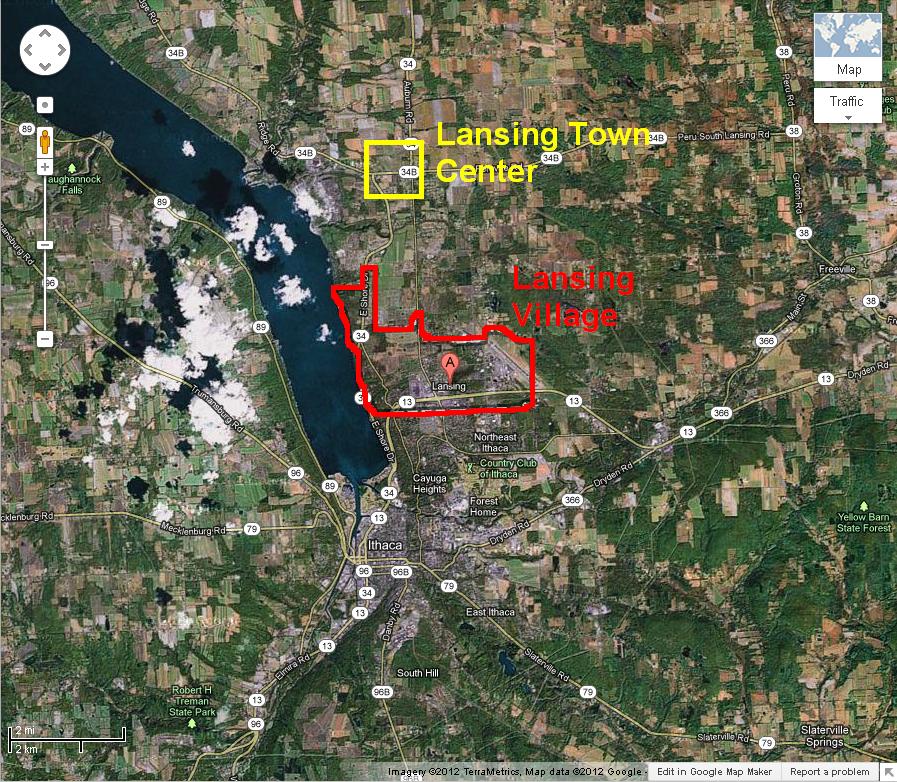
In the town of Lansing’s case, its plans are pretty big – the town recently bought 156 acres of land to lift deed restrictions the state had placed on its development. The goal is to develop this land into a sort of “Town Center” – and not at all like the similarly named shopping mall near Syracuse.

Lansing is unusual in that it never has really had a dense core, unlike Dryden (the town of Ithaca can’t be reasonably compared since it surrounds the city). The village was founded in 1974, and only includes the area from the airport west through the mall area and down to the lakeshore.

For the town center project (covered in great detail by the Lansing Star), the overarching design was created by Ithaca-based HOLT Architects, with landscaping by (also Ithaca-based) Trowbridge & Wolf. It consists of consolidated parking lots, pedestrian walks, bike paths, street beautification, and interactive landscaping (stone seating areas, etc). The area is subdivided into a large housing component, a small retail/professional area, and a business/tech complex (it would seem to me a little more interspersion of uses would be better, but I’m not a stakeholder here). So, rather than being a standard suburban build-out, an effort is being made to develop a pedestrian-friendly core.

Apparently, developers are quite interested in accessing the property. Two of the largest potential stakeholders are NRP Group and Calamar. The companies are willing to cover a large portion of the project’s road construction costs. NRP even took the step of flying Lansing officials to projects near Cleveland and Buffalo to showcase their work. Both companies are proposing senior housing complexes, one “affordable” (NRP) and one market-rate (Calamar). At least two other developments are currently proposed. The full build-out of the town center is expected to have 350,000 industrial/commercial sq feet, and 420 residential units.

There are a couple major hurdles to construction at this time – the more minor one being zoning, the more major issue being the construction of a sewer through southern Lansing. High-density housing doesn’t go well with septic tanks (nor is it permitted by the town code anyway), so the construction of a sewer to serve that area is required, and the proposal for construction is currently being refined before it is put out to vote.

The project has the potential to be a game changer – the town is on the verge of a large increase in development, with another 400+ units planned in the next several years in clustered developments outside of the town center project. As most of these will be suburban in nature, or at least vehicle-oriented, one might pessimistically look at the town center as a drop in the bucket for smart planning. But it’s certainly a step in the right direction on the way to establishing a genuine community center.