The Goldwin Smith Hall Addition

20 11 2008

Perhaps I’ll still have some construction tidbits to write about after all. So, up for review for the Ithaca Planning Board this month is a sketch review of the Goldwin Smith Addition. The “Goldwin Smith Annex” is a $45.1 million, 60,000 sq. ft addition in the back of the building [1], facing East Avenue, a la the Lincoln Hall addition in 1998. The GA Annex is set for a targeted completion date of Summer 2011, but given the current economic situation, we’ll see if that changes down the line. To quote the capital budget plan (first link):

“This project will design and build a new building adjacent to Goldwin Smith Hall to provide approximately
30,000 to 35,000 net square feet of new humanities and social science classroom and academic department space on the Arts Quad. The new space will address partially a chronic shortage of academic space that has characterized this area of campus and which has been exacerbated by recent and projected growth in faculty and programs in response to university initiatives. The current shortage of space has resulted in: (a) some faculty sharing offices or rotating among offices based on the pattern of temporary faculty leaves; (b) a lack of adequately sized classrooms and lecture halls; and (c) inadequate space for lecturers, graduate students, and staff.”

Where’d they get the 60,000 sq. ft figure from? My personal guess is renovated space in Goldwin Smith.  I’m not a fan of inconsistencies. However, the old budget plan indicates that an architects should have been selected in fall 2007.

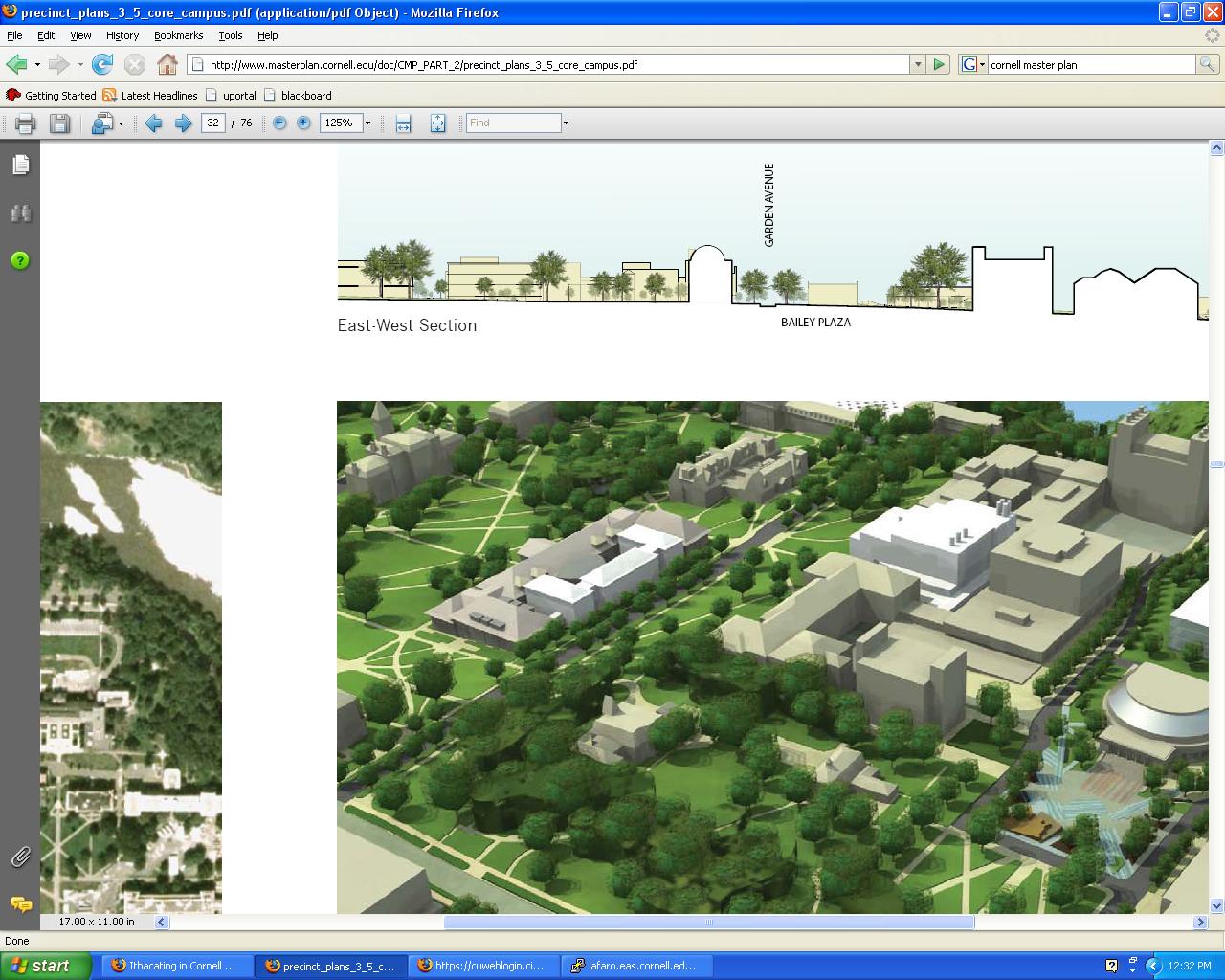
So, unfortunately, the sketch plan brings no mention of the architectural firm, which makes the task of getting a rough idea of the design a veritable hell. However, thanks to the master plan, we actually have an idea of the massing:

untitled

So, the rough massing concept seems to be three connected but otherwise independent structures, all of similar massing (and therefore roughly the same square footage). If we use the 60,000 sq. ft figure, except three two-and-a-half story buildings with footprints of about 7500 sq. ft each, which fits the area rather snugly. If it’s the 30-35,000 figure, we can except the footprint to be smaller, but the height massing will likely be about the same to maintain massing consistency with the main building.

In the meanwhile, I have requests filed in with the contact person for this project asking for any possible rendering or at least the architectural firm responsible, so I’ll come back to edit this post, hopefully in the not too distant future.

[1]http://dpb.cornell.edu/documents/1000383.pdf —page 54

[2]http://www.ci.ithaca.ny.us/vertical/Sites/%7B5DCEB23D-5BF8-4AFF-806D-68E7C14DEB0D%7D/uploads/%7BF4A05E59-733D-480A-A8C0-37224316CFF6%7D.PDF

“D. Sketch Plan, New Humanities Building, Cornell University (materials to be distributed at
meeting)”


9/7/08 News Tidbits: Alpha Omicron Pi to shut Cornell Chapter

6 09 2008

AoPi sisters confirmed Friday that their chapter will be closed as of the first of October, due to declining numbers within sorority rush. All current members will be moved to alumni status and allowed to live in the house until graduation. Once all current sisters have graduated, the intention is to reopen the house under a new set of women (this has been done with fraternities in the past. Pi Kappa Phi closed in 1986 and reopened in 1990, and Phi Kappa Tau closed in 1994 and reopened in 2000).

So, the news, while unfortunate, isn’t surprising to anyone familiar with the Cornell sororities. AOPi was typically derided and demeaned, and as a result of the nasty jokes associated with the house, women tended to avoid having it as a choice on their bids. Also consider that sorority rush turnout was lower than usual this past year, and you end up with a situation where the house can’t get enough women to make minimum member quotas. I feel really sorry for the current active membership of that sorority house.

This should really be a wake-up call to PanHel that something is amiss in the sorority system. Delta Phi Epsilon closed in 2003, as did Chi Omega. with Alpha Omicron Pi shutting down, this results in a net loss of two sororities in the past five years (PanHel selected Alpha Xi Delta to open on campus in 2004). With eleven left, is this really the system that they want? When some sororities have 140 women, and AOPi is closing with about 30 members left, as regulated as the system is for women you’d think the numbers could be a little more balanced.


News Tidbits 8/26/08

25 08 2008

So, perusing through the planning board meeting, this nifty little addition appeared for the city’s meeting Monday evening:

5. Site Plan Review
A. Site Plan Review, Delta Chi Fraternity Parking Lot Expansion, 102 The Knoll, Jagat P. Sharma,
Applicant for owner DCEF Cornell LLC. Lead Agency and Public Hearing. The applicant proposes to
expand the existing 10 car gravel parking lot along Barton Place to accommodate a total of 22 parking spaces. The proposed parking is one way, maintaining the current access and adding an egress point at the northern driveway on Barton Place. Proposed site work and improvements include removal of 2,700SF of trees, shrubs and vegetation, grading, new curbing at entrance and egress, relocation of guy wire, relocation of signage, landscaping, and installation of a masonry retaining wall approximately 4′ high and 80′ long along the northwest side of the parking area. Proposed surface of parking area is compacted gravel. This project received ILPC approval on 3-13-08. This is a Type 1 Action under both the City of Ithaca Environmental Quality Review Ordinance §176-4 B. (1) (h) [2] & [4] and an Unlisted Action under the State Environmental Quality Review Act and is subject to environmental review. (Materials sent previously)

~~~

Are you serious? Jagat Sharma, the architect of the project, has made his name by designing the apartment towers in Collegetown and some of the luxurious lakeside mansions in the Ithaca area. And Delta Chi hired his firm to design…a gravel parking lot expansion? I mean, couldn’t you get a standard construction company to just tear a base into the ground and lay the gravel without paying all the extra money for a bigger-name architectural firm to design it? If Delta Chi were building an addition, I could understand, but a gravel parking lot? Talk about money to burn.

I was wondering why there were construction permit signs going up over there with Sharma’s name listed as the architect. I honestly thought at first they were building a gatehouse or something. The other items for the meeting are nothing special; a house, roofwork on Eddygate, and a subdivision.

 EDIT 8/27: It’s a news tidbit, so I though I ‘d throw it in here.

http://cornellsun.com/node/31200

It’a a sun article talking about how Cornell gets bashed and we should give our detractors a f*ck off farewell. While I agree with the article’s sentiment wholeheartedly, I should point out one little fallacy- those pins with the “I’m the Hottest” crap were free. We gave them out as a promo to get you to buy random crap, and we still have a sh*t ton of them somewhere in our warehouse across town.


News Tidbits 8/5/08: The Development of Ithaca Gun

6 08 2008

http://cornellsun.com/section/news/content/2008/07/30/city-ithaca-pledges-overhaul-contaminated-gun-factory-site


City of Ithaca Pledges to Overhaul Contaminated Gun Factory Site

July 30, 2008 – 12:35am
By Molly OToole

On May 30, the New York State Department of Environmental Conservation announced a final resolution for the Ithaca Gun Factory Site, closing a long and precarious chapter in the City of Ithaca’s history. However, many Ithacans feel the future of the site may still be up in the air.

The DEC — in cooperation with Mayor Carolyn Peterson, the City of Ithaca, developers Frost Travis, owner Wally Diehl and a previous pledge by the state — has authored a plan to dissolve the old Ithaca Gun Factory, which has been left stagnating above the rushing waters of Ithaca Falls for the past 125 years.

The $3.02 million public-private partnership — which includes the state’s Restore N.Y. grant contribution — aims to not only fully remediate the site, but to also return it to the public eye by putting in a new public park. A pledge of over $11 million from a voluntary cleanup program and private donations will fund 33 luxury condominiums to be built over this hazardous history with the hope of giving the site a healthier future.

The DEC intends to cover 90 percent of the investigation and remediation of Ithaca Falls Overlook Park with its pledged $700,200 from the 1996 Clean Water/Clean Air Bond Act, which is part of the Environmental Restoration Program. Dianne Carleton of the DEC described the program as a “funding mechanism to protect or improve water issues.” These funds join the $2.3 million Restore N.Y. Grant presented to the City in January by former governor Eliot Spitzer for demolition of the factory buildings.

According to a project file of the Ithaca Gun site provided by the New York State Department of Health, demolition is slated to begin in early August.

Optimistically, the new condos could be available for purchase sometime in late 2009 or mid-2010, according to Travis, but he added, “I can tell you the start and complete dates are somewhat of a moving target with respect to development and construction. We won’t know until we’re in the process.” (cont.)

***

So, I’m always curious about what a new construction will look like. Unfortunately, nothing’s been released for the time being, and probably won’t for the next several months. However, that doesn’t stop speculation.

Consider the developer, Travis and Travis Inc. The firm is responsible for one other major new construction in the Ithaca area; Gateway Commons, a six-story apartment building on East State Street that was completed in early 2007.

The building on the right.


The building was designed by HOLT architects. Now, some developers end up forming a preference for a certain architectural firm. If this were the case with Travis and Travis, then they might seek a continued professional relationship with HOLT architects.

 In this case, the design is for 33 condominiums, limited in height to no more than about 50 feet. This was the end deal of an arduous and exasperating phase in its planning. Developer Wally Diehl wanted to develop the property in 2003, and turn it into a seven-story, 160-unit building with a two-story parking garage [1]. Needless to say, neighbors raised out, citing lost views and a loss of neighborhood character (apparently, the factory that was there 100 years was perfectly acceptable). Diehl tried an 80-unit, 50 ft. tall proposal (no higher than the old factory), but he complained that it was not privately feasible anymore, so the property sat, and a fire in August 2006 served as a wake-up call that the property had to be demolished ASAP (hobos and vandals go in all the time, so sit back and imagine the lawsuit on Ithaca city if someone went in and died inside, even though the factory is considered a hazardous site).

By hazardous site, a couple of things worth noting. The factory made guns for 126 years, closing in 1986. They used a lot of lead. This directly lead to the high lead levels in Fall Creek, where it flows next to the site, and where it was (is?) 500 times beyond the EPA safety level. An effort in 2004 to clean it was attempted by the EPA for 4.8 million dollars in Superfund money. But, lo and behold, they failed to adequately clean it, as lead levels were 460 times higher than the EPA’s goal. Ouch. Oh, and the IJ revealed in 2000 that the site was used to test uranium tubes, so there was uranium contamination as well [2]. So, the site was about as environmentally screwed up as it can get (with the exception of the Love Canal and Chernobyl).

 So the third proposal, backed by a $2.3 million dollar state grant and a $700,200 grant to reclean the site (and $10 million in private funding, through a partnership of Frost Travis and Wally Diehl), offers 33 high-end condos,a public promenade and a small public overlook that includes the smokestack of the factory. Finally, the majority of the opposed now appeased, it looks like everything is ready to go. One hopes.

So back to my curiosity about the design. Picking around the HOLT website [3], one finds their healthcare and higher ed portions of their portfolio. But, they designed student dorms for a couple of schools. So let’s profile those, since they were small-scale living units.

Townhouses, Colgate
Apartments, U. of Vermont

Apartments, U. of Vermont

 So, a rough idea of their design guidelines seems to be postmodern, with rustic influences. It helps that this company seems to have a strong attachment to Cornell; Carpenter Hall renovations, Tatkon Center, Sigma Chi renovations, Goldwin Smith reno, Donlon reno, among others. And they did several designs for IC buildings, so they just love it here (and considering they’re HQ’ed on N. Aurora Street, makes plenty of sense).

So, what might a high-end condo look like? I venture pitched roofs, dormers, and pillared entryways, with a height around 3 of 4 floors. The design will definitely not be a classic, but will have traditional elements, not too unlike the neighboring Gun Hill Apartments.

 [1]http://cornellsun.com/node/26431

[2]http://cornellsun.com/node/26384

[3]http://www.holt.com/S.html


News Tidbits- The Disappearing Suspension Bridge, and its Conflicting History

30 07 2008
It was during a snowstorm...in MARCH...

It was taken during a snowstorm...in MARCH...

Glancing at the Sun today, I was pleasantly surprised to see an article about the master plan written by columnist Munier Salem. The article diescusses a discrepency in the presence of the suspension bridge north of the Johnson Museum, that spans the Fall Creek Gorge from the base of the wooden staircase off University Avenue to Fall Creek Drive. In some massing renderings, the bridge doesn’t exist [1]. One of the focuses of Salem’s article was whether or not this was intentional.

My personal thought is that it was not intentional. A rough guess of foot traffic during the academic year is probably among a few thousand unique trips across the span per day, plus there’s a strong sense of establishment associated with that bridge- although the current one was built in 1960, there has been a bridge at the present site since 1913 [2].

The bridge is marked with its share of legends and lore. Most have heard the one where if someone refusing a kiss while crossing the bridge at midnight, that it will collapse into the gorge. Another, somewhat less popular legend, is that the 1913 bridge was designed by an engineering student as part of a final project in his senior year. However, when he turned it in and the professor reviewed it, the professor said that the design wasn’t structurally feasible, and failed the student. Dejected, the student jumped into the gorge for where the south end of the bridge connects to campus. His grieving family, being of considerable wealth, decided to take his design and make it a reality. Thus it was built to the young man’s decision, and it was stable. Thus, the student was vindicated.

However, these are only just legends; the original 1913 suspension bridge is mostly an embellishment of the real story (there was a low-slung one in the 1880s behind Risley, so take the concept of “original bridge” with a grain of salt). Edward Wyckoff 1889, a student at Cornell, is said to have designed the bridge as part of a project, but the professor failed him and Wyckoff withdrew from Cornell. Twenty-plus years later, he financed the construction of the bridge [4]; the bridge was built by a private company for the Cornell Heights Improvement Company, of which Wyckoff was a major financier of the company, so this seems plausible.

The 1960 bridge was designed by two professors. S.C. Hollister and William McGuire (yes, the same Hollister for whom Hollister Hall is named [3]). However, to conflict with this, article [4] suggests it was built in 1977. I’m pretty firm in that it was 1960, as an earlier DUE, from 1987, contradicts it and gives the 1960 date [5]. The current bridge sits about 138 ft. above the water level [2].

Anyways, Salem also noted the propsed bridge behind Eddy Gate; while I think it’s awesome (I lived in Casca for a year), I’ll save discussion for when I cover that in another Master Plan entry.


[1]http://cornellsun.com/node/30894

[2]http://www.alumni.cornell.edu/cu_facts/read_more.cfm?id=33

[3]http://www.cornell.edu/search/index.cfm?tab=facts&q=&id=382

[4]http://ezra.cornell.edu/posting.php?timestamp=1087880400 from June 2004

[5]http://ezra.cornell.edu/posting.php?timestamp=545716800 from April 1987


When History Repeats Itself (Somewhat)

13 07 2008

So, I was glancing through the Cornell Sun website, and came across this article:

http://cornellsun.com/section/news/content/2008/07/06/alumni-board-deactivates-current-members-psi-upsilon-fraternity

July 6, 2008 – 10:37pm
By Sam Cross

In an attempt to protect the prosperity of the fraternity and the safety of its members, the alumni board of Psi Upsilon decided to shut down the fraternity until the board deems it fit. Though the members of the campus fraternity have been deactivated, the chapter maintains its official recognition in the eyes of the University.

“While Cornell University still recognizes Psi Upsilon as an active fraternity on campus, the alumni have de-activated all of its members,” said Travis Apgar, associate dean of students for fraternity and sorority affairs, in light of the recent events.

Mike Bergelson ’95, alumni president of the chapter, explained the alumni’s decision to temporarily suspend the fraternity.

“The principles of the fraternity are to foster intellectual and social environment,” Bergelson said. “While we don’t want to be too prescriptive, the alumni saw that a far too great emphasis was being placed on the social aspects and not the fraternity values of brotherhood, responsibility and democracy.”

Brothers of the fraternity did not respond to The Sun’s inquiries.

Bergelson said he did not see the decisive move as a surprise and said the alumni have been trying to resolve problems with its current members for over a year.

“Last year at our annual meeting, the alumni told the current brothers that the house had some problems,” Bergelson said. “The physical house was not being properly kept, many brothers were not involved, along with other things. We spent a lot of time with the undergraduates to help them keep the fraternity in good order. Toward the end of the year, the leadership of the fraternity came to us and it was clear that a significant change could not be established in the current environment.”

Bergelson recalled an alumni meeting two weeks ago, during which the group discussed the chapter’s members and their leadership abilities. According to Bergelson, the group decided they would begin by rebuilding the chapter around a few key members.

“The alumni saw the fraternity not moving in the right direction and had to do something to resolve the situation,” Bergleson said. “It could eventually have put brothers in harm’s way. Psi Upsilon can still be fun and social but the brothers must do it in a safe way.”

The alumni did see the fraternity heading down a slippery slope. Bergleson emphasized that this was a “pre-emptive or pro-active” decision and the undergraduates had not committed a terrible transgression. Instead, the alumni saw the potential for trouble and sought to eliminate this possibility before anything occurred.

The fraternity’s alumni saw that the process of instilling brotherhood in its members had to be fundamentally changed to ensure that Psi Upsilon was a safe environment.

“We want guys to bond but we could meet our objectives in a better way,” Bergelson explained. “Brothers can participate in other activities like wilderness trips or community service to bond … Some of the rituals of the fraternity need to evolve.”

The University, which is not playing a prominent role in the matter, supported the alumni in their decision, asserting that the alumni’s chief concern was the well being of their undergraduate members.

“Psi Upsilon has had some judicial problem in the past few years,” Apgar said. “The University is in a role of support and advocacy for the alumni’s decision.”

When looking towards the future of the fraternity, Bergelson explained that the alumni are planning on carrying out the fraternity’s reorganization.

“Through individual interviews with each brother, we will determine brothers who should be activated again and others who should not,” Bergelson said. “Many of the brothers, even those creating problems initially, have stepped forward jumped on board with the alumni’s goals of rebuilding. Others, however, who still counter the alumni’s philosophy, will have to remain de-activated.”

Since the fraternity has not been kicked off campus by the University, the fraternity could be up and running by the start of this year. The decision of when to resurrect the chapter, however, remains at the discretion of the alumni.

“The rebuilding process could take us the summer and Psi Upsilon could be an active fraternity by the beginning of the school year,” Bergelson said. “It could be ready by the first semester, the second semester, or maybe in a year. What is more important is that the fraternity is heading in the right direction, upholding the rules of the state and the University as well as the ideals of fraternity men.”

***

But, this is not the first time in recent history that the fraternity Psi Upsilon has been in trouble. Here’s a Dear Uncle Ezra letter from October 11, 1988 (okay, maybe not so recent history- that was the month I was born).

http://ezra.cornell.edu/posting.php?timestamp=592545600

DEAR EZRA,
WHY WAS THE FRATERNITY PSI UPSILON THROWN OFF CAMPUS ABOUT SEVEN YEARS AGO?

                                                    SIGNED, CURIOUS

Dear Curious,
According to Randy Stevens, Coordinator of Greek Life, Psi Upsilon was not actually thrown off campus by the University, but rather the Psi Upsilon National Organization removed their charter.  Psi Upsilon had various problems which led to this.  Their membership was dwindling, they were very destructive to their house (which the University owns), they had problems with alcohol abuse, and miscellaneous other “behavior problems”.  But, as you may know, Psi Upsilon is now back on campus.  After about 4 years they petitioned for their charter, and, according to Randy, have been doing very well since that time. It’s nice to know people can learn and recover from mistakes.

***

http://cdsun-test.library.cornell.edu/cgi-bin/newscornell?a=d&d=CDS19810210.2.1.3&e=——–20–1—–all

Indeed, as the Sun Archives state, Psi Upsilon was removed in June 1979 for two years due to a number of infractions. The house, which was primarily football players at the time, was removed for “noisiness, general rowdiness, and a deteiorated financial status”.

The primary difference between the two cases is that one was initiated by the national organization, and the other by the local chapter’s alumni. But compare these quotes:

The principles of the fraternity are to foster intellectual and social environment,” Bergelson said. “While we don’t want to be too prescriptive, the alumni saw that a far too great emphasis was being placed on the social aspects and not the fraternity values of brotherhood, responsibility and democracy.”  The physical house was not being properly kept…

“Psi Upsilon has had some judicial problem in the past few years,” Apgar said. “The University is in a role of support and advocacy for the alumni’s decision.” (2008 article)

Their membership was dwindling, they were very destructive to their house (which the University owns), they had problems with alcohol abuse, and miscellaneous other “behavior problems ( 1988 DUE)


This is why you know your history. So you don’t make the same mistake and let history repeat itself.


P.S. So, I know one of the IFC Exec Board members is a Psi Upsilon brother. How does this affect his status with the board? Anyone have an answer to that?

http://ifc.cornell.edu/eboard.htm

VP for Judicial:
Matthew Dubbioso ’09 ___@cornell.edu Psi Upsilon