Campus Comodes

31 05 2009

The running title for this one was “The Best Seats on Campus”, but I thought that one was already used by the Sun. 

Anyone who has ever been on campus knows that at one time or another, nature’s calls have to be answered. It helps to have a completely subjective and not all that extensive guide to consider when using them. The idea for this entry came from an eight-mile run I went on last week, where somewhere on mile four I was hit with the intense pressures of the excretory system, which left me hobbling half a mile to the southeast edge campus, trying six different academic buildings before I could find an unlocked door and make my way to a bathroom to relieve myself (it was about seven p.m., hence the problem with the locked doors). But look, it provided a lovely conversation topic.

Unless otherwise stated, all bathrooms are first floor or the main bathrooms for a given building. All bathrooms are also mens’ rooms, since being arrested is not high on my list of things to do before I leave Ithaca.

For those who may recall, the Sun did a nice little piece rating bathrooms some time ago, which I’m unable to find a link for online (if anyone does know the URL, I’ll be more than happy to post it here). I’ll be using the same three-star system.
100_0655

100_0654

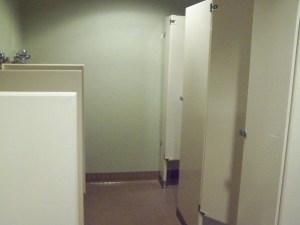
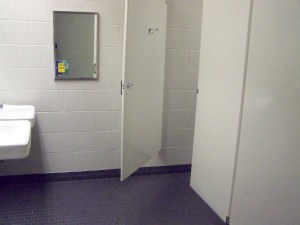
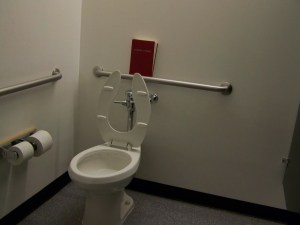
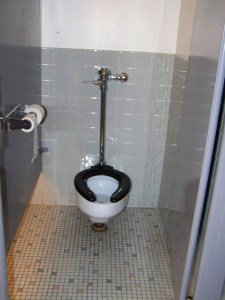
Our first pit stop is Olive Tjaden. Tjaden satisfies the basic needs by being a clean, well-lit room, and amply stocked. the decor is (surprisingly) sparse for an arts building, and the panoply of pipes up at the ceiling leaves something to be desired in terms of aesthetics. But holy crap does this room have a lot of space. Like, as much space as the big bathroom in Olin Libe that should really only be used by handicapped people, only this one you don’t risk getting yelled by some woman in a wheelchair as soon as you open the door.  I threw in Bishop’s History of Cornell book to give a sense of space.

Rating: * * *
100_0656

100_0657

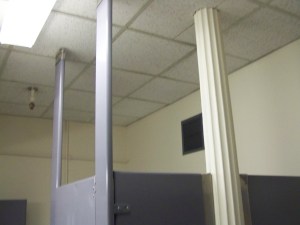
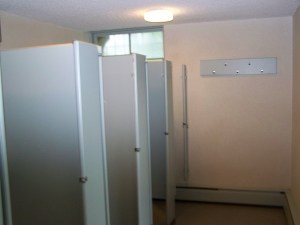
Likewise, McGraw is adequately equipped to handle bathroom needs, but lacks the spaciousness of Tjaden, and we all know that space can be a big plus if you’re carrying a lot of crap (no pun intended). However, it does have a nice cheap-looking pillar running throught the stalls, as if to make a half-hearted appeal to be different.

 Rating: * *
 100_0658

100_0659

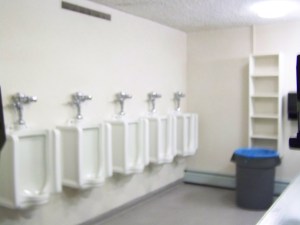
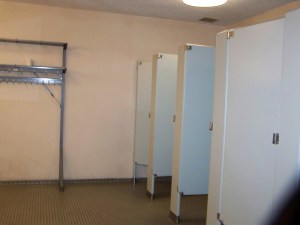
Uris Library is designed to be a high-capacity facility, so as a result, the frills are lacking. I maintain that the bookshelf against the wall of the urinals probably has some of the least-used shelves on campus. My one complaint is that on particularly wet and muddy days outside, all that just gets tracked into here, since the bathroom is so close to the entrance. Therefore, the rating changes depending on the day – decent (* *) on a good day, poor (*) on a messy day outside.

Rating: * * (dry weather day)  / * (wet and/or muddy day)
100_0660

Getting a photo of Olin’s bathroom was notoriously difficult thanks to the high volume traffic, even during this time of the year (these photos were taken during last week). Olin Libe’s main bathroom is in the basement, so it benefits from being a farther walk, as people have a chance to shake the mud and water off their shoes before they make it to the bathroom. While most restrooms make use of a privacy hallway to prevent peepers, Olin makes use of a second door , which can be both a blessing and a curse if someone is coming from the other direction.

Of course, in the 1980s, Olin Library bathrooms were much more invasive; here’s a DUE from Janurary 1987 [1]:

“DEAR UNCLE EZRA:

WHY ARE THERE NO DOORS ON THE MEN’S ROOM STALLS IN OLIN LIBRARY?

                                            ????????


Dear Wondering About No Privacy,
Apparently, a few years ago a University Librarian learned that the downstairs public men’s room in Olin had become a preferred meeting place on campus for gay men.  This person freaked out and ordered the men’s room closed.  This was strongly protested by some of the male staff members. The compromise was to reopen the men’s room, but remove the doors from all the stalls so there wouldn’t be any privacy.
        When you raised this question, and I consulted a current member of the staff about the issue, he volunteered to write a letter to the new University Librarian, Alain Seznec, about this matter and see whether he will order the doors re-installed.  Hopefully, privacy may return to Olin. “
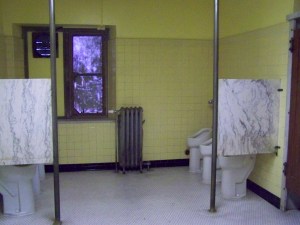
 
Yeah…so thankfully, we have stall doors.
 
Rating: * *
 
100_0664
100_0665
 
When Willard Straight was completed in 1925, not only did men and women have seperate bathrooms, they also had seperate entrances (women came in through the south entrance [2]).  The men’s bathroom is just tired-looking and worn down, the sole redeeming trait being the well-used antique scale sitting outside the main bathroom, in the corner of the privacy hallway. Really, if you can afford to wait, walk over to the other side of the building and you the cleaner and much more spacious unisex bathroom (be sure to lock the door). Be advised, the unisex room comes with a giant mirror, so you find yourself seeing more of yourself than you normally care to.
 
Rating: * (men’s room) * * * (unisex restroom)
  
100_0666
100_0668
  
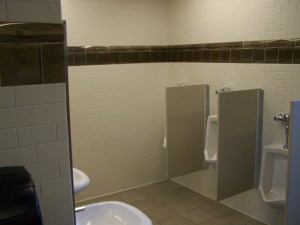
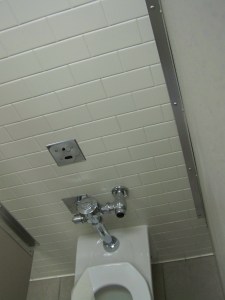
Here’s one for the engineers. As those who have had classes on the engineering quad may have noticed, men’s rooms outnumber ladies’ rooms by a considerable number (a fair guess is 3:1), thanks to the majority male engineering student population. That being said, the men’s rooms of Thurston have nice little assets like privacy barriers between urinals, but they also have those incredibly obnoxious sensors to flush the toilets. You know, the ones that go off as you stand up to wipe, or fail to go off at all and you’re left there trying to figure out how to finish business. I have a personal vendetta against automatic flushers, because I think the technology simply hasn’t been refined enough to be useful. Regardless, this is an adequate facility.
 
Rating: * *
 
100_0669
100_0670
 
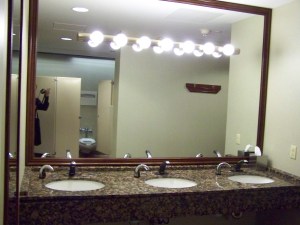
The Statler Hotel is all about impressing the visitor. They do a great job with the bathrooms. The bathrooms are nothing short of luxurious, and make you feel like you’re somebody. There’s even a vanity mirror and polished stone counters. The trick to getting to using this bathroom is to walk in and appearing more like a guest and not a student; that way, the employees won’t give you dirty looks when you’re heading back out.
 
Rating: * * *
 
100_0671
100_0673
 
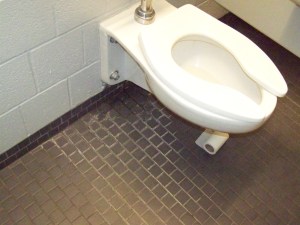
Somehow, I had this expectation going into Ives that the bathrooms would have extra safety and specialty features. To my dismay, they weren’t all that different from any other bathroom on campus. While the rooms were spacious, I can’t give three stars beceause of a slight amount of water damage to the tiles near where the toilet is hinged to the wall. Yes, the t.p. was under the toilet when I arrived here.
 
Rating: * *
 
 
100_0675
 
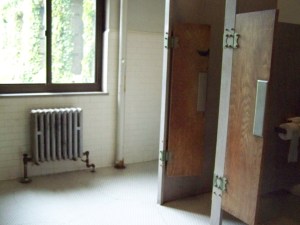
Plant Science must have the scariest bathroom on campus. Rotting tileworks, mildew stains, old fashioned doors and frickin’ bath towels hanging over one of the stalls were enough to give this room a bad rep. It doesn’t help that this was the bathroom that was claimed by some to have cockroach infestation issues not too long ago.  Let’s think about that for one moment. Cockroaches while you’re on the crapper.


 Use at your own risk.
 
Rating: *
 
100_0676
 
 100_0678
Last but not least, we come to our newest bathrooms, the ones installed on the first floor in Weill Hall. They’re installed rather conspicuously near the atrium, which might make for some uncomfortable rendezvous, but otherwise, they’re well appointed.
 
Rating: * *


[1]http://ezra.cornell.edu/posting.php?timestamp=538462800

[2]http://www.fs.cornell.edu/fs/facinfo/fs_facilinfo.cfm?facil_cd=2020


News Tidbits 4/16/09: Little Ithaca Grows Up

17 04 2009

Looks like Ithaca’s downtown area is seeing some long awaited expansion.

http://www.theithacajournal.com/article/20090416/NEWS01/904160358&referrer=FRONTPAGECAROUSEL

Major downtown construction projects are slated to move forward this year, a sign of Ithaca’s relative resilience in troubled economic times, city officials say.

The Hotel Ithaca project at the eastern end of The Commons should break ground this fall, and construction is scheduled to start by summer on the Cayuga Green condominiums between the Cayuga garage and Six Mile Creek, Downtown Ithaca Alliance Executive Director Gary Ferguson said.

This summer should also see the completion and opening of the new Cinemapolis in the ground-floor of the Green Street garage and Urban Outfitters on the ground-floor of the Cayuga Green apartment complex.

Hotel and condos

The $30 million, 100-room Hotel Ithaca project this month received city approval for zoning variances, and Common Council approval to jut several feet over the top of the Green Street garage. It’s scheduled to come for site plan review to the Planning and Development Board April 28.

The $12 million, 7-story Cayuga Green luxury apartment/condo project is the last piece of the years-long Cayuga Green downtown development. It already has needed approvals.

Ferguson said when he talks with fellow economic development planners around the state, “they’re just green with envy.”

“One, we’ve been planning them for some time so it’s not like these are just popping out of the ground. But secondly, while the economy’s been rough, this still is a very strong economy relative to other parts of the state, other parts of the country,” he said. “I think this malaise, if you will, is worse in a lot of other places and actually makes Ithaca look even more attractive to people.”

Bankers still seem to have faith in Ithaca, said Phyllisa DeSarno, deputy director for economic development for the city. This is evidenced by the fact that Cayuga Green developer Ken Schon has retained his financial backing.

“We were all crossing our fingers . . . because so many developers are losing their funding and banks are not going with projects,” she said. “But he said it does not look like that’s going to be his issue. He is moving ahead.”

The Hotel Ithaca was proposed to go up to the limit of 85 feet allowed by zoning, but the project developer received approval to go up an additional 21 feet, in order to enclose the building’s heating, ventilation and air conditioning systems. Under the city’s zoning, that kind of equipment is never considered part of a building’s height.

“This was a very, very major coup, really,” DeSarno said. “We were so thrilled that this happened because it sets a bar now I think for other developers, other builders to do something about mechanicals, which are really such a blight. When you’re coming off any of the hills, coming down from Ithaca College or Cornell (University), it’s going to be so much more aesthetically nice to have that screening there.”

The rooftop enclosure will also include meeting and conference space “to offset the cost of the structure,” according to information provided to the city’s Board of Zoning Appeals.

Openings

Construction continues on the future homes of Cinemapolis and Urban Outfitters on either side of Green Street.

Cinemapolis is scheduled to open in late May, potentially in conjunction with Ithaca Festival, said Lynne Cohen, one of the executive directors of Seventh Art, which oversees Cinemapolis.

Construction is scheduled to be complete in about a week, then all that will be left is to paint and install seating, projection equipment and refreshment equipment, Cohen said.

“With a little imagination, you can see what the theater’s going to look like,” she said.

Compared to the existing Cinemapolis theaters in Center Ithaca and at Fall Creek Pictures, the new location will have “fewer seats but better allocated,” Cohen said.

Cinemapolis’ contract at Fall Creek Pictures runs through the end of this year, but Seventh Art has not yet decided whether they’ll continue showing films there once the new location opens, said Rich Szanyi, Cohen’s husband and another Seventh Art executive director.

Tsvi Bokaer, founder of Fall Creek Pictures, could not be reached for comment.

Urban Outfitters, which will occupy the eastern half of the ground floor under the Cayuga Green apartments, is on schedule to open July 2, project architect David Levy said by email.

“Now obviously Urban Outfitters will be a big draw and all of the neighbors around Urban Outfitters, including The Commons, will benefit from them being here,” DeSarno said.

Ithaca will be the second Upstate New York location for college-age focused Urban Outfitters. The other is in Buffalo.

Tompkins Consolidated Area Transit also plans to rent space on the ground floor of the apartments, and Schon is in discussion with two local small businesses about filling the remaining area, DeSarno said.

“Obviously there are cuts throughout our city and the county in our businesses and in our employers,” she said. “But we certainly, like Bob Sweet from National Development Council always says to me, ‘(Ithaca is) an oasis amongst a muck and mire.’ ”

The Hotel Ithaca was proposed to go up to the limit of 85 feet allowed by zoning, but the project developer received approval to go up an additional 21 feet, in order to enclose the building’s heating, ventilation and air conditioning systems. Under the city’s zoning, that kind of equipment is never considered part of a building’s height.

“This was a very, very major coup, really,” DeSarno said. “We were so thrilled that this happened because it sets a bar now I think for other developers, other builders to do something about mechanicals, which are really such a blight. When you’re coming off any of the hills, coming down from Ithaca College or Cornell (University), it’s going to be so much more aesthetically nice to have that screening there.”

The rooftop enclosure will also include meeting and conference space “to offset the cost of the structure,” according to information provided to the city’s Board of Zoning Appeals.

~~~

For the record:

commons

Red box is part of the Hotel Ithaca site, green box is the Cayuga Green Condos site. Cayuga Green Apts, shown as under construction in this map, are where Cinemapolis and Urban Outfitters are going to be located. As Mr. Nagowski noted, Cinemapolis will be in the garage side of the construction area. Urban Outfitters is on the first floor of the apartment building.

Hotel Ithaca proposal:

http://www.gemstoneresorts.com/Properties.aspx

Cayuga Condos
http://www.josegarciadesign.com/images/cayuga-condo00.jpg

For reference, the height of Seneca Place is 121 feet, according to Emporis. The new apartment building on Green Street is 60 feet.


The Case of Two Different Fraternities of the Same Name

5 04 2009

So, I’ll open up this topic by saying that while some of the work is my own, a lot of the research was done by a friend of mine  named A.C., so I’ll start by giving him credit for going through some of the research and sharing it with me so that it could be published onto this blog.

First of all, the case is really old. This dates back to over one hundred years ago, in the 1890s. The fraternity in question is the Alpha Zeta fraternity on Thurston Avenue. According to their website, the Cornell Chapter was established in 1901.

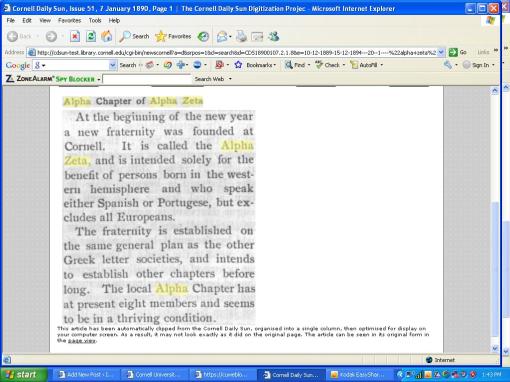
Then we have the following article from a Daily Sun blurb in 1890:

az-1890

That’s discrepency number one. Number two is that the current Alpha Zeta at Cornell is a co-ed aggie house. There’s nothing about being limited to western hemisphere non-European speakers of Spanish and Portugese (essentially, Latin America).

The following is a list of fraternities on Cornell Campus published in the Sun in May 1892:


 az-18921

Apparently, this ethnic Alpha Zeta lived at Cascadilla Place. Also, a few side comments – Huestis Street is now College Avenue, women lived in Sage College and as a result all the sororities were based there, and most of the houses were in the Collegetown-State Street corridor because that was between the campus and the boarding houses in the city where most male students lived.

Now, here’s an excerpt from the e-mail I received from A.C.

***

“Hello B.,

Here’s some information on the other Alpha Zeta.

From the Cornellian, it was active from January 1st 1890 to at least 1893.
It likely ended in 1894 when their youngest members graduated and they did
not have any new initiates.”

***

Therefore, we can make a logical conclusion. In 1890, an Alpha Zeta was founded at Cornell for non-European spanish and portugese speakers, perhaps a predecessor to the modern Latino fraternities of Lambda Upsilon Lambda and Lambda Theta Phi. However, if it closed in the mid 1890s, then there were no more Alpha Zetas in existence, and the name was free to be use. A few years later, the Cornell Chapter of the agricultural Alpha Zeta was opened, and we end up where we are today.

So, with regards to a incident happening where they were both on campus at the same time, that would not have been permitted. However, if there are local fraternities that lay claim to the name before a national tries to move in, then the national would probably have to negotiate a name change for the local.


Greetings from Sunny Ithaca

17 03 2009

Yes, it’s spring break. I’m working in Ithaca and studying for a GRE I have in a few days.  It’s warmer than usual and sunny. No, Ithaca does not miss you. Anyways…

100_3387

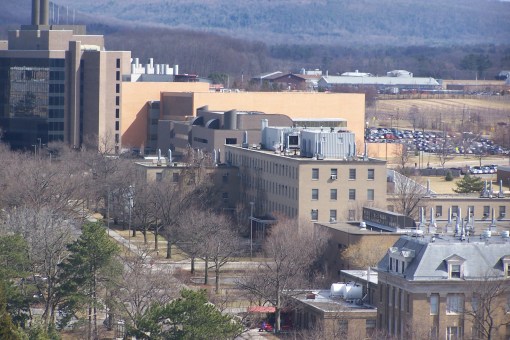
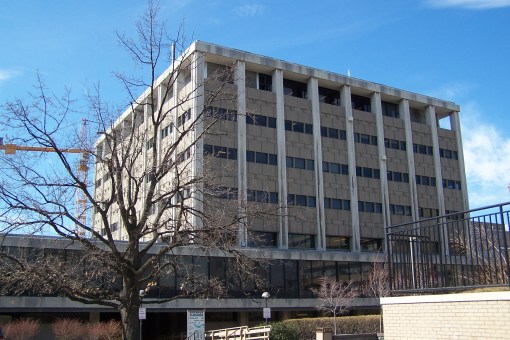
The building in the center of this image is Morrison Hall. Morrison, the home of the animal science major (pre-vet and non-pre-vet flavors) was built in 1961 [1]- hence the fact it’s a 133,000 sq. ft. characterless box (though I guess that’s better than the monstrosity next to it, the Boyce Thompson Institute).  The building was named for Frank B. Morrison, a professor and director of animal husbandry here at the university [2]. For the less recent alumni, the orange building in the back is the East Wing Addition to the Vet School that was completed in 2007. Yes, it has virtually, no windows. No one said Cornell’s modern architecture was known for its aesthetically pleasing qualities.

100_3414

In contrast, as utilitarian as Baker was meant to be, it still retains some charm to it, probably from the classical columns and brickwork of the structure. According to Charles Wilcox [3], the initial designs for Baker were actually drawn up around 1910, which was six years before Morse Hall was destroyed in a fire. Funding for Baker came through in 1918, and during it construction the benefactor was anonymous. George Baker, a prominent New York banker who donated $1.5 million to its construction, only unveiled himself at the building’s dedication ( a similar experience occurred when Balch Hall was dedicated). The building had any number of problems from poorly maintained exhaust hoods to flooding in the basement to the ceiling being so low that chemical engineering could not fit in the building and so had to have a building of its own. Some of these problems were rectified when Baker was renovated in 1969, but others such as the flooding continue even into today.

100_3386

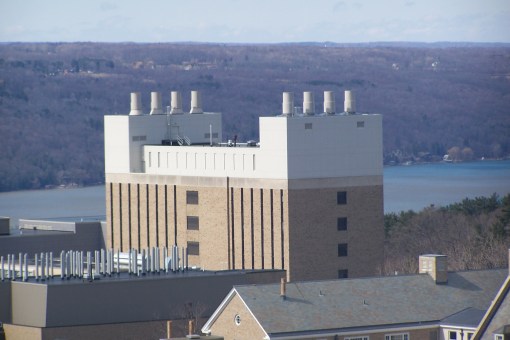
In the same category as Morrison (the category being random ugly crap we threw up in the ’60s) is the Spencer T. Olin Laboratory Tower.  I like this because there’s a nice detailed story concerning its construction floating around the internet [3]. The construction of the building was overseen by a Chem department honcho by the name of William Miller; he was less concerned about winning prizes in an architectural journal and more about the building performing its function properly. The nine-story, 64,000 square foot building was built in 1967, with the intention of being flexible in its use for the Chemistry department. The exhaust structures on the sides were built in the 1990s, making an unattractive building downright ugly. Two of the issues encountered during its instruction were an underground cave that actually caused a caisson (a base support column, if you will) to collapse (they believed an ancient underground river once ran through the site), and that the tarpaulins caught fire on the side of the building ( a tarpaulin is designed to allow construction in cold weather; like what you see on the new Vet building here).

100_31811

The last incident involving Olin is something that one would come to expect at Cornell. To quote Charles Wilcox’s paper:

“The decision to use an outside architect and to go for efficiency rather than beauty led to an amusing incident. The dedication of the new wing was held at the four-story interface between old Baker and the new wing. When President Perkins rose to give his speech, a group of students from the College of Architecture who had secretly gathered on the roof of the passageway unfurled a building-long banner that read MEDIOCRE and waved placards reading UGLY and VERY UGLY. The startled president stepped back to avoid being hit by weights at the bottom of the falling banner; although grazed he graciously laughed and responded: I question your judgment, but admire your logistics. It is not recorded what Bill Miller thought, but it is likely that he took secret pleasure in knowing that he had not wasted money on unproductive artistic features. ”

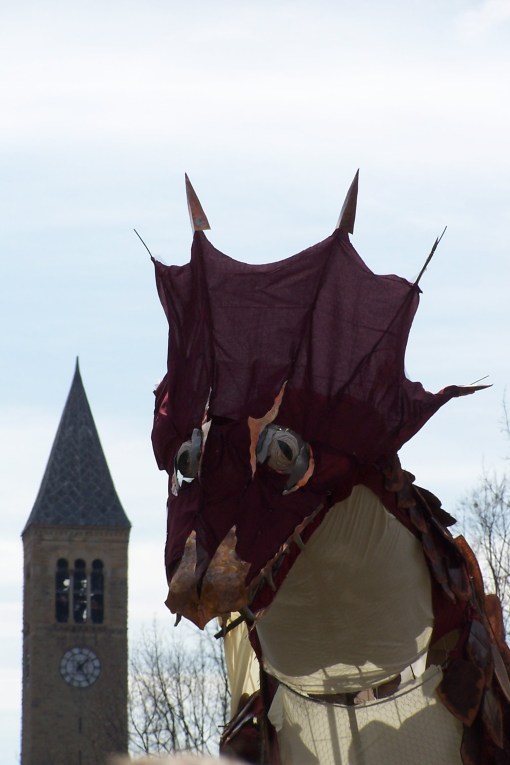
Oh architects! And we thought all you did was chain smoke, lock yourselves in Rand and burn dragons. Speaking of which,

100_34321

Me passing up photos on Dragon Day would’ve been like a pedophile passing a playground (though not nearly as perverse).

100_3396

Continuing our tour of building that were only built out of necessity, we have to mention Clark Hall. The homes of AEP and vanilla Physics, this 84-foot tall box was completed in 1965, and was named for W. van Alan Clark 1909, an Avon perfume scientist who donated $3 million towards its $7.3 million price tag [4]. So equivalently, that would suggest the donor for the new physical sciences building would have to donate about $33 million to the reconciled cost of $81 million [5]. I’m all for tapping in to Ratan Tata’s fortune to cover it.

By the way, if we can handle the height of Clark, I see no reason why we can’t handle a much slimmer building of similar height in Collegetown. Just saying.

[1]http://jds.fass.org/cgi/reprint/44/10/3.pdf

[2]http://jas.fass.org/cgi/reprint/66/10/2696.pdf

[3]http://www.chem.cornell.edu/history/laboratories/STOlin.htm

[4]http://www.cornell.edu/search/index.cfm?tab=facts&q=&id=144

[5]http://www.fs.cornell.edu/fs/projects/


Cornell’s Secret Societies

13 03 2009

I was politely asked to remove all of this entry.


Warren Real Estate Tries to Sell a Frat House

4 03 2009

This was oddly funny to me. The house in question is 210 Thurston Avenue, covered in an entry last July.

http://www.warrenhomes.com/index.cfm?action=detailed_listing&mls=128574&menu=0

Photo Property of Warren Real Estate

“Walk to Cornell University from this 22 bedroom group house. The house is legal for up to 33 people. This s a unique opportunity to own a wonderful investment property. There are 6 full bathrooms (2 master suites), a commercial style kitchen, and parking for up to 15 cars. Over 7,000 square feet of living space on first & second floors. The full basement has a paved concrete foundation and significant additional living space featuring a rec. room and a dining area.”

Now here’s the history they skipped over. This house was built around 1900. The first fraternity to inhabit its halls was Delta Sigma Phi, which closed in WWII and never reopened. Alpha Omicron Pi made use of this house for a short while, and Sigma Alpha Mu moved in for 1947/1948. Sigma Alpha Mu maintained the property until they moved to Sisson Place in 2004. After that, the house became known as Phi Delta Theta’s annex (which, for being the dry house on campus, the real estate website’s photo of a large beer pong table in their annex does nothing for P.R.).

Like, really guys? Next time, throw a sheet over the table, it won’t be so blatantly obvious. Like the beer cans wedged between the second floor balconies.

Even better, it would appear that not only is this house for sale, but Theta Xi’s moving in [2]. From a Craigslist excerpt:

“Theta Xi Fraternity is moving into the old Phi Delta Theta annex at 210 Thurston Ave. for the 09/10 school year. We will have around 10 brothers in the house and need around 10 boarders. The cost will be 100,000 for 20 people for a 10-month lease, which is 500 a person. ”

For the curious, this 7,044 square ft. house has an asking price of $950,000. Maybe Theta Xi has some rich alumni they could appeal to.

Looks like the times are a changin’.

[1]http://www.sammybeta.com/history.php

[2]http://ithaca.craigslist.org/roo/1017046808.html


The Music Building in its Many Forms

24 02 2009

So, a little background story to this entry. One of the things that I’m in charge of for my fraternity is maintaining the alumni newsletter. So, I had to send snail mail and a typed letter to the publishing company. Much to my annoyance, the nearest computer lab to where I was at the time was in Lincoln Hall, the music building.

Well, I’ve never printed anything at Lincoln before, so when I selected printers, i accidentally sent it to 374 MTH instead of the MUSIC printer. I being off not-so-sound mind apparently managed to read that as 374 MUSIC, so I went up and began searching the third floor.

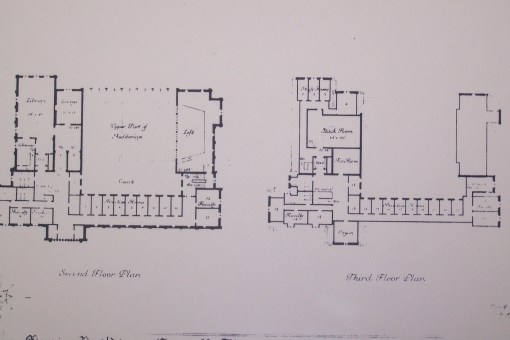
Then I found this display. Realizing its worthiness for writing materials, I grabbed my camera and took a few photos.

100_3185

100_3186

100_3188

It seems the above pictorials date from ca. 1900, and were proposed designs for a combined Architecture and Fine Arts building. No word on where the building would have been built.

100_3190

100_3191

This Collegiate Gothic design was proposed in the late 1920s, and would have been where Gannett Health Center stand today. Alas, the plan never saw the light of day due to budget cuts brought on by the Great Depression.

100_3194

100_3196

100_3197

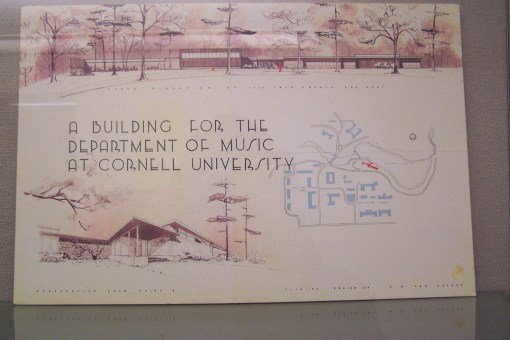
100_3198

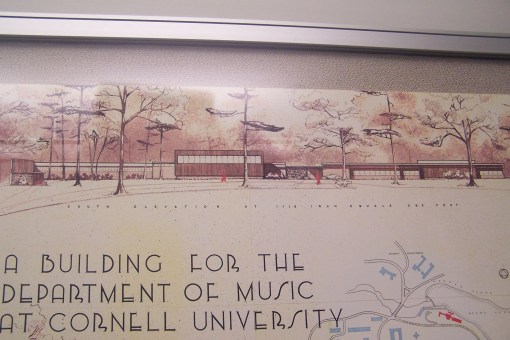
This modernist structure was proposed in 1950, and would’ve been built where Noyes Lodge stands today. Considering this school’s record of modern architecture, part of me is glad this never saw construction.


“#731”: This Post Went Without A Title for Four Years

4 02 2009

I guess if Cornell is going to put off all non-current construction until at least June 30 (see Skorton e-mail), I’d better go back to campus touring.

100_2500

The Biotechnology building. So bland we didn’t even bother to give it a real name (or Cornell just hasn’t seen the right dollar amount—one of the two).  The 150,000 sq. ft building was completed in 1986 (which might just as well be the height of modern-design blandness) by the firm Davis and Brody [1].  I guess when comparing this to Comstock Hall, which was also built in the mid-1980s, this is a mild improvement. The building, as the name suggests, focuses on biotechnology research, such as genetics and molecular biology. The building’s use is strictly research, housing 36 faculty, 50 post-docs, and about 100 graduate students [2]. Along with its primary use, the building houses a small dining facility and the Keller reading room.

100_2505

When it was first completed in 1931 [1], the Plant Science building was the largest single dedicated to plant research in the world (its about 170,000 gross sq ft [4]. The building was designed by Sullivan Jones in the Beaux-Arts style, but I’d venture a guess that it’s a stripped Beaux-Arts style, because the ornamentation is quite restrained, and since it was finished at the start of the depression (the building did stay true to the initial design). Plant science serves as the home to the plant science and horticulture departments [3]. The building itself isn’t particularly attractive, but the Minns Garden on the south side is the showpiece of the grounds. The garden is named for former professor Lua Minns, who used it in the 1920s as a practice ground for her students to do hands-on gardening work [5]. However, the original plot of land was where Bailey Plaza and Malott Hall stand today.

Courtesy of the Cornell Chronicle

In case you’re wondering, the building between the garden and Bailey Hall is Liberty Hyde Bailey’s model rural schoolhouse, which was built in 1907 and probably lasted until demolition for Malott around 1960 [6].

100_3075

Stimson Hall was completed in 1902 and designed by locally-renowned architect William Henry Miller [7]. While funded by Dean Sage (son of trustee Henry Sage for whom the Hall and Chapel are named), the building is named for Lewis Stimson, who was instrumental in the establishment of the Cornell Medical School. From 1902 to 1908, the medical school resided in Stimson Hall, but afterward it was relocated to New York City, where it still continues to exist today as Weill Cornell Medical Center. It should also be noted that part of the building was a morgue at this time.

Stimson was designed with the intention of a second identical building facing south to be built were Day Hall currently stands; but for whatever reason it was never built, so the south side looks a little incomplete, with a terrace that faces out into a parking lot today (the area between the two buildings was to function as a courtyard).

Today, Stimson Hall serves as the home of the Biological Sciences department, and the university Ombudsman (a person appointed by Day Hall to handle and address citizen complaints, according to Wikipedia [8]). When Kroch was built, Stimson was planned to be renovated into a library, but due to budget constraints, that was never undertaken. The tunnel between Kroch and Stimson was built to serve that purpose, but now it is only open for public use one day of the year—Slope Day [11].

100_3080

Speaking of Day Hall, we might as well briefly discuss it. To no one’s surprise, Day Hall houses most of the upper administration offices; for example, Skorton’s office is on the 3rd floor. The building was designed by Frederick Ackerman in a stripped classical style and completed in 1947 [9] (offhand, I believe Ackerman also designed the Psi Upsilon and Sigma Phi fraternity houses fifteen years earlier). The building was dedicated shortly after completion to Edmund Ezra Day, Cornell’s fifth president (1937-1949). Before renovation, the building provided sleeping and bathing facilities on the third, fourth and fifth floors for faculty.

For another fun tidbit of history, Day Hall was taken over in a non-violent protest for three days in November 1993 [10].  The takeover stemmed from protests from Latino students over a combination of incidents and complaints with the university, including the vandalizing of a large art installation by a Latino artist, and lack of minority representation within Cornell faculty.

And for the last time, there is no tunnel that leads from Day Hall to the Cornell Store.

[1]http://www.people.cornell.edu/pages/cre8/cudb/buildings.html

[2]http://www.mbg.cornell.edu/cals/mbg/resources/index.cfm

[3]http://hort.cals.cornell.edu/cals/hort/about/plant_sci_bldg.cfm

[4]http://www.fs.cornell.edu/fs/facinfo/fs_facilInfo.cfm?facil_cd=1022

[5]http://www.cornell.edu/tours/tidbit_template310d.html

[6]http://ecommons.library.cornell.edu/bitstream/1813/3171/36/009_36.pdf

[7]http://www.cornell.edu/search/index.cfm?tab=facts&q=&id=693

[8]http://en.wikipedia.org/wiki/Ombudsman

[9]http://www.cornell.edu/search/index.cfm?tab=facts&q=&id=239

[10]http://cornellsun.com/node/26269

[11]http://ezra.cornell.edu/searched.php -3/16/2004


The Clark Hall Addition That Was Never Built

22 01 2009

So, I came across rather serendipitously while going through some archived photos. Luckily, since I carry my camera around with me everywhere, I was able to take a photo.

100_2770

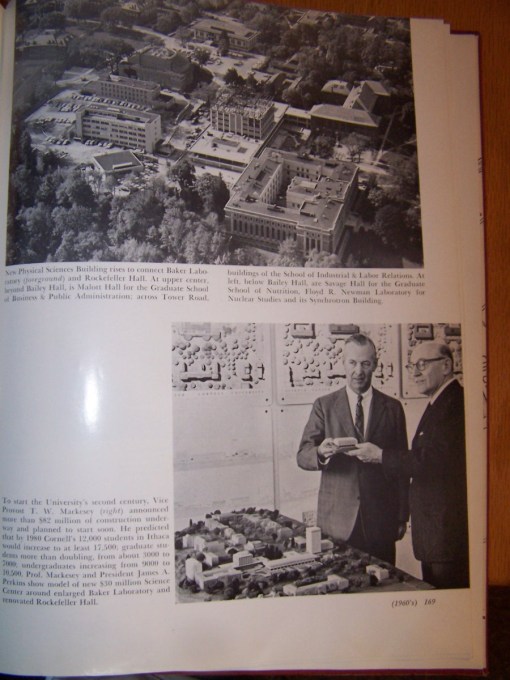
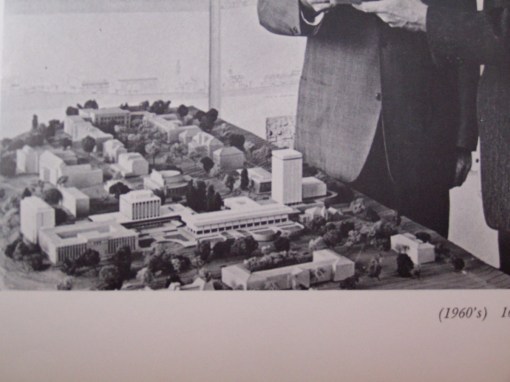
So, this comes from a revised edition of the 1954 Cornell Historical Photo book that I previously used in an entry, this being the 1965/66 update. This is clearly evident with the photo at the top, taken in approximately 1964 when Clark Hall was under construction.

Then we look at the bottom photo. And you notice there’s no Rockefeller. It’s replaced with some massive complex. My first thought was “what the f— is that! It’s f—–g massive!”.

100_2773

First, some chronological details. Since James Perkins is in the photo, and Clark Hall is completed, and this book was published in late 1965/early 1966, so we can assume this photo dates from about 1965. From the caption, we know this was a building proposal that would have been completed by 1980 (notably, the growth in numbers the caption cites stayed largely true to form- there were a little more than 17,000 students in 1980, but about 11,500-12,000 were undergraduate).

So, then we have the “renovated” Rockefeller—a massive low-rise building that by my guess was 180,000 or 200,000 square feet (for reference, Rockefeller is 125,000 gross sq ft [1]). There’s a large extrusion streetside, that I’m kinda imagining wasn’t too different from the west extrusion of Uris Libe that was built in the early 1980s. The low-rise largely conforms to Rockefeller’s footprint otherwise.

Then we have the massive tower right behind A.D. White’s house. We’ll call that “Rockefeller Annex”. This annex is massive- the model, when compared to surrounding buildings, suggests to me between 15-18 floors. The building has an odd rooftop with an indentation that was likely a balcony area. Design-wise, the building is strikingly similar to Lawrinson Hall, a highrise dorm that was built at nearby Syrcause University in 1965 [2].

Photo copyright of Syracuse University

However, the building at Cornell is a little different-facade wise, it seems to bear similarities to the model used for Olin Labs, which would be completed in 1967 and probably had only just finished with the final design. Think about it. An eighteen-story box with thin vertical windows like Olin Labs.Yes, that is a very horrific thought. It would be sacrilege to A.D.White’s house. Plus, the Big Red Barn would’ve been torn down to make way for the tower and its 3/4-story component to the southeast.By the way, behind Perkins and Provost Mackesey are some site plans. Which show three extensions from the renovated Rockefeller, but not much else for discussion.Conclusion: While we had some really bad architecture in the 60s and 70s, just be glad that not all of it was built. Be very glad.[1]http://www.fs.cornell.edu/fs/facinfo/fs_facilInfo.cfm?facil_cd=2014

[2]http://housingmealplans.syr.edu/facilityinformation.cfm?id=9


One Stormy Day on Campus, Continued

2 01 2009

Look at it this way; I’m not being paid to do this, and you don’t have to put up with a helicopter Mom asking twenty million questions about academics.

So, today I’m going through the engineering quad. Back in the day, the engineering buildings were Sibley, Franklin (Tjaden), Rand and Lincoln. By the early 1960s however, they had all shifted down to the present-day engineering quad.

100_2086

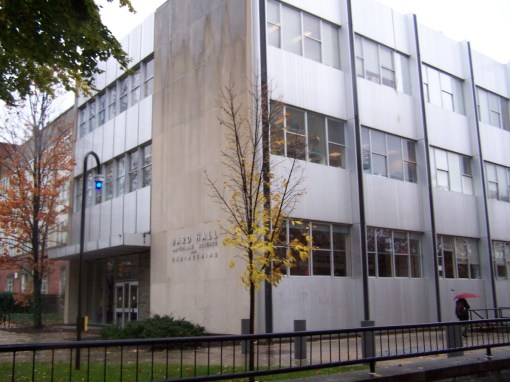
Bard Hall is one of the smaller inteconnected buildings that make up the engineering quad. The 50,000 sq. ft. building was completed in 1963 [1], 12 years after the construction of its neighbor Thurston Hall, but was designed by the same architects. Appropriately so, materials science is based out of this building, which is clad in brown Ithaca stone, limestone, glass, and aluminum. Bard Hall is named Francis Norwood Bard, Class of 1904  [2].

100_2087

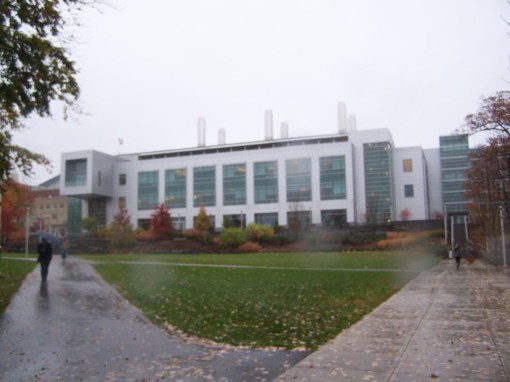
Don’t mind the rain spots. So, no review of the engineering quad would be complete unless I discussed Duffield Hall, the newest addition to the quad.

The plot of land that Duffield was built on was home ot some lanscaped quad space to the north, and the two-story white box that was the Knight Labs building to the south (the building was demolished and the labs were incorporated into Duffield).

Duffield Hall is named for Richard Duffield, Class of 1962. Duffield made his fortune by being the founder and president/CEO of the software company Peoplesoft [3]. The same Peoplesoft that screws everyone over for CoursEnroll.  

100_2093

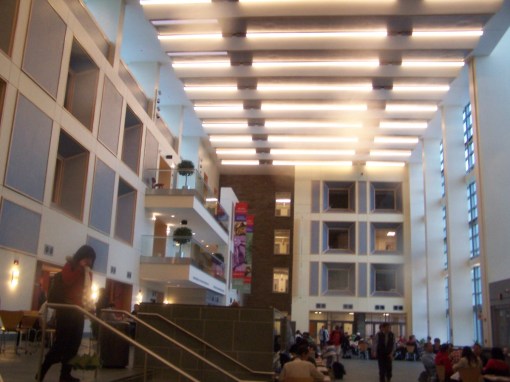
The building began construction in 2001 and was officially opened in October 2004.  The building has a usable area of about 130,000 sq. ft [4] and cost about $58.5 million. The building houses a small a la carte dining facility (Mattin’s), a large atrium, and Knight Labs (named for Lester Knight ’29) with its Cornell NanoScale Facility (CNF). Sorry, no photos of the folks in clean suits.

100_2088

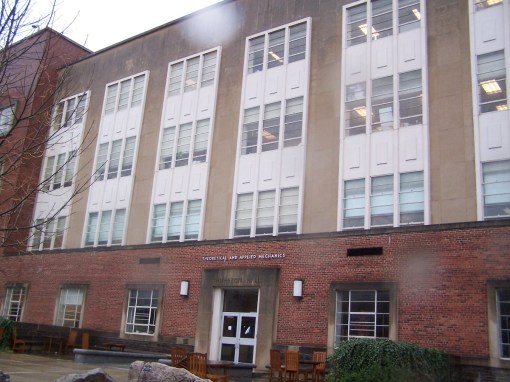
Thurston Hall is the centerpiece of the engineering quad. The building, designed in the Art Moderne style, was completed in 1951 [5]. This building technically has less usable space than Bard, but it depends on where you draw the line between it and Kimball Hall to the east, which was built at the same time. The building is named for Robert Thurston, an early Cornell engineering professor.

As you can see, the outside says Theoretical and Applied Mechanics (TAM). Technically, this department was merged with the school of Mechanical and Aerospace Engineering, effective yesterday (how convenient for this entry) [6].

100_2089

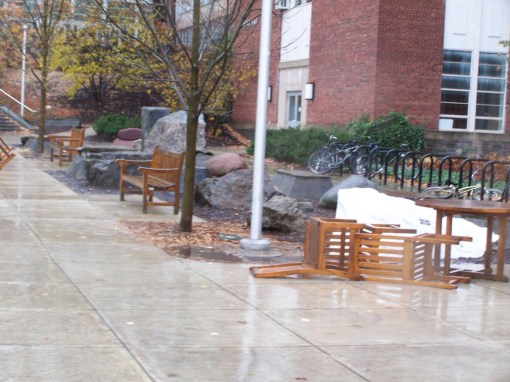
It was really windy.  Mother Nature just decided to  crap on Ithaca that day.

100_2091

The completely unobtrusive Kimball Hall. Technically, Kimball is recognized as “the Eastern pavilion of Thurston Hall”. Also completed in 1951, the building is 30,000 sq. ft. and originally housed the geology department on its upper floors [7]. The building is possibly named for Henry Kimball, Class of 1911, who was a state supreme court justice [8].

100_2092

Cornell’s 1950s Engineering Quad plan:

1. Design a completely boring structure. Because we’re overcrowded.

2. Find an alum willing to fork over enough cash to pay for it; slap their name on the building in return.

3. Repeat

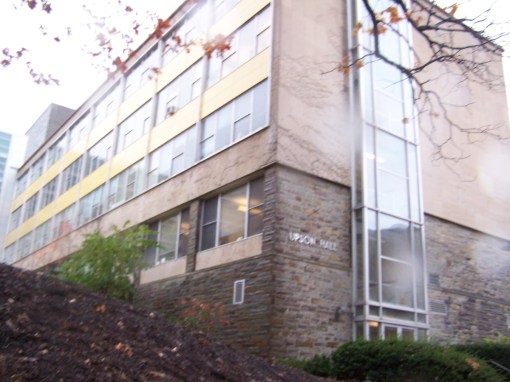
Upson Hall is a 160,000 sq. ft building completed in 1956 [9]. Upson Hall is named for Maxwell Upson, Class of 1899, and a longtime Cornell trustee [8]. The building serves as the central hub for the Computer Science department. This building could otherwise be known for a 24-hour computer lab that up until recently was a filthy lie (that damn thing was never open at night back in 07′).

100_2095

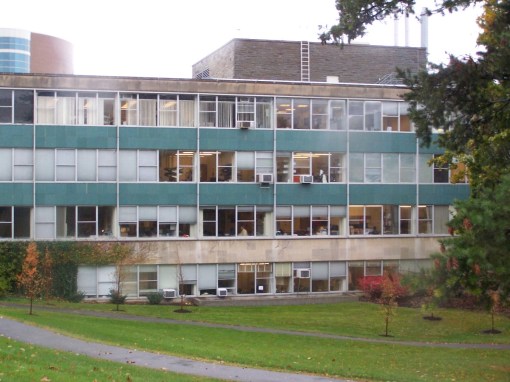
So, this is technically two buildings. The foreground box with the green window banding is part of Phillips Hall, a 100,000 sq. ft building built in 1955. The background structure (where the ladder is) is Grumman Hall, a 17,000 sq. ft building completed in 1957 [10]. Update: Or so I thought. It’s probably just another part of Phillips, but Grumman would be in the background if it was tall enough to be visible. Confusing, isn’t it?

Grumman is named for Leroy Grumman, Class of 1916 and founder of Grumman Aircraft (now Northrop Grumman [11]). Phillips Hall, named for Ellis Phillips 1895 [2], is home to the Electrical Engineering department, and Grumman houses some Aeronautics courses.

100_2099

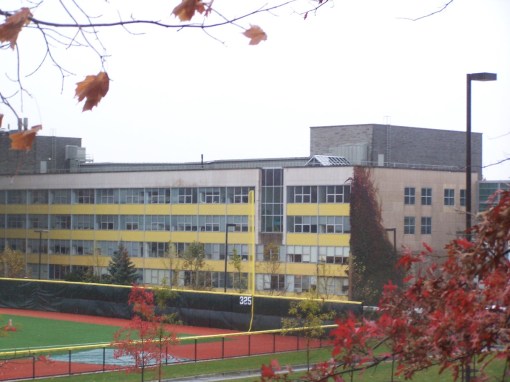
Update: Facilities calls this part of Upson. Apparently, the only way you can make a clear difference is the color of the window banding.   I s’pose it wouldn’t be as confusing if you’ve had classes here, but these are the only two of the main engineering quad that I’ve never had a course lecture or section.

(Thank Heaven.) 

UPDATE:

So, because I was using images and wordpress doesn’t allow imae attachments in comments, I figured it would just be easier to edit the original entry. As several readers (salem, Nagowski, and andrew) have noted, the physical seperations between Grumman, Upson and Phillips are very difficult to determine, since they are all interconnected. Consider the map below. 

up-gr-ph

The map would suggest that Grumman is the south wing of the complex, Upson is on the west, and Phillips on the north. However, going through the facilities websites, Phillips is listed as 100,000 sq ft (88,000 net), Upson as 160,000 sq ft (142,000 net), and Grumman is by far the smallest at only about 16,300 sq ft (14,500 net).

Back in the day, Grumman might have been much larger. Older images have suggested that there was a multi-story (~4 floors) box jutting out of the east side of the complex where Rhodes Hall stands today.

So, we then have the task of trying to determine what Cornell thinks are seperate building areas. Upson is undoubtedly the yellow banded building on the west (Upson Hall is clearly printed next to the staircase). However, it’s also the largest, yet its footprint (if we assume from the map) is seemingly small.

Here’s one issue: if you search Upson Hall on campus facilities, you get a photo virtually identical to my last photo, which I claim to be part of Phillips. http://www.fs.cornell.edu/fs/facinfo/fs_facilInfo.cfm?facil_cd=2045. Upson uses yellow trim, as does this wing of the complex. So, andrew is right on this one, it’s likely a part of Upson.

Phillips uses blue-green panels. Also, the corresponding facilities image is the north entrance next to Duffield. We could therefore say that Phillips is the foreground building in the image where I claim Phillips and part of Grumman are visible.

Courtesy of facilities, here’s their file photo of Grumman, which they describe as “A rectangular box with alternating horizontal bands of limestone panels, blue-green terracotta, and strip windows framed in aluminum.” :

The yellow banding of Upson is clearly visible, and Grumman is the building on the right, in the foreground of Rhodes. So, here’s a big question: at only 17,000 sq. ft, where does Grumman end and Upson begin? In the attached photos, I claim the background rooftop structure behind Phillips, with the ladder, is Grumman. However, it’s more likely another part of Phillips. Grumman is not in my images, and at such a small size, it’s not the easiest building to determine.

[1]http://www.fs.cornell.edu/fs/facinfo/fs_facilInfo.cfm?facil_cd=2070

[2]http://www.people.cornell.edu/pages/cre8/cudb/buildings.html

[3]http://www.duffield.cornell.edu/about.cfm

[4]http://www.fs.cornell.edu/fs/facinfo/fs_facilInfo.cfm?facil_cd=2000

[5]http://www.fs.cornell.edu/fs/facinfo/fs_facilInfo.cfm?facil_cd=2037T

[6]http://www.tam.cornell.edu/news/news-story.cfm?storyid=12537

[7]http://www.mssu.edu/seg-vm/bio_sidney_kaufman.html

[8]http://en.wikipedia.org/wiki/Sphinx_Head

[9]http://www.fs.cornell.edu/fs/facinfo/fs_facilInfo.cfm?facil_cd=2045

[10] http://www.fs.cornell.edu/fs/facinfo/fs_facilInfo.cfm?facil_cd=2043

http://www.fs.cornell.edu/fs/facinfo/fs_facilInfo.cfm?facil_cd=2039H

[11]http://en.wikipedia.org/wiki/Leroy_Grumman