Random Ithacana

18 12 2009

So, pardon the extraordinarily long break. Finals and research brought much of my outside life to a screeching halt, so this blog had to take a backseat for a couple of weeks. Oddly enough, site statistics didn’t really go down a significant amount, which probably says something about the consistent use of the historical info on this blog.

Anyways, during my holiday shopping, I happened upon a new little book that I felt the need to add to my collection. The book, Surrounded by Reality: 101 Things You Didn’t Know About Ithaca, NY (But Are About to Find Out) by Michael Turback, is a nice little book detailing some of the history and sights of the area. Some of the book entries share the same information that has previously been shared on this blog, but there was some new information to be garnered from its pages.

A lot of the book focuses on Cornell. Things that a lot of Cornellians already knew about the founder and A.D. White, but also some more obscure details. For example, a real description of Zinck’s. Theodore Zinck ran the “Lager Beer Saloon and Restaurant” out of the Hotel Brunswick at 108-110 N. Aurora (just off the current-day Commons) starting in 1880. Contrary to modern day bar-hopping, Zincl, while described as being a fatherly and caring figure who treated his customers with “Prussian high-handedness”. Customers could be thrown out of his bar, however, for drunkenness, bawdy songs, or derogatory references to the German Kaiser. The first Zinck’s operated until about 1903. That year, a typhoid epidemic rages through the city and claimed 85 lives, including Theodore Zinck’s daughter. Despondent, he drowned himself, effectively shutting down Zinck’s first incarnation. The bar reopened under his name in 1906 (which would be incredibly tasteless if he wasn’t regarded so affectionately), and continued in operation in some form in different names and places up to about 1967. Although, with the coming of the new Hotel Ithaca, it appears we may continue the local tradition of naming revered watering holes after a suicidal barkeep.

Another detail that the book referenced was the freezing over of Cayuga Lake. Cayuga Lake is about 435 feet deep, so usually the massive heat storage of the water keeps the lake from completely freezing over during the winter. However, that isn’t to say it can’t happen. Since 1796, the lake has frozen over about ten times (1796, 1816, 1856, 1875, 1884, 1904, 1912, 1934, 1961 and 1979). Wells College, a small and formerly all-female school located further up the lakeshore in Aurora, has a school tradition where if the lake is discovered to be frozen over, classes are cancelled for the day (there is no such tradition for IC or Cornell). According to the book, during the 1875 freeze one athletic young woman at Wells decided to celebrate the day off by skating down the lake and back. Not too shabby, once you consider that the lake is just under 40 miles long.

One last one for the road; most Cornellians are well aware of the legend that if a virgin crosses the Arts Quad at midnight, Ezra and A.D. White will step off their pedestals and shake hands in the center of the quad. Wll, as it turns out, Ithaca College has their won virginity legend. Outside of Ithaca College’s Textor Hall stands a 10-foot high ball sculpture mounted over a small pool of water. Their campus legend states that if a virgin ever graduates from IC, the “Textor Ball” will fall off its pedestal and roll down South Hill. According to Wikipedia, Ithaca College has 49,570 alumni, and I’m willing to bet most of them are from after the school’s 1960s expansion and relocation.


A Blind Eye to Sports

8 11 2009

As anyone who doesn’t live under an Ithacan rock knows, Cornell had its much-publicized and anticipated match against Harvard on the ice of Lynah Rink last night. Much to Cornell’s delight, the Big Red skated to an impressive victory over the Crimson, with a final score of 6-3.

I feel like I’m one of a handful of undergrads on this campus who really doesn’t give a damn.

Not that I don’t have respect for athletes at Cornell. I give them by full respect. It’s just that I have never followed sports, with the slight exception of cross country and track back in junior high and high school because I was on the team (and let’s be honest, they’re just not the same when it comes to skill or competitive spirit). I’m content to sit back and watch everyone else get excited, because I’m just disinterested in Cornell sports. I’m never sat all the way through a Cornell game in any sport.

So, unsurprisingly I never mention sports on this blog, unless there’s historical worth to mentioning it. Which I can briefly do now.

Back in the day of the university founding years, the big sport for students to follow was crew, aka rowing. A.D. White was a member of a rowing club during his own collegiate years at Yale (Bishop 33). The first boating clubs formed in 1871, and a regatta was held the following spring (if you could call it that). The first big victory came at Saratoga in 1875, much to the joy of the school and the town (story goes that A.D. White broke into McGraw Hall Tower and rang the chimes himself). Baseball and football were vague diversions, not even intercollegiate until 1874 (Bishop 134). Cornell actually had its own rules of football that no one cared about, so the university didn’t take a substantial interest in football until about 1886. The Cornell Atheltic Association formed in 1889 (296). The first athletic area, built in the same year, was off campus on what is now the site of Ithaca High School, and was called Percy Field after the donor’s son, who was at the time a student athlete at Cornell. Hockey was recognized in 1900, basketball a year later. Lacrosse started up in 1885, but was  like clothing fashions among students, coming back into and going out of style every few years.

Hockey was originally played on Beebe Lake. The idea of bringing it to Cornell came from a professor of engineering named Johnny Parson. Hecne, the establishment of the Johnny Parson Club. When the lake began to melt, the team would use the Ithaca city ice rink. The team won what might be its first intercollegiate championship in 1911 (417).

So, Bishop’s history of Cornell only mentions hockey twice, and was published in 1962, suggesting the sport was still on the periphery of athletics at that time. That was also the same year that underdog Cornell outplayed perennial powerhouse Harvard. Things started to get more interesting when the Harvard/Cornell hockey rivalry started to heat up in 1973 with Harvard’s tossing off a chicken at Cornell goalie Dave Elenbaas, as a knock against the Ag School (of course, nowadays we can depend on our alumni to knock the ag school). So Cornell students responded later that month by throwing fish onto the rink. As the decade wore on and Harvard’s program weakened, the Big Red wasn’t content to let things slide, so the rivalry has been intensified since the incident.

So that’s why Cornell-Harvard tickets can be so expensive, and why this one game is as close as Cornell gets to the storied rivalries of Big Ten schools. Some of us are more into it than others though.  


The Cornell Daily Sun

21 10 2009

100_1899


So, I first thought about writing an entry on the Sun because of fortuitous circumstances. I happen to write in some small capacity for the Sun, but with the exception of one person (to my knowledge; most everyone else couldn’t care less), no one at the Sun knows that I write this blog. Occasionally, someone will ask “when was Mann Library built?” or “when is Milstein Hall supposed to finish construction”, and it’s really tempting to put in my two cents, but  for the most part I focus on my work and leave when I’m done.

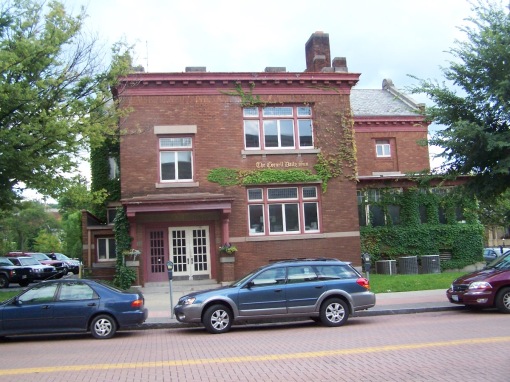
Regarding the Sun itself, the newspaper is based out of the former Elks Lodge building on the 100 block of West State Street, a block west of the Commons. The building itself dates from 1916, and the Sun renovated the building and moved into the 7,000 sq. ft. building during 2003 (prior to that, thsun rented space around the corner on Cayuga Street). The Sun is totally independent of the university, which is great because the school paper of the university I worked at this summer was nothing more than a mouthpiece for the administration and its cultish president, but I digress. The original Cornell newspaper was The Cornell Era, which was founded in 1868 and named as such because it marked the beginning of a great new era. Much to the Era’s chagrin, the Sun appeared on September 16, 1880, in the format of a four-page pamphlet-sized newspaper (Bishop 206).  The Era eventually became more of a literary magazine and shut down permanently in the late 1940s. The Sun has operated continuously since its founding.

The building itself is an interesting place ot visit. The main work area on the first floor has private offices, and a general work areas for contributors and writers filled with newspapers and article drafts from previous days. The upstairs has a spacious and stately wood-trimmed great room, which I suspect was probably used as a cermeonial/banquet room back when it was the Elks Lodge. I’ve never felt compelled to take photos inside the building, mostly because of the stares I would probably get.

Bishop, Morris. A History of Cornell. New York, New York: Cornell University Press, 1962. ISBN 0-8014-0036-8


Expecting A Warm Winter

4 10 2009

100_2434

Global warming completely aside, I think it might be worth noting that Ithaca can expect a warm winter for 2009-2010. This is because we’re in the middle of an El Nino year.

For those living under a rock, El Nino (or as meteorologists know it, the el Nino Southern Oscillation, often reduced to ENSO) is the much publicized periodic change in atmospheric and oceanic conditions highlighted by the shift of the eastern Pacific Ocean water temperatures to much warmer than usual conditions (typically most apparent off the coast of Peru). The effects on the Atlantic will lag somewhat behind the Pacific.

Well, El Nino conditions started to kick in during this past summer, around June. One effect that El Nino years (as they tend to last 12 to 18 months) have is that the Northeast is much warmer than usual during the winter. To illustrate this, I pulled the data for the last few El Nino years (Winter 06-07, Winter 02-03, Winter 97-98, and Winter 94-95, Winter 91-92) from the Northeast Regional Climate Center.

Month/Year Anomaly

Dec 2006 +8.0 F

Jan 2007 +5.6 F

Feb 2007 – 7.1 F

Dec 2002 -2.2 F

Jan 2003 -5.6 F

Feb 2003 -3.0 F

Dec 1997 +2.3 F

Jan 1998 +8.4 F

Feb 1998 +7.8 F

Dec 1994 +4.4 F

Jan 1995 +7.1 F

Feb 1995 -2.7 F

Dec 1991 +2.0 F

Jan 1992 +3.0 F

Feb 1992 +2.0 F

Data from pre-1995 is only available to those with research accounts. Thankfully, my senior thesis research has allowed me this perk. Anyways,  4 of the past 5 El Nino seemed to follow the typical pattern, and 2002-2003 did not. To be perfectly honest, that year is still under study as no one can really seem to explain what happened. A prevailing theory for a while was that it was another osciallation (the Pacific Decadal Oscillation) having an impact on El Nino, but that theory developed a big hole in it after a fairly typical 2006-2007 El Nino year. It takes 20-30 years for the PDO to change phases, so 2006-2007 should have been much the same, but it wasn’t.

Keep in mind this is all relative. Five degrees above normal during the coldest time of the year (late January) means a high of 35 and a low of 19. So don’t get too comfortable.


The Keyword Bar VI

7 09 2009
 100_1281

Yeah, I’ve been lax about updating lately. I have some things in queue, but I also have research going on, so things are a little hectic. Naturally I’m turning to my favorite cop-out of fielding responses to some of the search entries that have led people to the entries in this blog.

1. “alpha gamma cornell” (9/5/09)

This could be in reference to a fraternity or defunct sorority that the individual failed to incluse the whole name of, or it could be a reference to the research report “Hazed and Confused” by Adam Zwecker [1]. In Zwecker’s report of hazing within the Greek system of Cornell, he uses the psuedonym “Alpha Gamma (Phi)” in reference to a house that he was pledging that committed a series of hazing violations in flagrant disregard of system and campus policies. Rumor mill tends to associate the psuedonym with two or three different houses, and the actual house was reported to have been reorganized after the report to remove such dangerous activities.  I’ve heard the report used more than once as a reason why Cornell students avoid becoming part of the Greek system, which is unfortunate but I can definitely see the reasoning behind their decision.

2. “tke blackballed from lehigh” (9/4/09)

This one is interesting not because of who it deals with, but the term “blackballing”.  According to the fountain of information that is Wikipedia [2], blackballing is a rejection technique used in elections to decline membership in fraternities and gentlemen’s clubs. Typically, in Greek orgainzations, some method similar to blackballing or dinging is used to decline membership to potentially undesirable candidates. The name hails from the black balls used to signify opposition in elections in the fraternal orders of days long past.

Since the IFC at Cornell has made use in the recent past of an electronic system to keep in track of rushees visiting houses during Rush Week, and that the site includes the capability to record comments on these individuals submitted by houses, a person could be blackballed not just from a house, but from most/all Cornell fraternities if the comments are strongly negative. I imagine that would take an outstanding showing of stupidity.

3. “ithaca cornell share frat scene” (9/3/09)

I’m going to take this as a a question regarding whether Ithaca College and Cornell have uniform membership in greek houses. The answer is no for IFC and PanHel. Ithaca College banned Greek Life in 1980, and while there may be some underground groups, they operate separately from Cornell chapters. However, MGLC has found a way around this by creating “citywide chapters” which draw members from multiple colleges in the same geographic area. I’m aware of at least one MGLC sorority that has roughly half of its members from Cornell and half from Ithaca College. The legitimacy of these organizations with regards to Cornell’s greek affairs alone is debatable, but since most MGLC organizations are quite small, it probably doesn’t come up very often.

4. “three side dormitory cornell”  (8/30/09)

Donlon, but technically not correct, since it actually has six exterior sides. It’s just that the three curved sides are much more prominent.

100_1603 
Photo Courtesy of Cornell Facilities

Mary Donlon Hall was completed in 1961 as an all women’s dormitory, the last of the all women’s to be built on north campus before it went co-ed [3]. Mary Donlon Alger (class of 1915) was a prominent federal judge who served on the Board of Trustees for 29 years [4].

5.  “maximum building height town of ithaca”

Really depends on the zoning, but most residential zoning only allows a maximum height of 36 feet before a zoning variance is required. The two current projects beofre the board fall below that though; a 106-unit townhouse development by Holochuck Homes off of Route 96, and a 13-unit housing development called Cleveland Estates that will be south of Ithaca College off of Danby Road. The townhouse units might see some trouble because of traffic concerns and opposition to what the West Hill community feels would be an increase in crime if the housing is “affordable” (believe it or not, this is a leigitimate concern. The 128-unit Overlook at West Hill development has been plagued with what neighborhood residents feel are unreasonably high crime rates [5]). The town is looking into a moratorium on West Hill, which would effectively kill the proposal.

According to the West Hill Civic Association, this is the list of proposed and potentially developable properties that are under study:


1. Carrowmoor, 400 units, commercial space

2. Conifer (Linderman Builders), 100 more units (this is in addition to the 180 or so units already in place)

3. Holochuck Development, 106 units near hospital

4. Cornell Parcels, 33 acres off Trumansburg road

–Assisted care interested, 50 units of senior housing, (probably similar to Alterra)

–nothing formal before town

5. Land that can be developed, nothing set yet, Medical Center parcel

Tompkins County

6. Property off Bundy Rd. (67 acres)

7. Perry Farm (60 acres)

8.Kaderli Trade Inc. (100 acres)

9. Eco Village 3rd Neighborhood


***

[1]http://www.ilr.cornell.edu/smithers/docs/hazed_and_confused.pdf

[2]http://en.wikipedia.org/wiki/Blackballing

[3]http://www.fs.cornell.edu/fs/facinfo/fs_facilinfo.cfm?facil_cd=3026

[4]http://en.wikipedia.org/wiki/Mary_Donlon_Alger

[5]http://www.theithacajournal.com/apps/pbcs.dll/article?AID=/20090808/NEWS01/908080343


Cornell Criticism

12 08 2009

100_3851


What inspired this post were the none-too-charming rankings released recently by Forbes on their “Best Colleges” list [1]. The article itself wasn’t the trigger, but the comments, however…

Where’s Cornell? Where it belongs, behind a lot of small LAC’s where teaching undergrads is actually a priority.”

“…another thing I considered: Cornell has one of the highest suicide rates of all colleges/universities in the U.S. actually, at one point, it was the highest…”

(not true according to the New York Times, but that’s beating a dead horse…)

Now, I could really care less about overall school rankings. Cornell is one of top-rated schools in my field of study, so that’s about the only ranking I ever cared to know. But, there’s a little bit of dark humor to be found in the lengths that people will go to criticize other institutions.

Cornell, of course, is not new to criticism.  The school was maligned in its early years for being co-ed, for not having a religious affiliation, and for some faculty that ran dangerously awry from the norms of the time (one of which included a professor that was an atheist, which in the religiously driven nineteenth century was truly shocking and tabloid worthy). Even today, remarks of “SUNY Ithaca” and “the safety school of the Ivies” still manage to bother some of our thinner-skinned students and alumni. Read Ivygate’s comment section for examples [2].

In the early 1940s, there was “The Dilling Affair”. A student by the name of Kirkpatrick Dilling was brought before the Student Conduct committee and put on parole for engaging in stunts such as blowing dormitory fuses and filling ceiling lights with water. Well, his parents were extreme right-wingers who were convinced that their son was put on parole due to the committee’s underlying communism. Mrs. Dilling came to Ithaca, launched her own investigation, and published a scathering magazine report detailing how the reds has infiltrated the institution from President E. E. Day down. (Bishop, 568)

Sometimes, Cornellians are their own worst enemies. Consider the little feud between Ann Coulter and Keith Olbermann earlier this year. For anyone who wasn’t living under a rock, Metaezra has the full story [3], so I’ll take the liberty of abridging the drama. Coulter, a bastion of invective conservatism, made the remark that liberal mouthpiece Keith Olbermann didn’t go to the same Cornell, but rather state school Cornell (CALS). Most of us who went to Cornell, while aware of the difference (and that the only significant differences between them are source of funding and in-state tuition), but also know that criticism is about as bad an idea as sticking a knife in an electrical socket. But, Olbermann responded back by showing off his diploma on air and bragging about his Cornell degree, Coulter just had to respond back, and the catfight resulting in nothing more than embarassing just about everyone else who ever went to school far above Cayuga’s waters. 

Here’s some of my favorites – building criticisms, as recorded from respondents in the Cornell Alumni News:

Sibley Dome – “the breast of campus”

Rockefeller Hall – “public grammar school No .16”

Baker Lab – “A U.S. Post Office Conferred by a Republican administration”

Olin Hall – “might suit a department of alchemy better than chemical engineering”

…and that was before the sixties and seventies rolled around. The aesthetic critics must be rolling in their graves.

I s’pose Cornellians are their own worst enemies. To quote one more commenter from Forbes:

Wow! A lot of references to Cornell in these comments! As a Cornell graduate, I see that “complex” is still there for many Cornellians.

[1]http://www.forbes.com/lists/2009/94/colleges-09_Americas-Best-Colleges_Rank.html

[2]http://www.ivygateblog.com/2009/03/cornell-fan-admits-cornell-does-not-belong-in-the-ivy-league/#comments

[3]http://www.metaezra.com/archive/2009/03/ann_coulter_is_an_idiot.shtml


The Keyword Bar V

17 07 2009

100_0619

…because I’m too lazy at the moment to go from computer programming and into an entry that requires research on my part. Here’s a sampling of some of the search queries from the past few weeks.

1. “cornell honors fraternity” 7-17-09

Numerous and varied in their scope and goals. Like with social fraternities, the number of honors fraternities at Cornell seems to have decreased over the years as different organizations merged (often because they became co-ed and redundant) or closed. Here’s some current organizations that I can find (strictly professional fraternities are not included here):

A. Phi Sigma Pi – A general honors fraternity (3.0 standard) [1]

B. Alpha Chi Sigma – Honors chemistry fraternity (discussed previously in this blog)

C. Alpha Epsilon Delta – Pre-Med honors society

D. Eta Kappa Nu – Honors fraternity for compuer and electrical engineers

E. Golden Key – A general honors society for upperclassmen

F. Order of Omega – Honor Society for students in social fraternities or sororities. This one is more about who you know than it is about your GPA.

G. Phi Alpha Delta – Pre-Law honors fraternity

H. Phi Tau Sigma – Food Science honors fraternity

I. Pi Alpha Alpha – Honors Society for Public Administration and Affairs.

J. Pi Sigma Alpha – Government Honors Society

K. Psi Chi – Psychology Honors Society

L. Tau Beta Pi – General engineering honor society

For more info, just head over to http://sao.cornell.edu

2. “modern school no windows” 7-16-09

Windowless buildings have tended to be the product of kneejerk reactions to the energy crisis of the 1970s, or because they were (and in some cases still is) a relatively cheap way to maintain a climate-controlled facility (the lower floors of Bradfield, for example, which protect the plant genetics labs and cold-hardiness experiments). A personal example is that my mother went to a “new” high school in the 1970s that had no windows…by the time she graduated, they had already resolved that artificial lighting was too expensive in the long run, so they renovated it hardly five years after construction.

3. “cornell ilr looked down upon?” 7-13-09

Ask Matthew Nagowski over at MetaEzra. I look forward to his response.

4. “james gallagher, walmart architect” 7-13-09

Really? I didn’t realize Wal-Mart actually hired architects.

On a less facetious note, Wal-Mart has made attempts to diversify store facades to appease locals [2] — Ithaca’s is a good example [3].

5.”cornell couldiest place on earth” 7- 15-09

Ignoring the spelling, the question is still ridiculous. The number of cloudy days in Ithaca in a given year is 206 [4]. While there seems to be some debate as to the cloudiest place on earth, Anchorage, Alaska has 239 cloudy days in a given year, and St. John’s. Newfoundland records 255 cloudy days in a given year. From what I hear, Ben Nevis, a mountain in Britain, records about 290 cloudy days. As an atmospheric science major and as a CNY native, questions like this irritate the hell out of me.

6. “urban outfitters ithaca opening” 7-11-09

This question has appeared in some form about a dozen times in the past two weeks. based off of job postings, the target season seems to “Summer 2009”. According to the CNY Business Journal, the target date is/was July 2, so if someone wants to verify that, that would be great.

7. “redneck castle” 7-10-09

A double-wide trailer with turrets. The royal carriage is a rusted 1976 Chevy Nova.

8. “chi omega coming to cornell” 7-3-09

Possibly, possibly not. Logically, it wold make sense for either Chi Omega, Alpha Omicron Pi or Delta Phi Epsilon to revitalize their dormant Cornell chapter, as they were the last ones to leave campus. However, I’m fairly sure it depends on whether they submit intent to Panhel, who then chooses who they think would be best suited for campus. Using Alpha Xi Delta for example, the more recently closed sororities may not  be the ones invited back to campus. It’s something to keep an eye on in the upcoming year.

9. “married at sage chapel 2009” 7-9-09

Many, many weddings take place in a given year at Sage. I hear that getting a marriage set up in Sage is a bit like Thanksgiving shopping; the best days go to those who are ready earliest, which often requires hours of waiting in anticipation for the annual schedule to open. The rental fee is $300 [5].

10. “cornell’s secret societies” 7-5-09

I’m responding to both this and a comment from a reader suggesting I post them anyway. I was approached face-to-face, which was enough of an impetus for me to remove them. That being said, my work was copied by another website (without my permission, but I gave up trying to get them to remove it). If you look hard enough, you’ll find what you’re looking for, but it won’t be on this blog.

_____________________________________________________________

[1]http://rso.cornell.edu/psp/cms/?q=node/15

[2]http://www.interiordesignschoolreview.com/news/2004/06/walmart_uses_architecture_to_defuse_opposition.html

[3]http://cornellsun.com/section/news/content/2008/12/01/wal-mart-remodeling-moves-forward

[4]http://www.123syracuse.com/cloudycities.html

[5]http://www.cornell.edu/search/index.cfm?tab=facts&q=&id=630


Cornell’s Founding Fathers: Andrew Dickson White

29 06 2009
100_2070
Continuing the Founding Fathers entries, we’ll stop at the other man who helped the university go from a pipe dream to a stone and mortar reality, the illustrious Andrew Dickson White. Once again, the primary source is Bishop’s History of Cornell, with the page numbers in parentheses.

In terms of upbringing and character, White was quite much Cornell’s opposite. White was born in 1832 in Homer, which is also in Cortland County (30). The family moved to Syracuse when he was seven, and his father was a prominent banker. He rejected his Episcopalian upbringing, so his father tried to rectify that by sending him to a church school, Geneva College (now Hobart and William Smith), where he was a sophomore at the age of 16. Since the school was esssentially a bunch of drunken partiers (31), he left after one year (try to imagine studying for an exam while your classmates had barricaded themselves in a room and were attacking the president’s house. It was really that bad).  Although, I find it odd that the entire college had 37 students, and he still joined a fraternity (Sigma Phi). Frats were different animals in those days. Anyways, his father wanted him to go back, but when he showed up, he promptly left school and hid with a former teacher of his while he studied up for Yale’s entrance exams. At this point, old Horace White was furious, and said he would’ve rather received news of his son’s death. Well, A.D. passed the exams with flying colors, and entered Yale as a sophomore, spending a few happy years there, being a member of Skull and Bones and Alpha Sigma Phi (which was a class society back then, before it became a social fraternity — although, he was a tremendous asset to both fraternities as they established themselves at Cornell). After graduation, he hung out in Europe for a couple years, attending German and French schools and becoming all worldly and multifaceted. He arrived back in New Haven in 1856, where he obtained an M.A. and almost became professor, were it not for his anti-church sentiment. He was accepted as a professor at the progressive University of Michigan in 1857 (35), and married Mary Outwater of Syracuse that same year (38). After Horace White died (leaving him $300,000, an astonishing sum in 1860) and the Civil War broke out, White took a long leave of absence and came back to Syracuse in 1862 (41). Being politically inoffensive yet well known in Syracuse, he was nominated for and elected to the State Senate in 1863, hardly 31 years old. Here he met Ezra Cornell.

Skipping the university and focusing on White, he served as university president from 1866 to 1885. During and after that time, he served as ambassador to Germany, minister to Russia, and comissioner to Santo Domingo in the Dominican Republic. He was suggested for the Republican presidential nomination in 1884, and for vice-president in 1900. White passed away in November 1918 at the age of 86.

A.D. White’s oddities are so quirky to provide juicy details to any biography about him.

-For one, he was quite short, about 5 feet 5 inches. He was really sensitive about his height, and likely wore elevator shoes (he never admitted it) (43).

-White loved the ideals behind a great university, loved designing buildings and promoting Cornell qualities in print and in speeches—but he hated running the day-to-day affairs. Such work bored him. For a guy know to be excitable, nervous and emotional, routine affairs were not in line with his interests.

-He often dreamed of being an architect or journalist (his architectural designs were based off of  his adored Oxford, which he would’ve made sweet love to in a hypotheical world). He felt that red brick made a building look cheap, hence his distaste for Lincoln and Morse. This is why they were built when he was abroad. [5]

-He only really considered three men his social equals – Goldwin Smith, Willard Fiske, and W.C. Russel (the vice-president of Cornell in the 1870s and 1880s) (45). He hated to be overshadowed and outdone (47), and while he was a sucker for flattery, he would dwell on criticism for days at a time.

-He was known for being very high-minded. One student publication (47) in the 1870s referred to him as “Andy Deity White”. Friends and accquaintances would mockingly refer to him as “You Majesty” and “Saint Andrew”. This high-mindedness was probably why he hated pranks.

-His wife hated Ithaca. Prior to 1874, he used to go up to Syracuse on the weekends. In those days, that involved a steamer on the lake during the warmer season, or in winter a buggy trip to Cortland to catch a train. This was no fun in the CNY blizzards. (100)

-He threatened to resign many times: in 1870, 1871, 1872, 1873, 1879 and 1883. Even when he didn’t resign, he was abroad so often that trustees and staff were begging for him to come back and actually do this job (200).

-Although he was an avid rower at Yale, he never watched Cornell sports matches. He never saw a football, baseball or basketball game (he considered football barbaric), and only saw a Cornell crew race five years after he left the presidency (48).

-He loved animals. He expelled a student in the 1880s for killing a chipmunk with a cane (49). He would allow squirrels to run through his library, even when they chewed on his books.

-His commisioner job in Santo Domingo was because he had to decide whether or not the U.S. should annex the Dominican Republic and make it into a “refuge for colored people” (103). We’re going to assume that his progressive nature, and the fact that the Dominican Rep, was never made into a second Liberia, to mean that he recommended a “no”.

-White’s ultimate grudge came from where he felt he wasn’t given enough credit. When Charles Adams took over as president, he gave an 86-minute inaugural speech, of which 12 were dedicated to White. He was gravely offended because he felt his work was ignored (he expected Adams, a former student of his at Michigan, to glorify him). (258)

-A.D. White met Leo Tolstoy while working in Russia. Tolstoy shared his fascination with Mormonism with White, who then also became fascinated, and amassed a collection of Mormon literature second only to that of LDS and Brigham Young U. itself. This was possible beause the Mormon faith was founded near Rochester, hardly an hour drive from Ithaca, so he raided local collections. [2,3]

 He was a great man, of course. But White would’ve been the old guy to tell lone, rambling stories that would put people to sleep, full of his own pomp and circumstance and still trying to share his ideals with anyone who had two ears and half a heart to pay attention. He was rather needy and attention seeking, and begrudged those whom he felt didn’t give him proper credit.

Our founders are only human.

[1]http://www.cornell.edu/president/history_bio_white.cfm

[2]http://www.absoluteastronomy.com/topics/Andrew_Dickson_White

[3]http://en.wikipedia.org/wiki/Life_of_Joseph_Smith,_Jr._from_1827_to_1830

[4]http://www.fullbooks.com/Autobiography-of-Andrew-Dickson-White1.html

[5]http://www.chem.cornell.edu/history/laboratories/Morse.htm


Cornell’s Founding Fathers: Ezra Cornell

27 06 2009


100_2075

So, one of the comments received recently on this blog suggested I write an article on an individual. I thought about it, and then  decided against it. I’m limited in what I can say, as I’m sure people have both good and bad opinions of this person, as they would anybody. I write about Cornell and groups that comprise it, but with the extraordinary exception of Mary Tomlan ’71, I generally limit myself in comments on individuals.

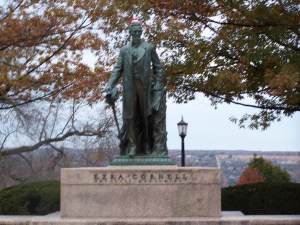
However, I decided to take the idea and run with it in another direction, by revealing a little of the history of the founders who shaped much of the university in its formative years. This entry will cover Dear old Ezra Cornell himself. Any citations within the entry will refer to Morris Bishop’s History of Cornell unless otherwise noted.

A lot of Cornellians know bits and pieces about the founders of Cornell. Dear old Ezra himself, born in 1807 in downstate New York to a quaker family (Bishop 8), moving to the Cortland County town of DeRuyter at 12, and then to the boomtown of Ithaca in 1828. According to Bishop, he was a tall, gaunt gentleman, disinclined to show emotion or to talk more than necessary. He married Mary Ann Wood in 1831 (12). Initially, Ezra made his living operating a flouring mill for Col. Jeremiah Beebe (flouring mills would ground up gypsum to be used in fertilizer). After the Panic of 1837 (akin to today’s economic crisis, only craploads worse), he lost his job and tried his hand at several ventures, including selling plows in Maine and Georgia, which failed (15). When he went back on another trip to Maine in 1843, he lucked out, and an accquaintance asked him to design a machine to lay telegraph lines. Being a self-taught mechanic, he built it, received a contract to lay the wire, became convinced it was bad method, and read up on electricity, coming to the conclusion that overhead wires were best (16).

As a builder of wires, he made his fortune, and by 1849 had laid one-third of telegraph wires operating in the U.S. (17). Since he took his payment in stock, when Western Union bought him out around 1855, he was a made man. He went back to Ithaca, bought the land where CU sits today, and ran a model farm. He became president of the NYS Agricultural Society, and used some of his money to donate a library to Ithaca City (which was built at the SE corner of Seneca and Tioga it was demolished in 1960 as part of urban renewal. It was turned into a parking lot). He was the oldest member of the State Senate when he was elected in 1863 (persumably in the days before they had political gridlocks that accomplished nothing but gave everyone a mighty headache). It was here that he met A.D. White, when he was getting a bill of incorporation for the library (White, as the head of the Literature committee, had to approve the bill). I’ll be covering Andrew Dickson White in an entry in not too near future.

So anyways, the basic facts are great and all, but Ezra also had his oddities and faults. These are the facts Cornell probably doesn’t share so much. Can’t blame them-

~Ezra was extremely self-righteous, which led to him being scorned by most of the Ithaca community. He was also extremely forgetful with regards to his debts, and his family’s needs (Bishop 13). People did not trust him, especially with money. For many years, his wife and kids had to live off her father thanks to his lack of provisions.

~He was apparently quite tactless as well. Col. Beebe, and later Samuel Morse (of Morse code fame) would have a hard time dealing with his demeanor. Beebe called him “coarse and impudent” (13), and Morse referred to him as “the plague” (17).

~Carl Becker just out-and-out called him a bad businessman. The fact that he managed to make a fortune in the telegraph industry was astounding to even his own family and friends. He beat competitors by “starving them out”, even if it meant keeping himself in the poorhouse. (18)

~Family and friends did not pronounce his last name Cor-nell. They pronounced it Corn’ll. His own pronounciation of his name changed sometime in the late 1840s or early 1850s. (19)

~Cornell hated Syracuse. He referred to as “that Gomorrah” (11) after he was cheated out of some wages when he was young. Kinda funny that A.D. White represented Syracuse in the State Senate. When White proposed using a large hill to the south of Syracuse, Cornell threatened to withdraw from the proposal unless the university was moved to Ithaca, which he had hopes of becoming a major city. Well, it didn’t, and the proposed hill was where Syracuse University established itself in 1870.

~Cornell’s vision of the campus was that of an industrial campus, egalitarian in nature. Namely, anyone could work their way through school, in the chair factory and shoe factory he proposed to set up on campus (126),like a trade school. One could not have been farther from the classical college educations of that time, or from A.D. White’s vision of CU.

~Perhaps tying to Cornell’s unorthodox nature, a Rochester newspaper concocted a story in October 1869 that Cornell sought to make a huge personal profit out the university (183). Doesn’t sound too different from the stories you find in editorials in the Ithaca Journal about how Cornell ruins the city. It came up again in 1873, when a Schuyler County legislator accused Cornell of defrauding the Morrill Act in order to make a $22 million profit, which resulting in a formal state invesitgation (it cleared Cornell in April 1874[186]).

~Cornell loved to invest in railroads as much as he did his own university. His desire to make Ithaca a major city resulted in a constant investment in new railroads in and around the area, such as the Elmira-Ithaca-Cortland route and a proposed route to Auburn. He invested so much that White and Cornell’s attorney thought he might go bankrupt if something were to happen, like the Panic of 1873. Uncle Ezra lost a lot on those failed railroads (187).

~In what I can only describe as completely creepy, Ezra had nine kids [1], and sadly, one of them, Charles Carroll Cornell, died at the age of 4 in 1837. So Two years later, his wife had another son. They named him Charles Carroll Cornell. This child died at two years of age, so at least he never had to realize the utter sketchiness associated with named after one of your dead older brothers.

Long story short, Cornell could be stereotyped as the rather crotchety old man who would scare small children at a glance and launch into stories of “when I was your age” to be shared with the students.

http://en.wikipedia.org/wiki/Ezra_Cornell

http://rmc.library.cornell.edu/Ezra-exhibit/time/ECfa.timeline.html

[1]http://www.nndb.com/people/456/000135051/


Rumor Mill: Alpha Xi Delta’s New House?

9 06 2009

Being in another part of the country sort of limits my ability to keep this blog as active as it usually is. That being said, occasionally some tip or rumor comes along, and if it piques my curiosity, I’ll sooner or later get around to addressing it.

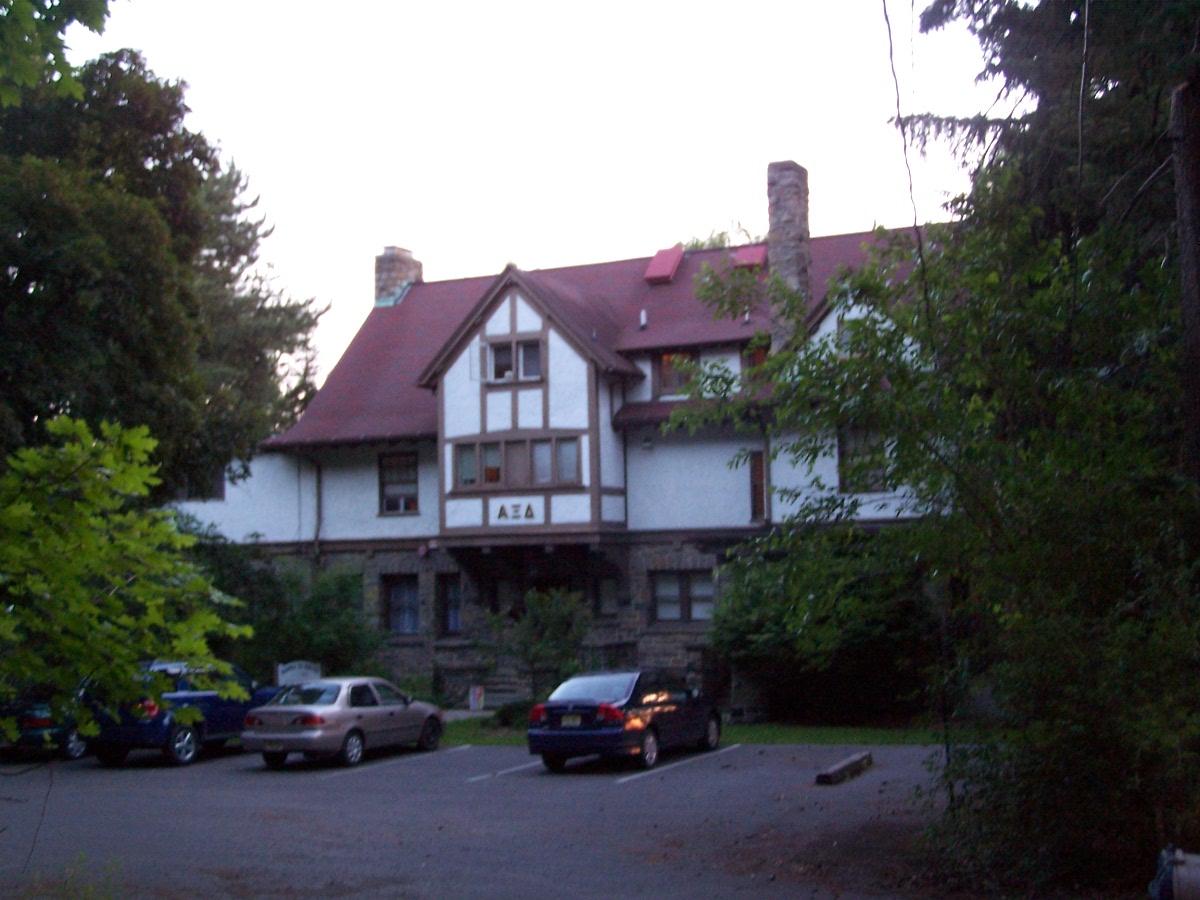
In this case, it would appear that popular rumor is ciruclating that Alpha Xi Delta sorority would be moving into Alpha Omicron Pi sorority’s old house. To make a long story short, AOPi closed this past year for a number of reasons, leaving their recently renovated (and rather luxurious, if I dare say) house on Ridgewood Road open. The house itself has a long storied history of being involved in the Greek system, with no less than four different Greek organizations calling at home at some point or another in its nearly one-hundred year history (see other entries).

The rumor has its plausible points. For one, Alpha Xi Delta doesn’t own their house at 115 The Knoll. That house is still owned by Delta Phi Epsilon sorority, which closed about six years ago [1]. Rumor mill seems to suggest that Alpha Xi Delta’s moving to Ridgewood may not be permanent, as AOPi stated that once the last sisters graduate (2011?), the sorority is hoping to reactivate itself, persumably in the house it owns.

I guess my question is, if the rumor turns out to true, then what’s being done with 115 The Knoll? Is Delta Phi Epsilon reactivating, or is the house intended for another purpose? I s’pose only time will tell on this one.

 [1]http://www.rso.cornell.edu/DPhiE/DRhistory.html