Cornell Graduation Rates

25 10 2013

4-8-2013 231

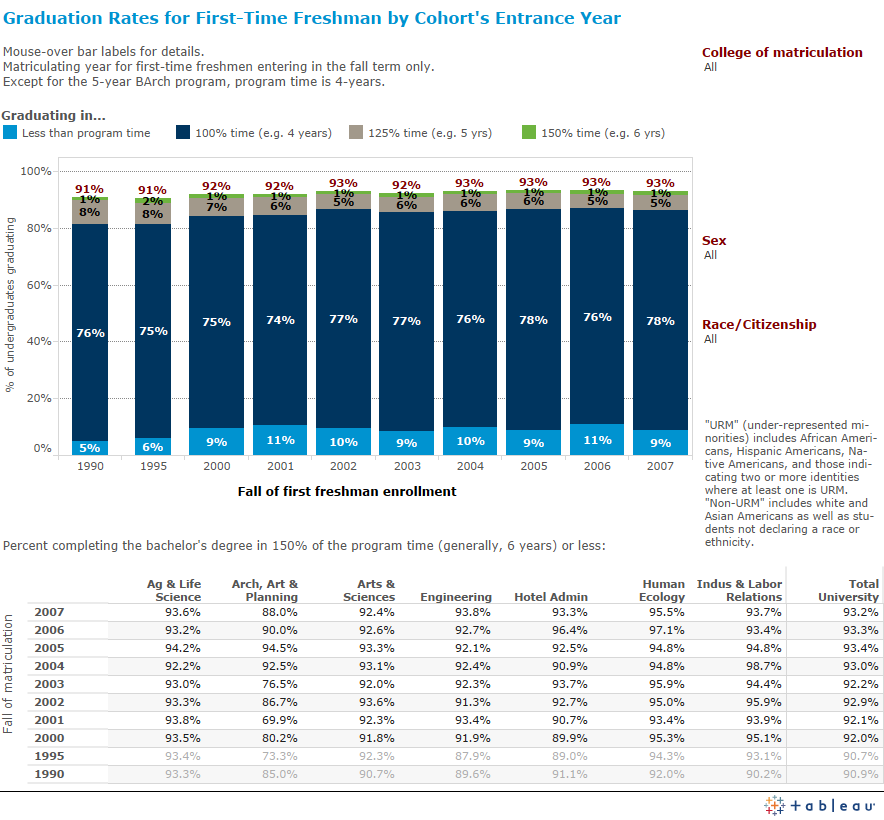
Graduation; perhaps the most important part of the Cornell experience. Facts are from the university factbook, as is the image below:
Freshman_grad_rate_trends

-For freshman who started in Fall 2007 (graduating 2011-2013), the overall university graduation rate (frosh who finish in six years or less) was 93.2%. Human Ecology set the standard at 95.5%, with most of the other schools clustering near the average, except for AAP, which polled at only 88%. Arguably, AAP’s number are more prone to skewing, since they’re the smallest college and it takes 5 years to complete architecture degrees; but the facts are what they are, AAP usually ranks below average, and is often the worst of the seven colleges for graduation rates.

-Over the decade, graduation rates jumped in the first half from 92 to 93.4%, but have dipped slightly since. The number still poll better than the 1990s, when graduation rates were just under 91%. The localized max is 98.7% for Fall 2004 ILR freshman, and the local min is the 69.9% for fall 2001 AAP freshmen. Compared to the 1990s, students seem to averaging a slightly quicker completion of their courses of study, with an increase in the less-than-4 year path, and a decrease in the percentage of super-seniors.

-Women consistently graduate at slightly higher rates than men. In 2007, 95% of women graduated within six years, vs. 91% of men. This is consistent across schools and in most years, though in some years the gap is as low as 1%, but the gap has trended slightly larger in the past few years.

-University-Recognized Minorities (URMs, referring to non-white and non-Asian students) graduate at slightly lower rates, 88% for those starting in fall 2007 (the value has been in the upper 80s for most of the past decade). URM males fare worse, at 85% for fall 2007’s freshman class. For African-American males, the rate has been as low as 75% in recent years.

-International student finish at rates not substantially different from the general student body, but they finish in less than 4 years at much higher rates – 20 to 30% of those freshmen will finish early. If I remember correctly (i.e. I can’t seem to find anything to back this up), certain countries, like Singapore, push their students to finish as quickly as possible.

-About 1 out of every 8 students will graduate from a college different than the one they were enrolled in as a freshman (ex. started in Arts and Sciences, finished in CALS). There’s no real trend over time, or for school transfers (evidence that AEM is trying to become more exclusive?)

-Transfer students graduate at rates virtually identical to those who started at Cornell as freshmen, with the exception of AAP, where they do not do as well. Once again, small incoming transfer numbers can skew this figure easily.

-About 3-4% drop out after freshman year. From there on, about 1-1.5% who finish their sophomore or junior year will not come back for the subsequent year of their matriculation.


Cornell and Carl Sagan

26 01 2013

100_1714

When I came up for the idea of this topic, I was originally a little hesitant to write an entry. Unlike A.D. White or Dear Uncle Ezra, there are probably a number of readers who can remember when Sagan was alive and active on campus (Sagan passed away in December 1996). If the number of hits I receive for his old house at 900 Stewart Avenue are any clue (~600 hits since this blog’s inception), the late astronomer and Cornell professor remains a relatively popular figure. As someone who was just a kid when Carl Sagan passed away, it’s a little harder for me to identify, and in Sagan’s place, figures such as Bill Nye and Neil DeGrasse Tyson fill different niches not-too-distant from Sagan’s public role.

With all that in mind, I decided to take an approach similar to what I did with my “Founding Fathers” entries, and provide a smorgasbord of tidbits. I have no intention of delving into his interests of extraterrestrial life, agnosticism/humanism, or marijuana use, but the wikipedia entry would be a fine substitute for those interested in those topics.

-First off, the basic facts. Carl Sagan arrived at Cornell in 1968. We should only be so lucky that the high minds of Harvard decided to deny him tenure the previous year, because they were unhappy with his “pandering to the public”. Sagan became a full professor of the astronomy department in 1971, and remained so (the David C. Duncan Professor in the Physical Sciences) until his untimely death from pneumonia while recovering from cancer a quarter-century later.

-Carl Sagan might have been an excellent publicist for science, but few would call him a focused academic. The filming of his Cosmos  television series in Los Angeles in the late 1970s forced the university to cancel several of his courses, and several grad students under his advisory had to move into the research groups of other department faculty. His astronomy colleagues were unimpressed with this shirking of duties and attempted to have his lab kicked out of the Space Science building.

-Things were not a whole lot better upon return to campus, the blessing and curse of the success of his television series and associated NYT bestseller. While Sagan garnered much favorable publicity and considerable wealth, he was also subject to death threats from those in vehement disagreement to his views. Police regularly patrolled his home, and his name was removed from the Space Science directory and from his front door, out of safety concerns (this policy must have relaxed late in his career). Some of his colleagues remained unenthused about him, accusing Dr. Sagan of being an egotist, blurring the lines between fact and fiction, and failing to give other scientists due credit.

-While at Cornell, Sagan began a critical thinking course (ASTRO 490). This course was under his guidance until he was hospitalized in 1996, when other faculty filled in. The course was discontinued after his death, but was brought back under the tutelage of other faculty a few years later. Under Sagan’s time, the course could only be enrolled into after completing a rigorous interview process for one of the 20 available slots.

-On the note of Neil deGrasse Tyson, Sagan tried to recruit him to do his undergrad at Cornell. Unfortunately, the future Dr. Tyson chose to go to Harvard instead. Bill Nye had Sagan as a professor, so perhaps Sagan has had more of a hand in the science communication to Generation Y than we realize.

-One of the more whimsical tales of Sagan is that during the height of his popularity, he had a secret tunnel from his home to campus, where he could drive his Porsche away from prying eyes. In reality, he would walk some of the back-trails along the gorge.

-Another reason to seek anonymity – Sagan used a vanity plate inscribed with “PHOBOS”, a Martian moon. These vanity plates became a hot souvenir for anyone with a screwdriver and ten minutes, since 900 Stewart has no driveway or garage (rather, it has a deep curb). Sagan eventually caved and asked the DMV for a more anonymous plate.

-I’ve already covered Sagan’s home a couple of times previous, but a quick rehash – built in 1890 as the meeting place for the Sphinx Head secret society, who sold it their neighbor, Dr. Robert Wilson, in 1969. The building went relatively unused, and was once again, this time to Dr. Stephen Mensch, in 1979. Mensch renovated the property into a home, and actually allowed Sphinx Head to make occasional use of the property. Sagan acquired the property in the 1980s, and the house is still a part of his estate, though it is vacant. According to a 1993 DUE, Sagan likely did not live in the property towards the ends of his life.

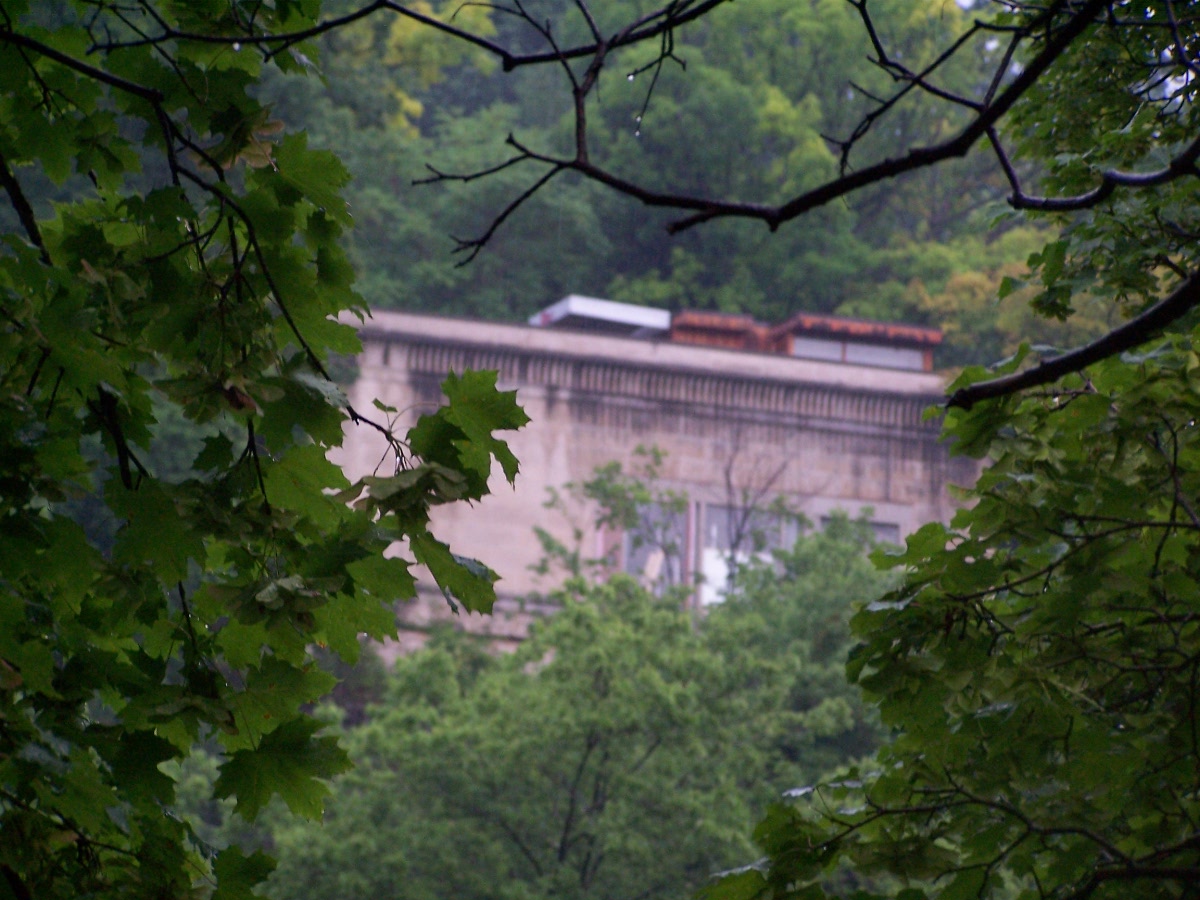
Although vacant, it would be ill-advised to try to trespass – the property is covered with security cameras, one of which is right above the entrance-way (the not-visible corner in the below photo).

On a personal note, when I had taken the photos of the former Sagan residence, I had not known this was his home. I just thought it was a highly unusual building in an area of mostly early 20th-century homes. It was not until I typed the address into my search bar when I came home that I discovered the building’s significance.

100_1690


Cornell’s Geneva Campus

6 08 2011

So, when we think of Cornell’s campus, most people think of Ithaca. Occasionally, someone also might mention the medical school down in New York City. But in the ag school, asking the right person, might result in an unexpected response – Geneva, New York. Geneva is a small city of about 13,000 located about 50 NNW of Ithaca, on the northern end of Seneca Lake, and although most folks could not care less about the community, it does have some importance for the university thanks to the presence of the Geneva Lab.

The formal name of the Geneva campus is the “New York State Agricultural Experiment Station“, often referred to as the Geneva Lab for short. It also started off as a rival to Cornell, at least when it came to research grants. The Geneva Lab was started in June 1880 thanks to state funding, although Cornell had sought the funding from the state (Bishop 223). The lab started off with a staff of seven scientists. After the Hatch Act provided further funding for agricultural experiment stations in 1887, the competition created between the two created tense relations throughout the turn of the century. To is credit, Cornell had their own experiment station since 1879, but it sorely lacked funding (keep in mind this was during a time when the ag school had an almighty 50 students, give or take a few each year). Thanks to increased state and federal funding with the second Morrill Act, state appropriations, and the Smith-Hughes Bill, money became easier to obtain, and relations had improved enough by WWI that Cornell professors routinely exchanged with researchers at Geneva for various ag-related projects (Bishop 440).
By 1923, the state authorized the Geneva research station to be placed under Cornell’s control. At this point, the two were basically working together on most everything and trying to avoid redundancies in administration, so by 1920 they were already informally affiliated. The Geneva station had a staff of 55 and hundreds of acres would benefit the ag school’s research, while taking advantage of Cornell connection, including the Cooperative Extension program.

More funding started coming Cornell and Geneva’s way with the Purnell Act in 1925, which led to Cornell-owned ag research facilities in the Hudson Valley and on Long Island, near Riverhead (Bishop 477).  The Geneva facility’s research shifted from helping farmers produce good crops, to making better products, such as making pears disease-resistant, new apple varieties, and working with Birdseye Foods on better quick-freezing techniques for vegetables. By 1940, the researchers at Geneva were made faculty in the ag college.lastly, animal-related research was shifted over to the Ithaca campus at the end of WWII, leaving the Geneva lab to strictly plant-based work.

Today, the Geneva campus comprises 20 buildings (623,000 sq ft), 870 acres, and about 300 faculty, staff and grad students. Most of the work done these days is the development of improved food safety and storage techniques and genetic enhancement of crops to create more productive or tolerant varieties. The four programs shared between the two campuses (which were merged as a post-recession cost-cutting measure last year) are Entomology, Food Science, Horticulture and Plant Pathology.

In summary, Cornell has a large presence in upstate New York, and it’s not just in Ithaca. So, maybe the proposal for the new school on Roosevelt Island in NYC isn’t all that unusual for Ezra’s research university.


Munier’s Grading Guide

29 07 2011

Let’s face it – the majority of students as Cornell are driven by their GPAs. For grad school, for their first job, or whatever their immediate postgraduate endeavor. Sure, they may not mean everything, but GPAs are important enough that many people are dedicated to getting as close to a 4.3 as possible.

However, as anyone who’s been at Cornell for a while can recognize, grades are not distributed evenly, especially between majors. Sure, you could work hard and maybe pull a B+ in a course where the average is a B, but few people would turn down the opportunity to pad their transcript with an easy A. Well, Cornell recognizes this, and has begun to print the median grades for that class, as well as the grades a student has in a course, on their transcript, starting with the class of 2012.

It helps to get an idea where certain median grades lie. For a while, Cornell printed median grades and posted them online. Well, that only fueled the culture of “easy A classes”, so they stopped. Enter Munier Salem ’10’s cleverly-done guide to median grades. Using the fall 2009 median grade report, Munier put together an interactive infographic describing the distribution of grades in a given department (ASTRO, ASIAN, PHYS, and so on).

Now, I could’ve summarized it, but Ivygate already did that. So, I’m going to try a different tack.

I’m a CALS alum. So my interest is in CALS departments (regardless of whether or not they’re shared between schools – I’m looking at you BIO). Using the infographic, I pulled the percentages for different grades in a given CALS department and assigned a value to the grade itself – a 10 is an A+, a 9 is an A, 8 is an A-, and so on. The results in the graphic are actually given in a bar graph, but this method will break it down to just one mean value for simplicity. In example, say EXMPL has four courses – one with an A average, one with an A- and two B’s. (.25 * 9) + (.25 * 8 ) + (.5 * 6) = 7.25, just above a B+ average. Note that this doesn’t take the number of credits a course is worth into account, and in the infographic only a few larger majors are broken down by the course number of the class. Lastly, the quality of students can vary somewhat between majors (the dairy science concentration in Animal Science comes to mind). In conclusion, my grade exercise is more for show than for anything of real value.

AEM: 8.08

ANSC (animal science): 7.83

BEE (bio engineering): 7.57

BIO (standard biology): 7.13

BSOC (bio & society): 7.01

COMM: 8.05

CSS (crop& soil sci): 7.33

DSOC (dev. sociology): 7.66

EAS (earth&atmos sci): 7.34

EDUC (which is being phased out): 7.54

ENTOM (entomology, i.e. bugs): 8.15

FDSC (food sci): 7.70

HORT (horticulture): 8.01

INFO (info sci): 7.72

LA (landscape architecture): 7.89

NS (nutri sci): 8.06

NTRES (natural resources, a.k.a. natty res): 7.88

PLPA (plant pathology): 7.34

Now, this doesn’t take different majors into account, who may take courses from a few different departments. But if we do place any value in this, it’s that it’s good to be an AEM or entomology major, and that you might want to avoid biology & society courses (refuting my own belief that using the word “society” in any course meant it was an easy class).