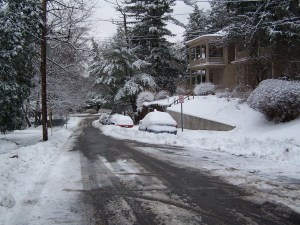
Global warming completely aside, I think it might be worth noting that Ithaca can expect a warm winter for 2009-2010. This is because we’re in the middle of an El Nino year.
For those living under a rock, El Nino (or as meteorologists know it, the el Nino Southern Oscillation, often reduced to ENSO) is the much publicized periodic change in atmospheric and oceanic conditions highlighted by the shift of the eastern Pacific Ocean water temperatures to much warmer than usual conditions (typically most apparent off the coast of Peru). The effects on the Atlantic will lag somewhat behind the Pacific.
Well, El Nino conditions started to kick in during this past summer, around June. One effect that El Nino years (as they tend to last 12 to 18 months) have is that the Northeast is much warmer than usual during the winter. To illustrate this, I pulled the data for the last few El Nino years (Winter 06-07, Winter 02-03, Winter 97-98, and Winter 94-95, Winter 91-92) from the Northeast Regional Climate Center.
Month/Year Anomaly
Dec 2006 +8.0 F
Jan 2007 +5.6 F
Feb 2007 – 7.1 F
Dec 2002 -2.2 F
Jan 2003 -5.6 F
Feb 2003 -3.0 F
Dec 1997 +2.3 F
Jan 1998 +8.4 F
Feb 1998 +7.8 F
Dec 1994 +4.4 F
Jan 1995 +7.1 F
Feb 1995 -2.7 F
Dec 1991 +2.0 F
Jan 1992 +3.0 F
Feb 1992 +2.0 F
Data from pre-1995 is only available to those with research accounts. Thankfully, my senior thesis research has allowed me this perk. Anyways, 4 of the past 5 El Nino seemed to follow the typical pattern, and 2002-2003 did not. To be perfectly honest, that year is still under study as no one can really seem to explain what happened. A prevailing theory for a while was that it was another osciallation (the Pacific Decadal Oscillation) having an impact on El Nino, but that theory developed a big hole in it after a fairly typical 2006-2007 El Nino year. It takes 20-30 years for the PDO to change phases, so 2006-2007 should have been much the same, but it wasn’t.
Keep in mind this is all relative. Five degrees above normal during the coldest time of the year (late January) means a high of 35 and a low of 19. So don’t get too comfortable.
 Ithacating in Cornell Heights