So, I study meteorology at Cornell University. When this comes up in conversation with someone for the first time, there are three basic responses:
1) So you want to be on TV, right?
Actually, no. I’d like to something in operations, like the National Weather Service. Granted, a few of us do pursue broadcasting as a career, but not many. Many of them are actually communications majors (seriously, just google Al Roker or Willard Scott).
2) Hey, that’s a great job! You’re one of the only people who get paid to lie!
I’m not a politician. I look at models. I determine with the best of my ability what is going to happen. Weather is very dynamic, so if the high is off by two degrees, or it rains a half-hour earlier than expected, it’s not my fault. And you can go screw yourself.
3) So what do you think of global warming?
This question is one I try to dodge when I can. When I can’t escape it, I give the formulaic, highly technical response taught by my professors:
“Global warming is happening. We don’t know why.”
This is part where the second person refers to me as a diplomatic pansy. But I can live with that.
With regards to my major itself, I like to think of it as the illegitimate child of the engineering and hotel school, so they threw it to CALS. Cornell meteorologists, or “meteos”, take a lot of physics and engineering classes, particular engineering math. This means that a GPA doesn’t tend to stand out too well(specifically, mine—thank you differential equations). Yet, we’re a very close-knit, social bunch. Well, most. This major hemorrhages people like blood from a stabbed hemophiliac, so the ones that are left are bound to grow close. My class of 21 (and falling) is at the point where everyone knows everyone, and usually can share some embarassing story about their classmates becoming intoxicated at a Happy Hour. This is where the hotelie reference comes into play. My majors throws its own parties. We call them Happy Hours, and they happen at least once a month. And sometimes, the faculty will play beer pong with the students. And we bond, and we help each other out through good times and rough periods. This is why that even though the engineering courses give/gave me a lot of bullsh*t, I still love my major. But I might accidentally spill a can of gas all over the front of Thurston Hall someday, and accidentally drop a match onto it. Accidents happen.
Meterologists live in the enormous monstrosity known as Bradfield Hall [1]. Bradfield was built in 1968-69. Considering what else came out of the late sixties (hallucinogens and hippies), this is not a good sign. The building was designed to house agronomy, water resources-hydrology, and crop and soil sciences. Hence, they needed climate controlled rooms. And what was architect Ed Rosen of Ulrich Franzen Group’s way of dealing with this? Why, let’s have no windows in the building. Because everyone loves a misshapen thirteen-floor* windowless brick box of crap. It took much protesting from the meteorology department to get a band of windows on the top floor. Why the university continued to employ the firm[2] is beyond my grasp. The construction company forgot to actually attach the brick wall to the steel frame of Bradfield, so for the next decade or so after completion, the building was sandbagged, as bricks would randomly pop out of the building and plunge into the street or parking lot below (I wonder if any ever punctured roofing on neighboring Emerson Hall?). At the same time, the firm designed Martha Van Rensselaer’s North Addition [3]. It was essentially an upside-down trapezoid, cantilevered above the street. Hahaha, we forgot how to build and design with this one too, because by 2001, it had to evacuated; structural deficiencies made it liable to tumble down onto the street below [4; photo below from Cornell Facilities]. And then, Franzen designed some Vet School buildings, and the Boyce Thompson Institute in 1978, but these hideous additions have yet to be demolished for being structurally unsound.
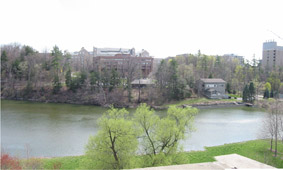
As of this time, Bradfield is the second tallest building in Tompkins County, at 167 feet (McGraw Bell Tower is six feet taller). But it does have the highest habitable floor, so it’s fitting that the major that studies the sky sits at the top of the tallest building.
[1] http://farm1.static.flickr.com/16/22952335_a3f96c0bf3.jpg?v=0
*Eleven floors, with two sub-basement floors. Some records read it as fifteen floors, but this is false.
[2]http://www.people.cornell.edu/pages/cre8/cudb/buildings.html
[4] http://www.fs.cornell.edu/fs/facinfo/fs_facilInfo.cfm?facil_cd=1015N
[4] http://www.news.cornell.edu/Chronicle/01/7.12.01/MVR.html


